By The TENS Magazine Editorial Staff
1. The Host City and Venue Selection
The culmination of this Champions League campaign will take place in Budapest, Hungary, marking a significant milestone for Central European football. The Puskás Aréna, a state-of-the-art facility opened in 2019, has been designated as the venue for the final match. With a capacity exceeding 67,000 spectators, the stadium previously hosted matches during UEFA Euro 2020 and the 2023 Europa League Final. The selection of Budapest underscores UEFA’s strategy to bring major finals to diverse European capitals, moving beyond the traditional strongholds of London, Munich, and Paris to showcase modern infrastructure in emerging football markets.
2. The Expanded League Phase Format
The road to Budapest features the implementation of the new “Swiss Model” league phase, which has replaced the traditional group stage system. Under this format, 36 participating clubs are placed into a single league table rather than being divided into eight distinct groups. Each team is drawn to play eight matches against eight different opponents, with four fixtures played at home and four away. This structural overhaul is designed to increase the frequency of high-profile matchups earlier in the tournament and ensure that every match influences the final league standings, thereby maintaining competitive integrity throughout the initial phase.
3. Complexity of the Draw Procedure
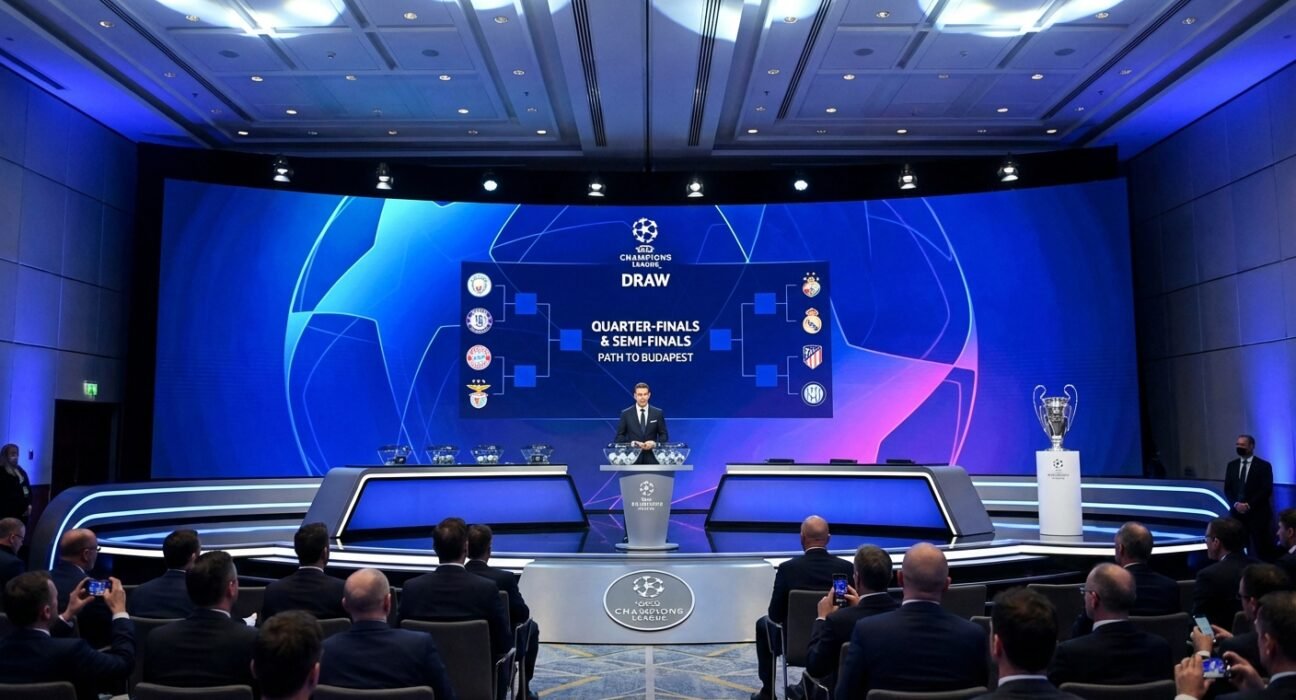
Due to the intricate variables introduced by the new league format, the draw process has evolved into a hybrid operation involving both manual and digital elements. While the physical drawing of balls remains a ceremonial component to determine the team in question, dedicated automated software is utilized to randomly assign the eight opponents. This technological intervention is necessary because a purely manual draw for the complex matrix of fixtures would require hundreds of balls and take several hours to complete. The software also ensures that competition regulations, such as country protection, are strictly adhered to instantly.
4. Seeding and Pot Allocation
Despite the shift to a single league table, the draw relies on a seeding system based on UEFA club coefficients to ensure competitive balance. The 36 teams are distributed into four pots of nine teams each. The draw protocol dictates that every club, regardless of their own seeding, must face two opponents from each of the four pots. This egalitarian approach prevents lower-ranked teams from being disproportionately burdened with difficult fixtures and ensures that top-seeded clubs face equally strong opposition early in the campaign, creating a more balanced strength of schedule across the board.
5. The Knockout Phase Qualification Pathway
The qualification criteria for the knockout rounds have been significantly altered to heighten the stakes of the league phase. Only the top eight teams in the final league table will qualify automatically for the Round of 16. Teams finishing between 9th and 24th place must compete in a two-legged knockout phase play-off to secure the remaining eight spots. This system eliminates “dead rubber” matches, as teams in the middle of the table will be fighting for seeding in the play-offs, while the top teams compete fiercely to bypass the extra round of fixtures.
6. Elimination of Drop-Downs
A critical change in the regulations for the road to Budapest is the removal of the safety net that previously allowed third-placed Champions League teams to transfer to the Europa League. In this new format, teams that finish 25th or lower in the league phase are eliminated from European competition entirely for the remainder of the season. This raises the jeopardy for underperforming clubs, as there is no secondary tournament to salvage their continental campaign, ensuring that the focus remains exclusively on Champions League progression.
7. Scheduling and the Exclusive Weeks
The match calendar has been adjusted to accommodate the increased number of fixtures required by the new format. The league phase now extends from September through January, introducing Champions League football to the winter calendar in a way previously unseen. Additionally, UEFA has introduced “exclusive weeks” for its competitions, where the Champions League will be the sole focus during specific matchweeks, with no Europa League or Conference League matches scheduled. This scheduling strategy is intended to maximize global viewership and media attention for the premier tournament.
8. Financial Implications and Prize Money
The expansion to 36 teams and the increased number of matches have resulted in a substantial uplift in the total revenue distribution for participating clubs. The financial model for the road to Budapest includes performance-related bonuses for every win and draw in the league phase, as well as significantly higher payouts for qualification to the knockout stages. This economic structure is designed to benefit a wider range of clubs, providing crucial revenue streams that support squad development and infrastructure projects across the European football landscape.
9. Country Protection Rules
The draw adheres to specific country protection regulations to maintain diversity in the fixtures. In the league phase, teams cannot be drawn against opponents from their own domestic association. However, to accommodate leagues with a high number of entrants—such as the Premier League or Bundesliga, which may have four or five representatives—the software allows for a maximum of two opponents from one other specific association. This rule prevents the tournament from becoming a repetition of domestic league fixtures while acknowledging the dominance of Europe’s top-ranked leagues.
10. Logistics and Travel for the Final
As the tournament progresses toward the final in Hungary, logistical planning for traveling supporters becomes a primary focus. Budapest is a central hub in Europe with extensive rail and air connections, yet the influx of over 60,000 fans requires meticulous coordination regarding accommodation and urban transport. The local organizing committee in Budapest works closely with UEFA and local authorities to establish fan zones, dedicated transport routes, and security protocols to ensure a safe and celebratory environment for the climax of the European football season at the Puskás Aréna.