
Artificial intelligence is moving deeper into the machinery of scientific discovery. OpenAI has announced a package of model access, API support, and technical collaboration for the U.S. Department of Energy’s Genesis Mission, a national effort designed to connect researchers with advanced computing, scientific facilities, and AI systems.
The commitment arrives as the Department of Energy says the Genesis Mission has secured more than $800 million in partner support. DOE describes those commitments as a mix of computing resources, credits, foundational-model access, cloud infrastructure, scientific expertise, research partnerships, and direct funding. That figure represents combined partner commitments across the consortium—not an $800 million payment from OpenAI.
What OpenAI is contributing
According to OpenAI’s July 22 announcement, the company plans to provide $4 million in Codex access to approximately 2,000 Genesis researchers working at national laboratories and universities. It also committed $3 million in API support for two large scientific campaigns.
OpenAI says participating researchers may receive as much as $10 million in API usage for every $2.5 million spent. Selected national-laboratory researchers working on eligible biology projects may also receive access to GPT‑Rosalind, a specialized bioscience capability.
The company identified two intended campaign areas. One would explore whether frontier AI, simulations, materials expertise, and physical experiments can advance the search for high-temperature superconductors. The second, described as an “Atlas of the Machine-Accessible Frontier,” would examine where AI can already contribute meaningfully using available knowledge, data, and computation—and where real-world evidence is still indispensable.
A larger national AI-for-science effort
The Department of Energy independently announced the consortium commitments and said the initiative is intended to accelerate AI-enabled scientific discovery. The Genesis Mission brings together DOE’s 17 national laboratories, universities, government facilities, and private-sector partners.
Its proposed infrastructure would connect supercomputers, experimental facilities, scientific datasets, and AI systems. DOE’s stated ambition is to increase the productivity and impact of American research and innovation over the next decade, including work in energy, advanced materials, biotechnology, quantum computing, manufacturing, and national security.
The important detail is that the mission is not being presented as a replacement for scientists. Both DOE and OpenAI frame AI as an additional research layer: a way to explore more candidate ideas, analyze larger datasets, write and test software, and move promising hypotheses toward physical validation more efficiently.
Why this matters
Modern scientific programs often face a coordination problem as much as a computing problem. Researchers must connect specialized instruments, simulation software, massive datasets, laboratory procedures, and teams spread across institutions. AI systems that can reason across those tools may help reduce the time spent translating between environments or preparing routine technical work.
Codex access could be particularly useful for researchers who need to maintain analysis pipelines, convert older scientific code, document experiments, or build interfaces between instruments and data systems. API support could also allow laboratories to test models inside carefully controlled research workflows instead of relying only on consumer-facing tools.
But access alone does not prove that AI will produce faster discoveries. Scientific conclusions still require reproducible methods, domain expertise, security controls, and experimental validation. OpenAI’s announcement acknowledges that increasingly capable systems must be studied for both their benefits and their risks when they enter consequential research environments.
What to watch next
The pilot programs will be worth judging on concrete outcomes: whether researchers can reproduce AI-assisted results, whether models reduce time without introducing hidden errors, and whether national laboratories can protect sensitive systems while expanding access to advanced tools.
The Genesis Mission is an ambitious bet that AI can become part of the country’s scientific infrastructure. OpenAI’s contribution gives that bet additional computing and software resources. The next phase will show whether those resources can translate into validated advances rather than simply more experiments.
Sources: OpenAI; U.S. Department of Energy; DOE Genesis Mission overview.
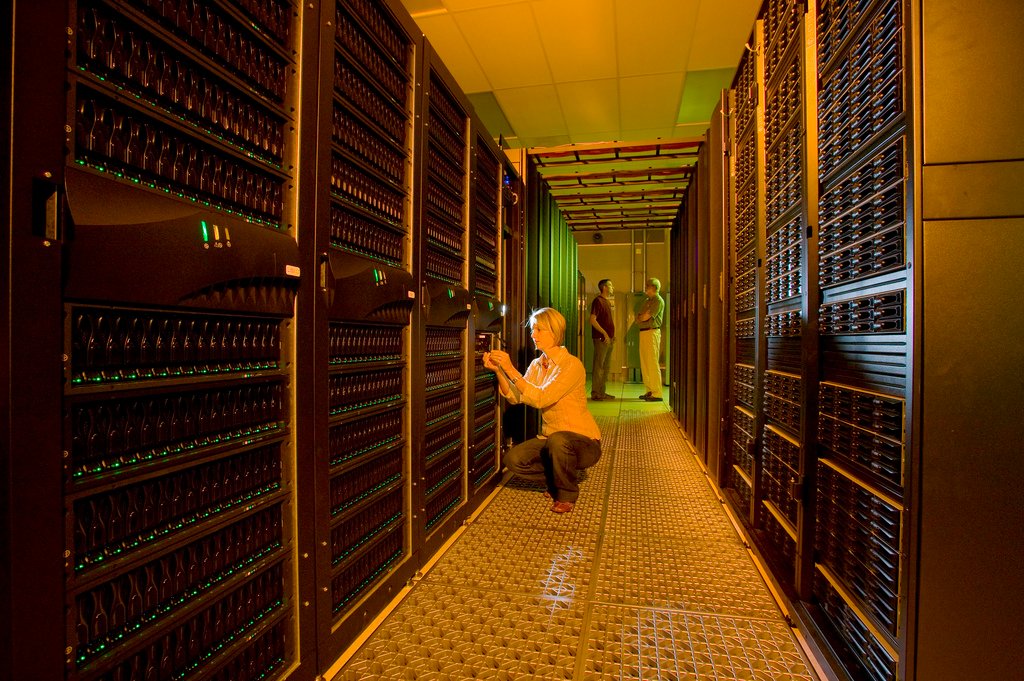
Featured image: Cindy Heer checks the Hyperion high-performance-computing testbed at Lawrence Livermore National Laboratory. Credit: U.S. Department of Energy via Wikimedia Commons. License: Public domain (PD-USGov-DOE).

.jpg)