
Scientific discovery increasingly depends on software, but much of that software was never built like permanent infrastructure. A new field report suggests coding agents can help repair that gap—modernizing packages, translating old code, and accelerating data pipelines—while also making the human role in verification more important. The challenge spans universities, research institutes, and open-source communities.
OpenAI published the report on July 28, bringing together eight agent-assisted computing projects, primarily in genomics and other life-science fields. Five projects used Codex alone, while three used Codex together with Claude Code. The work ranged from routine packaging maintenance to major language migrations and GPU-focused redesigns.
From research prototype to durable infrastructure
Scientific tools often begin as code written by a small academic team to accompany a paper. Once other laboratories adopt that code, a prototype can become shared infrastructure even if it lacks modern packaging, tests, documentation, or a long-term maintenance budget. As datasets grow, those weaknesses can slow research and make results harder to reproduce.
The 55-page exploratory field report documents several ways coding agents were used against this problem. One team modernized the build and release process for cyvcf2, a Python library that reads and writes genomic variant files. Another migrated the MHCflurry immunology package from an aging TensorFlow/Keras stack to PyTorch while preserving its published model weights and equivalent predictions.
That MHCflurry change was not merely a demonstration. The project’s official repository identifies version 2.2.0 as its first PyTorch-backed release and says existing workflows can continue using the same pretrained models. It is an example of agent-assisted work reaching an established upstream project rather than becoming a disconnected rewrite.
Large gains, with important qualifications
The most dramatic case involved RustQC, which consolidated more than a dozen RNA-sequencing quality-control steps into one Rust program. In the report’s case-specific benchmark, a workload based on roughly 186 million paired-end reads fell from 15 hours and 34 minutes of summed sequential task time to 14 minutes and 54 seconds. Disk traffic also dropped from 2.5 terabytes to 0.1 terabytes.
Seqera’s original RustQC account explains the engineering reason for the gain: the conventional workflow repeatedly reads and decompresses the same large file for separate tools, while RustQC processes it once and distributes each record to multiple analyses. The project also published benchmark details and reproduction material.
Those numbers require careful framing. The field report says it standardized the case studies and checked selected artifacts, but did not independently reproduce every benchmark or validate every reported result. Its numerical outcomes are contributor-reported and specific to the tested projects; they are not a general performance score for coding agents.
The bottleneck moves from writing to proving
Across seven of the eight projects, humans remained the final judges of whether the software worked. Agents could implement clearly scoped tasks, but their own confident assessments were not reliable evidence of scientific correctness. Researchers had to define acceptance tests, choose representative data, investigate discrepancies, and decide when the result was ready.
The strongest validation methods compared agent-produced code with something external and measurable: byte-identical output, agreement with an existing implementation, known answers from simulated data, or statistical behavior defined in advance. Real-world datasets repeatedly exposed edge cases that small synthetic tests missed. Initial implementations often arrived quickly, while the last stretch of debugging took substantially more effort.
This changes the division of labor rather than removing the scientist. Researchers can spend less time typing routine implementation code, but more time specifying goals, designing tests, reviewing failures, and interpreting whether an output is scientifically meaningful. For institutions adopting coding agents, investment in validation systems may matter as much as access to the models themselves.
Maintenance is the long game
Faster rewrites can create a second problem: many competing versions of the same tool, each demanding attention from a limited pool of expert maintainers. The report argues that teams should coordinate with existing projects early when possible, preserve attribution, and establish a credible owner for any separate implementation.
The broader lesson is practical. Coding agents can already reduce some of the engineering scarcity surrounding scientific software, especially when success can be measured precisely. Their lasting value will depend on whether the resulting tools remain reproducible, trusted, and maintained after the first impressive benchmark.
Sources: OpenAI announcement; Scientific computing in the age of agentic AI: an exploratory field report; Seqera’s RustQC project account; MHCflurry official repository.
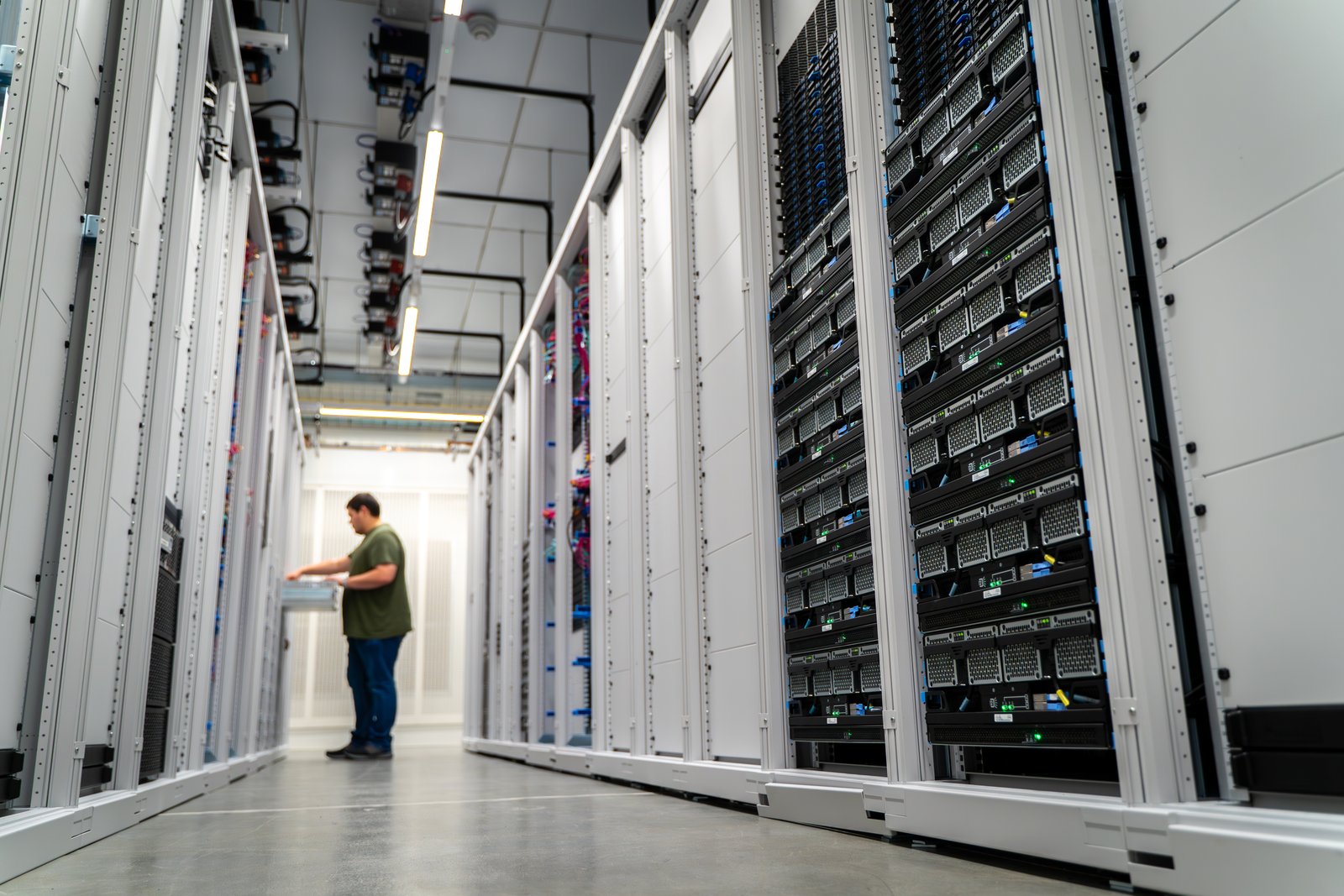
Featured image: The data centre at EMBL’s European Bioinformatics Institute, with a person working among the server racks. Photograph by Jeff Dowling | EMBL-EBI via Wikimedia Commons, licensed under CC BY-SA 4.0. No modifications were made.

