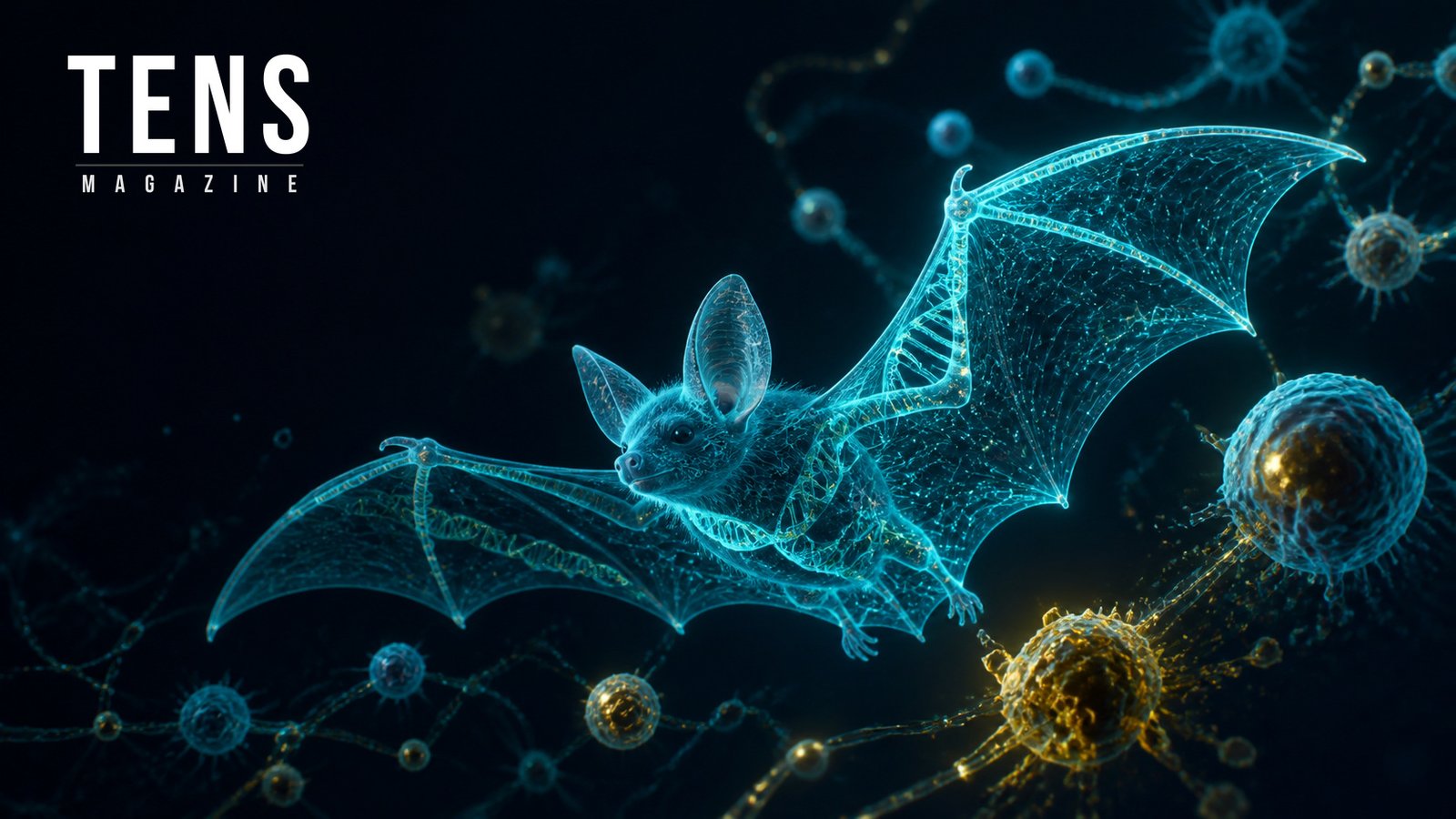
Long-lived bats are often treated as a catalog of unusual genes waiting to be translated into human longevity. A new comparative genomics study points to a harder—and more useful—idea. In Myotis bats, selection appears to have connected antiviral defense, cancer suppression and the decision to eliminate badly damaged cells. The signal is a network of trade-offs, not a single longevity switch.
Researchers reporting in Nature generated near-complete genome assemblies and primary cell lines for eight closely related Myotis species. The genus offers a rare natural comparison: species with similar small bodies can have sharply different maximum lifespans. The study paired evolutionary analysis with laboratory tests of immune-gene variants and DNA-damage responses.
Two routes through the immune genome
The genomes were unusually complete, with an average of 98.6 percent of sequence placed into 22 or 23 chromosome-scale scaffolds. That resolution allowed the team to examine not only changes in protein sequence but also structural variation and gene copy number.
The comparison revealed different evolutionary patterns for proteins that interact with DNA viruses and those that interact with RNA viruses. Across Myotis and a larger set of bat genomes, positive selection was enriched among DNA-virus-interacting proteins. RNA-virus-interacting genes, by contrast, showed more copy-number expansion and contraction. That distinction matters because it argues against describing bat immunity as one uniformly amplified system.
A key example was PKR, an innate immune sensor that can shut down protein production after detecting double-stranded RNA. The researchers resolved one-, two- and three-copy PKR haplotypes, including duplicated forms that appear to have persisted across species for millions of years. Yet expressing two PKR copies together in engineered human cells did not create a simple supercharged response. Their effects were broadly additive, and high expression carried a cell-viability cost.
TENS analysis: The PKR result acts as an internal warning against simple gene-dosage stories. A duplicated defense gene can broaden evolutionary options while also creating toxicity, so persistence may reflect a managed compromise rather than an across-the-board advantage.
Longevity meets damaged-cell clearance
The team also modeled body size and lifespan across more than 1,000 mammals. Several Myotis lineages showed exceptionally rapid evolutionary increases in lifespan. But an apparent difference in how lifespan scaled with body mass between bats and other mammals was not statistically significant after accounting for shared ancestry. That correction weakens any claim that bats simply broke a universal size rule.
Genes under selection in longer-lived lineages were enriched in pathways related to cancer, immunity and aging. In the little brown bat, Myotis lucifugus, selected pathways included DNA double-strand-break repair. The functional experiment then produced an unexpected response: after primary skin fibroblasts were exposed to a DNA-damaging agent, cells from this long-lived species lost more viability and entered apoptosis more readily than cells from the comparison bats.
At first glance, that seems inconsistent with enhanced repair. It may instead reflect a stricter quality-control decision. When damage is severe, removing a compromised cell can protect the organism from the long-term risk of malfunction or cancer. The study further found that genes responding to DNA damage overlapped with proteins involved in DNA-virus interactions, connecting immune evolution to cell-cycle control and repair.
TENS analysis: The most important result is therefore architectural: immunity, cancer resistance and longevity may share biological machinery, so selection on one pressure can reshape the others. That is more informative than nominating any one bat gene as a human anti-aging target.
Where the evidence stops
This is comparative animal genomics and cell-culture evidence, not a lifespan experiment. The researchers did not extend the life of a bat or another animal, and they did not test a treatment in people. Evolutionary enrichment identifies associations across branches of a family tree; it cannot by itself prove which change caused longer life.
The functional work also covered a limited set of primary bat fibroblasts and engineered cells under acute laboratory stress. Skin cells exposed to a potent DNA-breaking compound do not reproduce aging across an intact organism. Maximum-lifespan records can be uneven across wild species, while genome assemblies often represent one or a few individuals and therefore cannot capture all variation within a population.
TENS analysis: For longevity research, the translation path should begin with conserved decision rules—when a cell repairs, pauses or self-destructs—rather than copying a bat-specific gene configuration. Those rules would need validation in multiple tissues, intact animals and eventually carefully designed human studies before they could support a healthspan claim.
The study expands the comparative toolkit by adding high-quality genomes, cell lines and public data for a genus with extraordinary lifespan diversity. Its near-term value is mechanistic: it gives researchers a sharper way to test how immune pressure and cancer prevention may have co-evolved. It does not offer medical guidance or evidence that manipulating PKR, apoptosis or any bat pathway would safely slow human aging.
TENS Magazine conceptual illustration