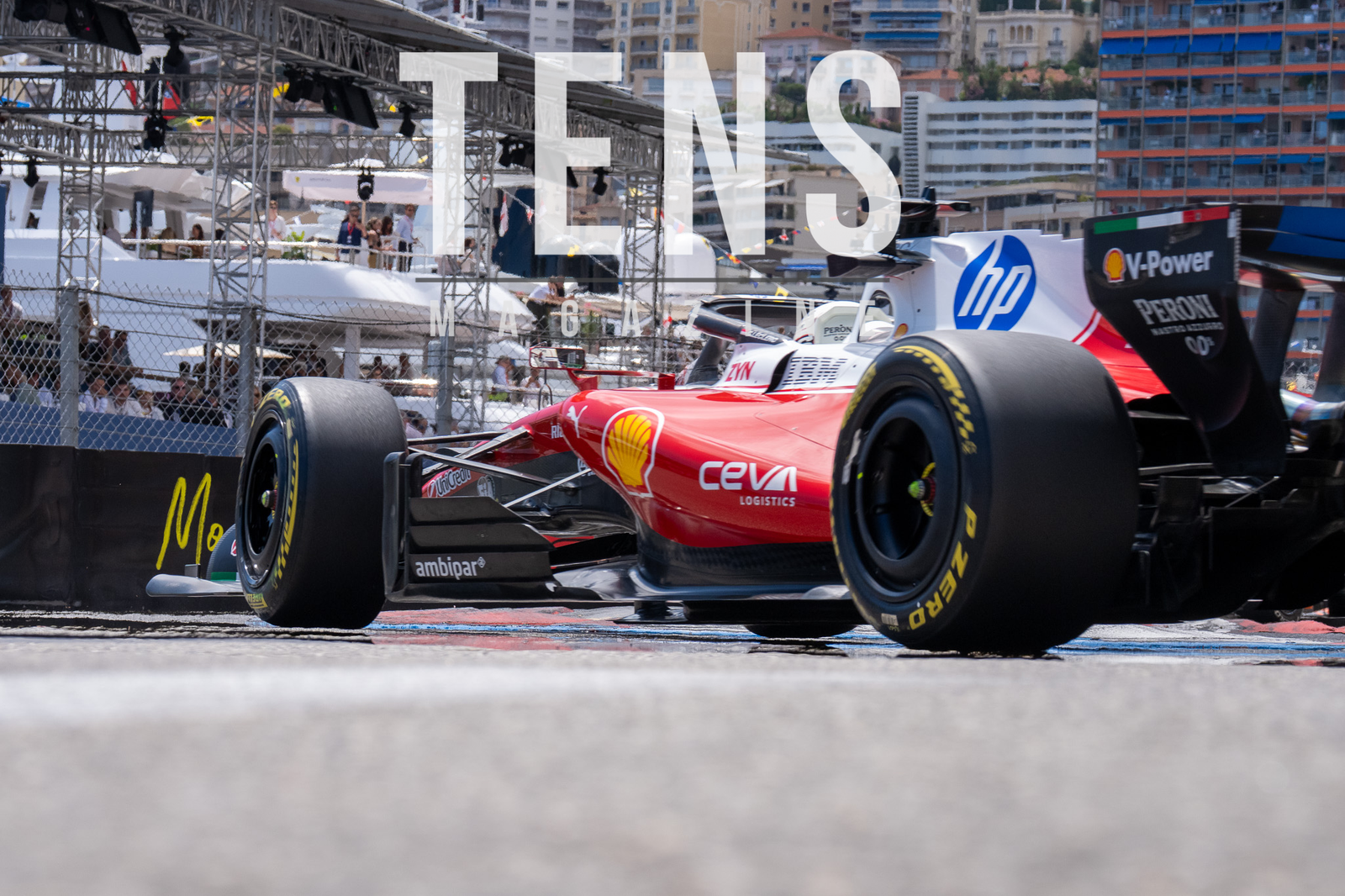
Lando Norris won Madrid’s first Formula 1 pole by eleven thousandths of a second. Ferrari’s more intriguing number was two: two cars together, close enough to the front to complicate the race for three different teams.
Lewis Hamilton qualified fourth and Charles Leclerc fifth for the September 13 Spanish Grand Prix. Neither delivered the headline lap on Saturday. Yet their proximity gives Ferrari a possibility worth watching: if both stay with the leaders, the team could present rival pit walls with two different strategic threats.
This is TENS Magazine analysis of the published qualifying and starting-grid order, not a prediction of Ferrari victory. The opportunity depends on race pace, tyre life and the opening lap. Fourth and fifth are useful positions only if the cars occupying them remain useful together.
The grid has an unusual imbalance
Formula 1’s official results put Norris first, Kimi Antonelli second and Max Verstappen third. Their teammates sit sixth, seventh and eighth: George Russell for Mercedes, Oscar Piastri for McLaren and Liam Lawson for Red Bull. Ferrari alone has both cars in the leading five.
Reading those positions as team pairs changes the picture. McLaren has first and seventh, Mercedes second and sixth, Red Bull third and eighth, and Ferrari fourth and fifth. Ferrari lacks the foremost car but has the smallest separation between its two entries. That distinction could matter once the contest moves from qualifying laps to pit-stop decisions.
It does not make the other leading drivers isolated. Russell, Piastri or Lawson could gain places immediately, and their teams can still coordinate strategy. The narrower claim is that Ferrari begins with both drivers positioned to engage the same group ahead, without first needing one teammate to clear the other Ferrari.
Six thousandths is a reason to keep options open
Hamilton’s final-session time was 1:32.013; Leclerc’s was 1:32.019. Subtracting the official figures produces a gap of 0.006 seconds. Norris’s 1:31.824 left both Ferraris within two tenths of pole. Those calculations describe qualifying performance, not a measured race-pace deficit.
The strategic implication is restraint. A six-thousandths separation offers little basis for deciding in advance that only one Ferrari can mount a challenge. Different tyre behaviour or traffic could make either driver the stronger runner on Sunday. Preserving two viable races would give the pit wall more information before it has to commit.
There is a cost to that patience. If the Ferraris fight each other while the first three escape, their neat position on the grid becomes irrelevant. The useful version of a close pairing keeps both within reach of the opposition; the wasteful version spends their tyres settling an internal argument.
Two threats require a real choice
Consider a conditional scenario: Hamilton and Leclerc remain close to the leading group as the first pit-stop window approaches. Ferrari could stop one earlier to seek an advantage on fresh tyres while leaving the other out. A rival responding to the first car would then need to consider the second car’s alternative timing.
That is a decision problem, not a free tactical victory. The early stopper needs clear track and enough fresh-tyre performance to recover the time lost in the pits. The later stopper needs tyres that still work. If either condition fails, splitting the cars could simply create two compromised strategies.
Pitting them together poses a different question: whether the second car would lose time waiting for service. Keeping both on an identical plan may also make Ferrari easier to cover. The point is not that the team must split its strategy, but that two competitive cars could let it choose when a split is worthwhile.
The tyre warning cuts both ways
In the FIA’s post-qualifying press conference, Antonelli warned that pushing early could produce steep tyre degradation. He also acknowledged that degradation might be lower in the race. Norris said he had little high-fuel running and would study Piastri’s work. These are the drivers’ assessments, not independently measured Sunday performance.
Formula 1’s weekend guide, drawing on Pirelli’s preparation, describes substantial tyre loading and a smooth new surface. It lists no historical overtaking or Safety Car figures for the venue. That supports caution about confident strategy forecasts: this first Grand Prix has no previous Madring race to supply those benchmarks.
For Ferrari, high degradation could strengthen the value of different stop timings, but it could also punish a car left out too long. Lower degradation might preserve track position and reduce the reward for an early stop. Neither branch can be selected from Saturday’s six-thousandths teammate gap.
What would make the opportunity real?
The first useful check is whether both Ferraris remain near the first three after the opening exchanges. The second is whether either can follow without using up its tyres. The third is whether a pit stop offers clear running rather than a return into traffic.
If those conditions hold, Ferrari’s paired presence could force the leaders to defend against more than one plan. If the field stretches or a Ferrari falls behind, that possibility shrinks quickly. Norris earned the best starting position; Ferrari’s task is to turn two nearby cars into choices its rivals cannot comfortably ignore.