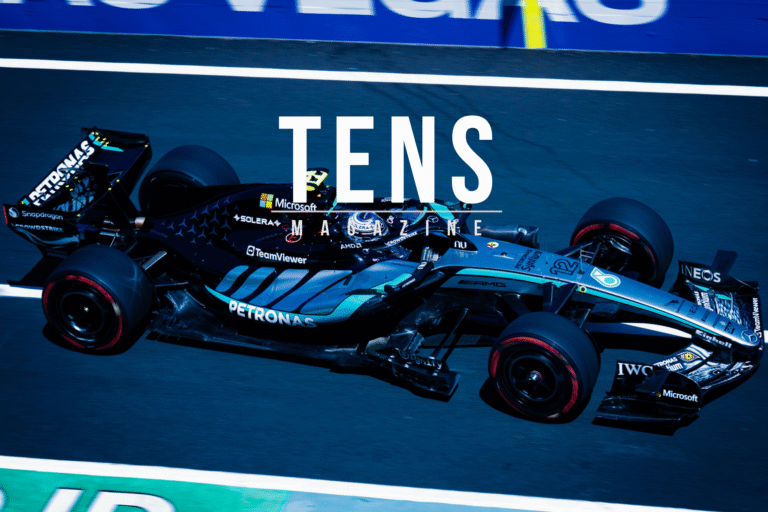
TENS Magazine analysis
Madrid has hosted its first Formula 1 Grand Prix. Its next challenge is harder to photograph: giving a quicker car somewhere useful to go. The response to Sunday’s race should be judged by the choices a revised circuit creates, rather than by the scale of the construction project.
On September 14, Autosport reported that Spanish Grand Prix managing director Luis Garcia Abad was willing to modify Madring for 2027 and had received FIA recommendations. That establishes an intention to improve the venue. It does not establish an approved final design, or prove that any particular alteration will deliver better racing.
The TENS assessment is that Madrid needs a practical passing test: can a pursuing driver create an alternative line, make a credible attempt and remain in the contest afterward? That question also connects the circuit debate to strategy. A pit wall has more freedom when surrendering track position does not effectively end its afternoon.
A close finish is not a passing measurement
Formula 1’s official classification records Kimi Antonelli winning the September 13 race, with Max Verstappen 4.351 seconds behind and Lando Norris 5.089 seconds behind. Subtracting those gaps puts Norris 0.738 seconds behind Verstappen at the finish. Charles Leclerc was fourth, ahead of George Russell.
That narrow second-to-third gap establishes proximity at the flag. It cannot tell us how many serious attacks were possible. A driver can spend a race close enough to threaten on television while lacking the space needed to threaten under braking. Equally, a small finishing gap alone cannot prove that passing was impossible.
For that reason, an assessment of the redesign should distinguish three observations: reaching the car ahead, attempting a move and completing it. Counting only completed overtakes hides where the process breaks down. A layout that lets drivers approach but repeatedly prevents an attempt has a different problem from one where attacks happen and defenders successfully resist them.
The useful change creates a choice
Autosport’s reporting identifies drivers’ frustration with entries that require braking and turning together, and carries Norris’s suggestion of a straighter approach and wider entry in the closing sector. Those are attributable driver views, not a TENS engineering validation. We have not examined a proposed layout or its safety assessment.
Our analytical test would ask whether the attacking and defending cars can reasonably choose different paths. Simply making a corner slower would not necessarily answer that. If both still need the same narrow entry, the follower may arrive faster without gaining a usable option. The relevant improvement is room to contest the corner, not merely a more dramatic braking event.
The exit deserves equal scrutiny. An apparent opportunity that immediately funnels both cars into one unavoidable line could produce interrupted attacks instead of sustained competition. Any proposal must be evaluated with its surrounding corners and safety requirements. A promising sketch is the beginning of that work, not evidence that it has been completed.
Strategy needs a route back
Madring’s own race account describes the virtual safety car as decisive: Norris missed the initial opportunity to pit while Antonelli and Verstappen benefited, and the McLaren’s subsequent stop included a slow wheel change. The organiser’s account is useful evidence of the sequence, but it should not be confused with an independent measure of the circuit’s racing quality.
The strategic question is what happens after an unfavourable sequence. If a car returns behind a rival with a performance advantage, can its driver do anything with that advantage? A viable passing opportunity would not remove safety-car luck or make every tyre strategy work. It could make the consequences less final, allowing some lost position to be contested on track.
This is also why a passing improvement could matter before anybody overtakes. A team considering fresh tyres must weigh their potential speed against the traffic into which its driver would return. Greater confidence that traffic can be challenged may widen the set of plausible plans. That is a conditional effect, dependent on tyre performance and race circumstances, rather than a prediction of extra stops.
Judge the evidence, not the promise
The Race reports that circuit officials are considering revisions in three areas, with details to be discussed with the FIA, teams and drivers. It also notes that there is no official Formula 1 overtaking count. We therefore make no numerical claim about Madrid’s passing total and do not treat reported areas of work as a finished specification.
For the next edition, the useful comparison would record credible attempts as well as completed passes, identify tyre and pace differences, and separate ordinary racing from starts, position handbacks and mechanical trouble. Those distinctions would help explain why the racing changed. A larger raw total could otherwise flatter the layout simply because the field or conditions were different.
Madrid does not need to promise that every faster car will get through. Defending is part of racing. It needs to show that a pursuer can ask a question the driver ahead must genuinely answer. If a revised circuit supplies that contest while preserving safety and its driving challenge, the improvement will reach beyond one corner and into the decisions of every pit wall.