Tampa Bay’s first win of the season required more than a productive night from its rookie quarterback. The Buccaneers beat Dallas 24–16 at AT&T Stadium on Thursday, October 8, using a rushing attack that moved the ball in large chunks and a defense that ended the Cowboys’ final threat. The result offers a useful way to separate the work that builds a lead from the work that preserves it.
The Buccaneers’ official reporting credits Bucky Irving with 165 rushing yards and Tampa Bay with 241 on the ground. Dallas’s own account confirms the team rushing total and the final score. Those figures establish a substantial problem for the Cowboys’ defense. They do not, by themselves, explain why Dallas still had an opportunity late in the game.
TENS Magazine analysis: Tampa Bay succeeded at three connected tasks: reducing the distance its offense needed to cover, converting opportunities into points, and denying Dallas a final scoring answer. Keeping those tasks separate gives both teams a more useful evaluation than treating the win as a verdict on one quarterback or the loss as a single defensive failure.
What the explosive gains actually changed
In its account of Jalon Daniels’s first NFL victory, Tampa Bay reports a 72-yard Irving run followed by Emeka Egbuka’s 14-yard rushing touchdown to open the second half. On the Buccaneers’ next possession, Daniels connected with Tez Johnson for 64 yards before Irving finished the drive with a short touchdown run. Those are confirmed sequences in the team’s reporting, rather than projections about what this offense might become.
The two long gains totaled 136 yards, calculated by adding 72 and 64. Against Tampa Bay’s reported 419 yards of total offense, that is approximately 32.5 percent. The calculation describes how concentrated the production was: almost a third of the team’s yardage came from two snaps. It does not mean the remaining plays were unimportant, or that those gains can be removed to describe an alternative game.
Their immediate value was practical. Each moved the offense close enough to finish without repeatedly negotiating the middle of the field. The following touchdowns supplied the points; the explosive plays supplied much of the distance. Crediting both parts avoids assigning the entire scoring possession to its most memorable moment.
That distinction also sharpens Dallas’s review. Preventing a long gain and defending the next snap are separate responsibilities. A defense that loses the first confrontation still has a chance to limit the damage. Here, Tampa Bay completed both scoring opportunities. The film review should therefore examine the breakdown and the response, rather than stop at the highlight.
A rushing plan still needed a passing answer
Tampa Bay’s account of Daniels’s performance says the offense ran on 39 of its 65 snaps. That is 60 percent, calculated directly from the club’s totals. Head coach Todd Bowles explained that the ground game was intended to help his young quarterback, while also crediting the offensive line and Irving’s work.
A run-heavy distribution describes the allocation of plays, not the full difficulty of the quarterback’s assignment. Daniels still had to deliver the Johnson completion that helped produce another touchdown. The useful assessment is whether the passing game contributed when called upon, not whether a lower passing volume makes the quarterback incidental to the result.
Nor does one successful distribution establish a permanent formula. Thursday provides evidence that this combination worked against Dallas. It does not establish that the same balance will suit every opponent, or settle any future personnel decision. The next evaluation needs to preserve that boundary between an observed performance and a forecast.
Building the margin did not end the contest
The Buccaneers’ game report describes a later fourth-down stop near the Dallas goal line, followed by a Cowboys touchdown and an unsuccessful two-point attempt. Tampa Bay ultimately needed Alex Anzalone’s interception to end Dallas’s final offensive possession. The Cowboys’ official account likewise identifies that late interception as the end of their last opportunity.
Those events matter because a large yardage gain and a successful closeout solve different problems. An offense can create a cushion without making the remaining possessions irrelevant. Tampa Bay’s earlier scoring gave its defense room to work; the defense still had to protect that room. The final score records the combined result, not automatic proof that every late decision was sound.
Dallas coach Brian Schottenheimer said he would review the team’s first five games and evaluate what needed to improve, according to the Cowboys’ report. That is a confirmed commitment to review, not an announced staff change. A useful review would distinguish allowing explosive gains, failing to finish possessions and surrendering the ball. Each costs a team differently, and each requires its own explanation.
For Tampa Bay, Thursday’s evidence is encouraging but specific: the offense created and completed major scoring opportunities, and the defense supplied the final stop. For Dallas, the continuing chance to recover should not obscure the earlier failures that made recovery necessary.
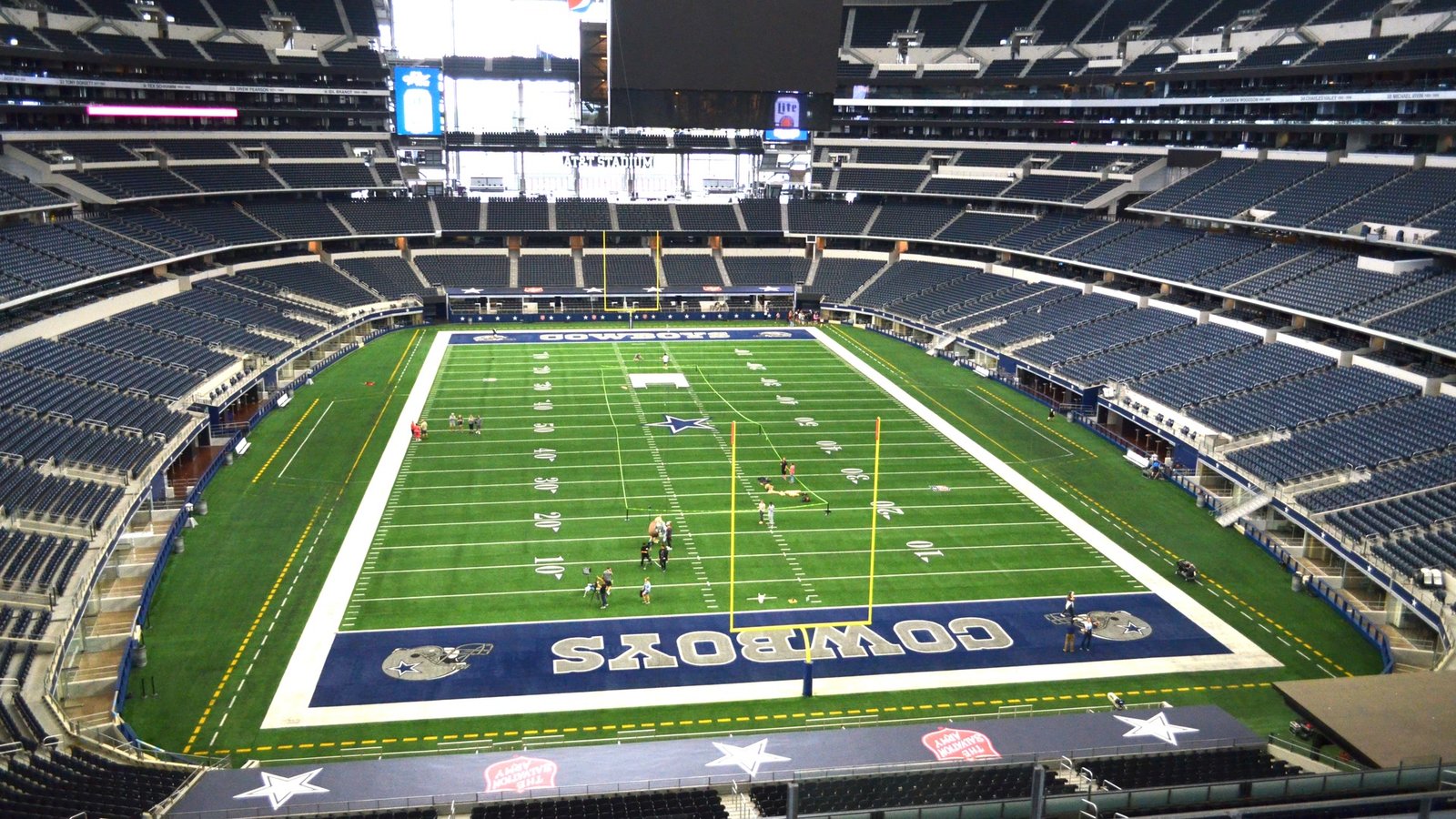
Image: Archival 2022 interior view of AT&T Stadium, not the October 2026 game. Photograph by edwarddallas via Wikimedia Commons. Public domain, Public Domain Mark. Modifications: center-cropped from 4,928 × 3,264 to 4,928 × 2,772 pixels and resized to 1,920 × 1,080 pixels.