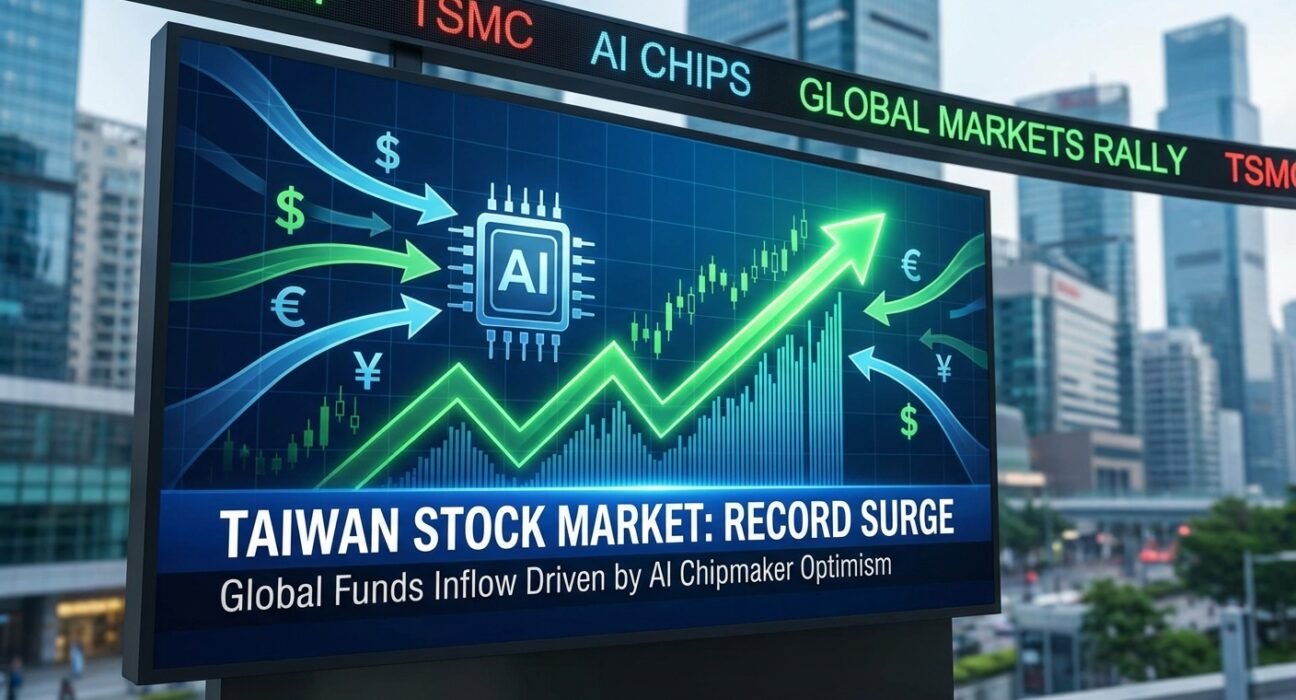
Global institutional investors have poured a record amount of capital into the Taiwanese equity market, triggering a historic surge in the benchmark index. On Tuesday, February 25, 2026, foreign funds purchased a net $2.77 billion of Taiwan stocks, marking the largest single-day buying spree since December 2005. This massive influx of capital drove the Taiex index to a new all-time high, closing above the 35,000-point threshold for the first time, as investors doubled down on the hardware backbone of the artificial intelligence revolution.
The rally was overwhelmingly led by Taiwan Semiconductor Manufacturing Co. (TSMC), the world’s largest contract chipmaker and a critical supplier to global tech giants like Nvidia and Apple. The surge in buying reflects a growing consensus among global asset managers that while AI poses disruption risks to software and service industries, the manufacturers of advanced semiconductors remain the ultimate “safe haven” trade. This sentiment has propelled TSMC’s market capitalization past the $2 trillion mark, cementing its status as one of the most valuable companies in the world.
TSMC shares climbed significantly during the session, with the company now accounting for approximately 45% of the total weight of the Taiex. This heavy concentration underscores the market’s reliance on the semiconductor sector but also highlights Taiwan’s indispensable role in the global technology supply chain. Analysts note that the “AI scare trade”—where investors flee sectors vulnerable to automation—has paradoxically benefited Taiwan, as capital rotates out of potential AI victims and into the “pick-and-shovel” plays that build the physical infrastructure for AI computing.
The buying frenzy extended beyond TSMC to other key players in the electronics ecosystem. Foxconn, the world’s largest electronics contract manufacturer, and MediaTek, a leading fabless semiconductor company, also posted strong gains. Server manufacturers such as Quanta Computer, Wistron, and Wiwynn saw their stock prices rise as well, driven by expectations of sustained demand for AI servers and data center infrastructure. These companies are viewed as integral to the build-out of the computing power required to train and run large language models.
Market data indicates that this was the sixth consecutive session of net buying by foreign investors, bringing the total inflows for the month to nearly $7 billion. This stands in sharp contrast to other regional markets, such as South Korea, which has seen capital outflows from its memory-chip focused sector over the same period. The divergence suggests that global funds are specifically targeting the logic chip and advanced packaging capabilities that are unique to Taiwan’s industrial base.
The surge in equity inflows has also provided support to the New Taiwan Dollar, which strengthened against the U.S. Dollar despite broader strength in the American currency. Currency strategists believe that the stability of the local currency is further encouraging foreign participation, as it reduces the hedging costs for international funds seeking exposure to Taiwanese assets. However, gains in the currency were somewhat tempered by steady dollar buying from local life insurers rebalancing their portfolios.
Despite the euphoria, some market observers have raised concerns about the extreme concentration of the rally. With TSMC comprising nearly half of the benchmark index, the Taiex is uniquely sensitive to the fortunes of a single company. While the current sentiment is overwhelmingly positive, driven by the insatiable demand for high-performance computing chips, any potential supply chain bottlenecks or geopolitical tensions could introduce significant volatility.
Looking ahead, investors are closely watching upcoming earnings reports from major U.S. technology firms, particularly Nvidia, to validate the lofty valuations of the AI supply chain. The consensus remains that as long as capital expenditure on AI infrastructure continues to grow, Taiwan’s semiconductor sector will remain a primary beneficiary of global capital flows. The record-breaking activity this week serves as a powerful signal that the market views hardware manufacturing not just as a cyclical play, but as a structural winner in the unfolding AI era.