By The TENS Magazine Editorial Staff
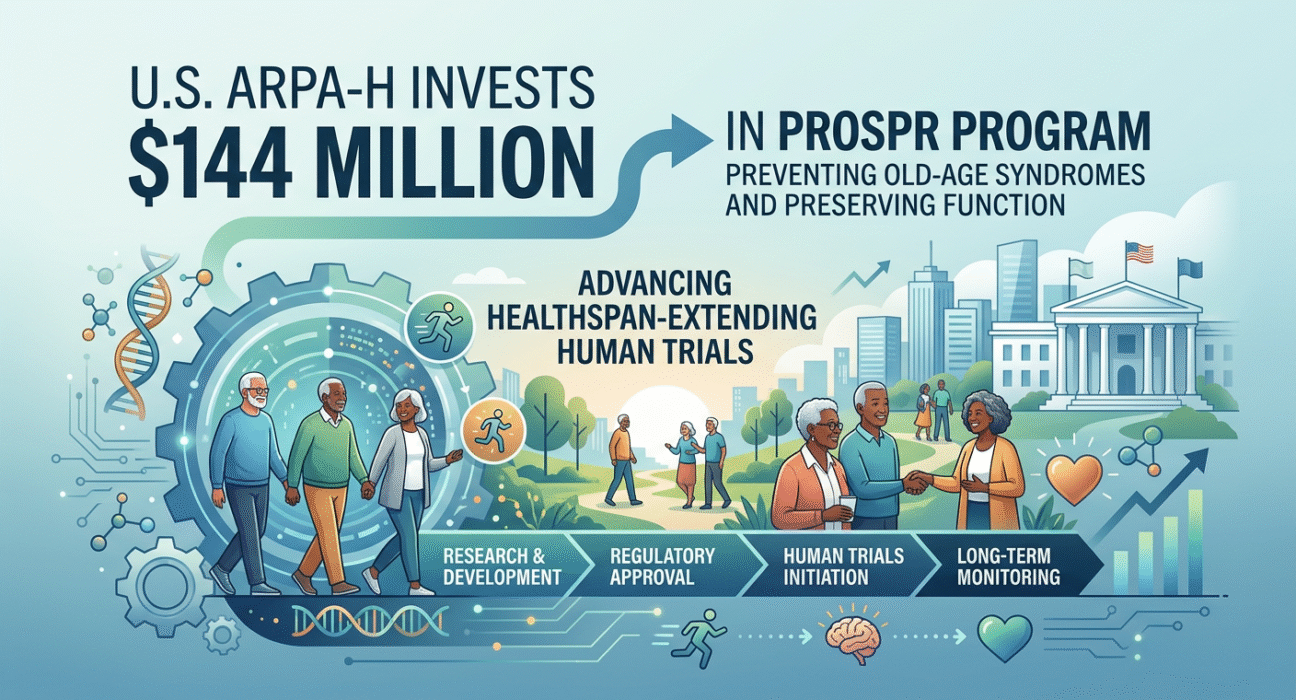
The Advanced Research Projects Agency for Health (ARPA-H) has announced a major commitment to transforming the field of longevity science, awarding up to $144 million in funding to launch the PROactive Solutions for Prolonging Resilience (PROSPR) program. This ambitious initiative aims to shift the medical paradigm from treating age-related diseases after they appear to proactively extending “healthspan”—the number of years a person lives in good health.
ARPA-H Director Renee Wegrzyn described the program as a “tectonic shift” in how healthy aging is studied. The agency has selected seven performer teams, comprising leading academic institutions and biotechnology companies, to develop novel biomarkers and clinical trial designs. The primary goal is to shorten the timeline for proving the efficacy of anti-aging interventions from decades to just one to three years.
Accelerating Clinical Trials for Longevity
One of the most significant hurdles in aging research has been the duration required to prove that a treatment works. Traditional trials often require waiting for participants to develop diseases or die to measure success. PROSPR seeks to overcome this by identifying early physiological and biochemical markers that can predict long-term health outcomes.
Andrew Brack, the PROSPR Program Manager, stated that the initiative is designed to power a new “healthspan industry.” By validating these surrogate endpoints, the program aims to create a regulatory pathway where therapies can be approved based on their ability to preserve resilience and function, rather than solely on disease prevention.
The Seven Performer Teams
The funding is distributed among seven distinct teams, each tackling a specific aspect of the challenge, from data analysis to human clinical trials of specific compounds:
- Stanford University: Researchers will harmonize vast existing health datasets to generate a “healthspan score” (PROSPR-IC score). They plan to test this score’s accuracy through a one-year lifestyle intervention supported by new in-home digital health assessment technology.
- University of Texas Health Science Center at San Antonio: This team will conduct a Phase 3 hybrid trial to repurpose three FDA-approved drugs—SGLT2 inhibitors, rapamycin, and semaglutide—to establish a regulatory path for aging therapeutics.
- Columbia University Mailman School of Public Health: Led by Daniel Belsky, this group will analyze data from completed trials to identify biomarkers responsive to interventions, effectively creating a “biological clock” for healthspan.
- Cambrian BioPharma: The New York-based biotech will advance human trials of a novel, oral rapamycin analog designed to selectively inhibit mTORC1, a key pathway in metabolic aging.
- Linnaeus Therapeutics: This team will test LNS8801, a compound with demonstrated cardiometabolic benefits, to see if it improves aging outcomes in healthy older adults.
- Apollo Alpha: Based in Florida, this company is developing an oral compound capable of crossing the blood-brain barrier to target energy homeostasis, lipid metabolism, and inflammation.
- University of Rochester: Researchers here will evaluate TPN-101, a drug originally developed for HIV, to determine if it can suppress retrotransposon activity and reduce age-related inflammation.
Economic and Social Impact
The push to extend healthspan is driven by more than just scientific curiosity; it addresses a looming economic reality. As the global population ages, the burden of chronic diseases like diabetes, cardiovascular conditions, and neurodegeneration threatens to overwhelm healthcare systems. ARPA-H estimates that extending the average American healthspan by just one year could generate trillions of dollars in economic value through reduced healthcare costs and continued productivity.
By moving trials out of the clinic and into the home via decentralized designs, PROSPR also aims to make participation more accessible and representative of the general population. The program’s success could eventually lead to a future where aging is treated as a manageable biological process, allowing individuals to maintain their independence and quality of life well into their later years.