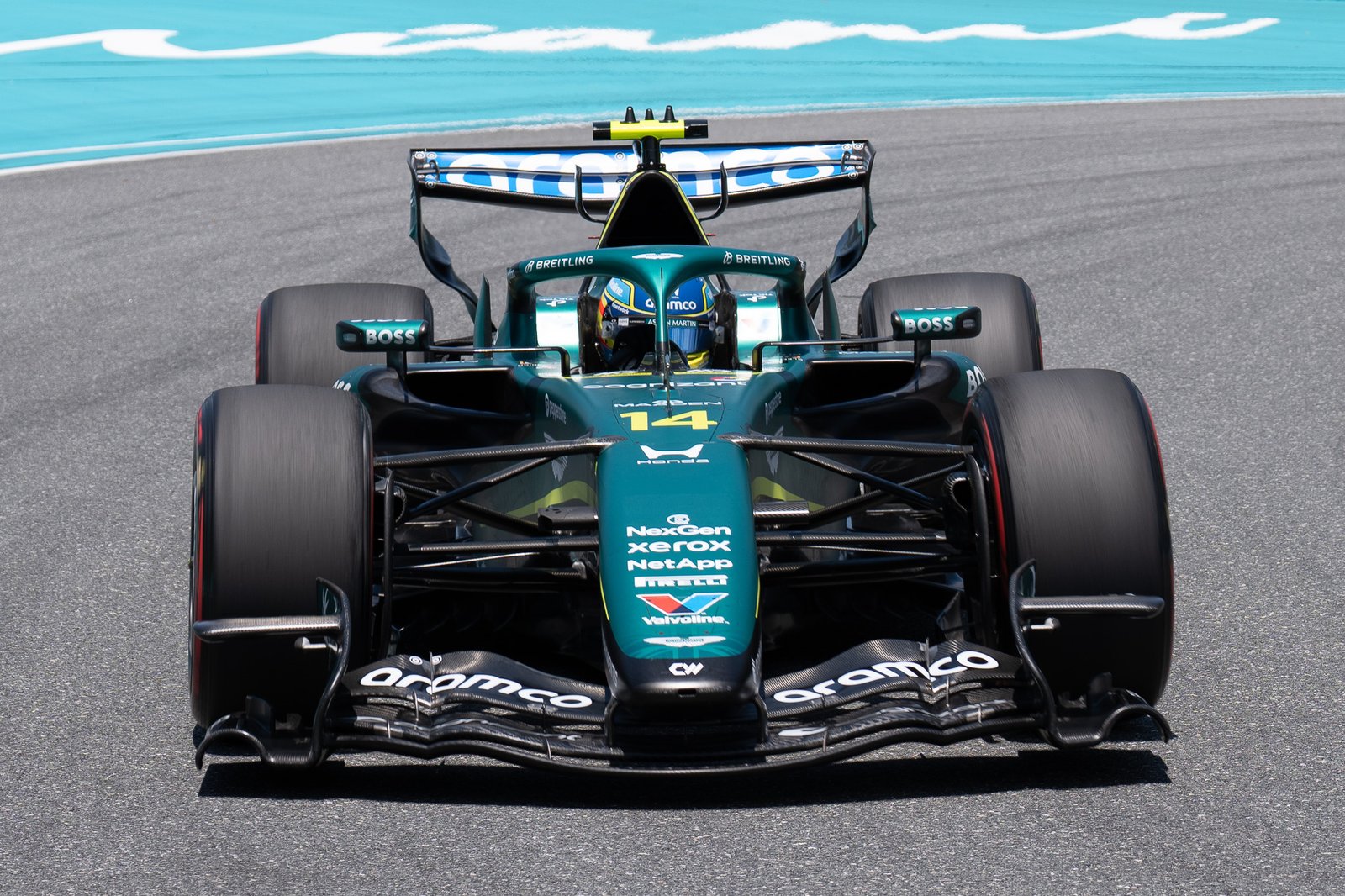
Aston Martin left Hungary without a championship point, yet with something more useful than a flattering result: evidence that its development process may finally be producing the car it expects.
That distinction matters. Lance Stroll and Fernando Alonso finished 13th and 14th at the Hungaroring, positions that do not support a revival narrative. But the heavily revised AMR26 was visibly more competitive in the corners, drew immediate attention from midfield rivals and, crucially, behaved in a way that aligned with the team’s simulations. For a project that began 2026 on the back foot, correlation is the first prerequisite for recovery.
A large package, but not a finished car
Aston Martin’s Hungarian package was extensive. Motorsport reported 16 declared changes in the FIA documentation, including a slimmer nose, a new floor, revised sidepod inlets and substantial work at the rear. The scale invited the convenient “B-spec” label, although Adrian Newey described it more precisely as a major aerodynamic evolution built around the same basic chassis layout and front suspension.
That is more than semantics. Calling the AMR26 a wholly new car creates an expectation of an instant competitive reset. The actual programme is staged. Newey said Hungary represented only the first part, with further chassis developments intended for Zandvoort and later rounds. A Honda power-unit update is also expected after the summer break. Budapest therefore supplied an opening measurement, not a final verdict.
The official Formula 1 race report called Stroll and Alonso’s performance Aston Martin’s most encouraging display of the season. Both cars finished ahead of the Haas and Williams entries, while the team’s cornering performance prompted cautious praise from rivals. The limitation remained obvious on the straights, where the car continued to surrender time.
The first test was correlation
Aston Martin’s most important Hungarian result was not P13. It was the apparent agreement between factory prediction and track behaviour. Alonso said after Friday practice that the package delivered the numbers the team expected. That is the quiet foundation beneath every successful upgrade campaign: engineers need the physical car to answer the same questions as their wind tunnel and simulation tools.
A fast part that arrives by accident is difficult to develop. A modest gain that behaves as predicted can be expanded, diagnosed and repeated. Hungary suggests Aston Martin has moved from searching for a direction to testing a sequence. That does not make the sequence fast enough, but it makes the next step more intelligible.
TENS analysis: three tests still stand between progress and recovery
The first remaining test is repeatability. The Hungaroring rewards downforce and offers relatively little emphasis on sustained straight-line efficiency. Zandvoort will provide another high-load examination, but Aston Martin will need evidence across contrasting circuits before it can claim a broadly useful platform rather than a track-specific improvement.
The second is convergence. The chassis and Honda power unit cannot be judged as isolated rescue projects. The new bodywork appears to have reduced the cornering deficit, while straight-line performance remains the conspicuous weakness. If the power-unit update improves deployment or output without disturbing cooling, reliability or packaging, the two programmes could reinforce each other. If it does not, the car may remain quick only in the sections where overtaking is hardest.
The third is operational completeness. Stroll lost running after a suspension failure on Friday, even though Newey said the affected area was not materially changed by the upgrade. Aston Martin also has a poor retirement record this season. A development curve is only valuable when both cars can gather representative data and finish races. Reliability is not separate from performance when lost laps slow the learning process.
Our forecast is therefore deliberately conditional. If the Zandvoort package repeats Hungary’s correlation, and if Honda’s update narrows the straight-line loss without adding new reliability problems, Aston Martin should become a more persistent threat at the back of the points during the second half of 2026. That is an evidence-based possibility, not a guaranteed outcome.
A better question for the summer break
Before Hungary, Aston Martin’s central problem was whether it understood why the AMR26 was slow. After Hungary, the sharper question is whether it can turn one successful development correlation into a sustained rate of improvement.
That is progress, even if it is not yet recovery. The B-spec did not transform Aston Martin’s season in a weekend. It did something more credible: it gave the team a testable route out of the midfield’s basement. The next races will determine whether that route leads forward or merely looked promising on one accommodating circuit.