
Artificial intelligence is usually deployed inside a datacenter as a workload. A new research project asks whether AI can also redesign the software rules that decide where workloads run, how many resources they receive, and how a computing fleet spends its power budget.
AtumAI, introduced in a technical paper submitted to arXiv on August 3, is a framework from researchers at the University of Texas at Austin and Microsoft Azure. It converts an operator’s plain-language goal into a formal specification, generates candidate control policies, tests them in simulators, and feeds the measured results back into another search round. The authors report that its policies beat expert-engineered baselines in three experiments.
What AtumAI changes
A datacenter control plane manages resources rather than performing the user-facing work itself. Microsoft Learn describes control-plane operations as the layer used to create and manage resources. Inside a fleet, related policies decide which machine receives a virtual machine, when a service should scale, or how power should be divided among servers.
Those decisions combine competing goals with hard limits. Packing more jobs onto fewer machines can improve utilization but create contention. Reducing a service’s CPU allocation can save capacity but increase latency. Switching an inference request to a smaller model can conserve power but reduce accuracy.
The paper argues that a general-purpose AI agent is not enough for this work. A language model may suggest plausible code without proving that it respects every capacity, performance, or accuracy constraint. AtumAI therefore begins with a task compiler. It turns a request into a machine-checkable intermediate representation covering objectives, constraints, decision variables, workload characteristics, and the evaluation method.
The important shift is from asking a model for one clever policy to building a controlled search process around many measured candidates. The language model proposes ideas, but diffusion broadens the structural possibilities, an evolutionary algorithm tunes numerical choices, and a surrogate model filters the pool before expensive simulation. High-fidelity measurements, not the model’s confidence, decide what survives.
Three tests, three different trade-offs
For workload placement, the researchers simulated 90 hosts using arrivals drawn from Microsoft Azure virtual-machine traces. The final policy improved admission success by 17 percent and scheduler throughput by 8 percent without increasing CPU hotspots. Its combined score was 1.13 times the hand-tuned baseline.
The Azure Public Dataset V2 documentation helps explain the scale behind that input. Microsoft says the trace is a representative subset of a first-party Azure workload from one region, covering 30 consecutive days and nearly 2.7 million virtual machines. AtumAI did not operate the production region; it used traces to drive a simulator.
In a resource-scaling experiment with 100 services sharing 30 nodes, AtumAI improved the paper’s cost-quality measure by 24 percent while keeping service-level-objective violations at 1.3 percent. In a separate power-management simulation of a 960-server inference fleet, the selected policy cut provisioned power by 21 percent and raised throughput by 17 percent while preserving the required accuracy floor.
Read together, the experiments suggest that the reusable contribution is not a single scheduling trick. Different policies emerged for placement, scaling, and power, yet the same compiler-and-search architecture handled all three. That is a more consequential claim than saying one model wrote better code for one benchmark.
Why feedback matters more than a bigger model
The paper’s ablation studies offer the clearest evidence for that interpretation. In workload placement, a language model alone reached only 1.01 times the baseline. Adding structural and numerical search without the full feedback loop reached 1.05 times; the complete system reached 1.13 times. In the power test, the model alone merely matched the baseline, while the full loop reached 1.31 times.
Results also varied less by model once the framework was in place. Several Gemini variants and Claude Opus 4.8 all produced improvements, although the best model differed by task. The authors’ compiler test was harsher: a language model without a formal intermediate representation failed to produce a valid policy under the stated hard constraints.
This reframes the role of AI in infrastructure engineering. The model supplies candidate reasoning, but formal constraints define admissibility, simulations provide evidence, and iterative feedback identifies the bottleneck to attack next. The arrangement resembles engineering optimization more than autonomous administration.
Promising evidence, not a production deployment
The reported gains need a careful boundary. Every final policy was measured in a high-fidelity simulator, not deployed as the controller of a live datacenter. The researchers say each simulator was cross-checked against a real system, including a Kubernetes deployment for the scaling case, but simulator validity is not the same as long-term production reliability.
The expert baselines, scoring weights, workload regimes, and safety floors also shape the result. Scores are normalized within each use case and cannot be compared across the three experiments. The paper does not establish how the framework handles unmodeled failures, adversarial requests, incomplete telemetry, or the organizational approval required before software can change fleet behavior.
The practical test for AtumAI is therefore not whether it can generate a policy that wins in simulation. It is whether operators can audit the compiled specification, reproduce the measurements, detect when reality has moved outside the simulator’s assumptions, and roll back safely. Those controls would determine whether “self-evolving” infrastructure becomes disciplined optimization or automated configuration drift.
AtumAI presents a credible research direction: treat datacenter policy design as formal, evidence-driven search rather than unconstrained code generation. Its next milestone is equally clear. The framework must show that its measured advantages survive real workloads, hardware changes, operational incidents, and human review.
Sources: AtumAI technical paper by Qiushi Lin, Chaojie Zhang, Íñigo Goiri, Aditya Akella, Ricardo Bianchini, and Jovan Stojkovic; Microsoft Learn overview of control-plane and data-plane operations; Microsoft Azure Public Dataset V2 documentation.
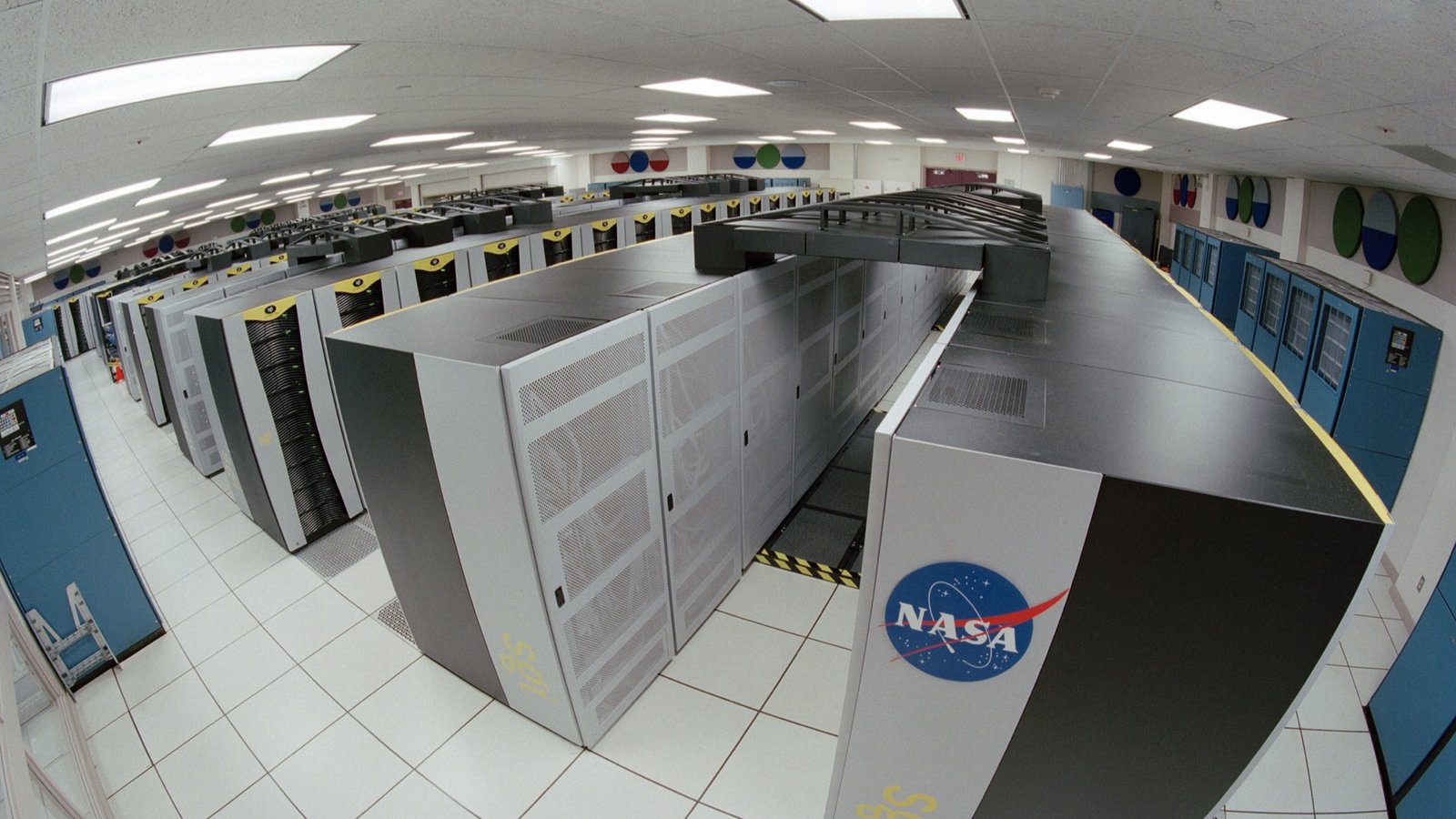
Featured image: The Columbia supercomputer at NASA’s Advanced Supercomputing Facility. Photo: Trower, NASA via Wikimedia Commons. Public domain (U.S. government work). Center-cropped from the original to 16:9 and resized to 1,920 × 1,080 pixels; no generative or substantive alteration.
