Atlanta has a starting quarterback confirmed for Sunday. Chicago still has a decision to announce. The difference matters even though Michael Penix Jr. and Caleb Williams both finished Friday as full practice participants. Their teams’ October 16 reports give Bears–Falcons a useful dividing line: participation describes preparation, while the game designation and the coaching decision determine how firmly an offense can plan around its quarterback.
The Falcons reported that Penix had no game designation and would start against Chicago. The Bears listed Williams as questionable. Those are the confirmed positions entering the weekend, not a forecast of how either player will perform. TENS Magazine’s analysis is that the most revealing part of this matchup is how each team manages what remains unsettled, including defensive personnel, rather than simply whether a familiar quarterback returns to the huddle.
Read the decision alongside the practice report
Chicago’s official report said Williams practiced fully Friday after missing three games. Coach Ben Johnson had not named a replacement starter if Williams could not play; Tyson Bagent and Case Keenum remained the alternatives discussed in the report. That leaves two distinct public questions: whether Williams will start, and who gets the assignment if he does not.
For an offense, that distinction changes the preparation problem. A confirmed starter lets the final rehearsal concentrate on one quarterback’s communication with the center, receivers and sideline. An unresolved decision requires a plan that can survive a change in operator. This is an assessment of the planning burden, not a claim about how Chicago divided its practice repetitions or which player Johnson privately prefers. Neither detail is established by the report.
The useful question for Sunday is therefore how much continuity Chicago can preserve across those possibilities. Protection calls, route adjustments and the timing of substitutions need to work with whoever takes the snap. A change at quarterback does not automatically demand a new offense, but it can make clarity more valuable than variety. There is no evidence here for declaring that the Bears must simplify their playbook; there is a clear reason to watch whether their execution looks coordinated.
Atlanta’s certainty has limits elsewhere
NFL reporting independently confirmed Penix’s expected start and noted that neither he nor coach Kevin Stefanski had disclosed the extent of his rib injury or the findings of earlier imaging. Availability is the reportable football development. It is not evidence for a medical conclusion, a promise of unrestricted movement or a projection of future durability.
Atlanta’s own Friday report also ruled cornerback C.J. Henderson out and listed defensive end Za’Darius Smith as questionable. The quarterback decision therefore settles only one part of the team’s preparation. The defense still has to account for a confirmed absence at cornerback and uncertainty on the edge while Chicago’s starting passer remains unresolved publicly.
That combination creates an interesting tactical tension. A defense can protect a replacement corner with help, but that help has to come from somewhere in its coverage. It can send additional pressure, but doing so commits defenders who might otherwise support coverage. These are general tradeoffs, not a prediction of Atlanta’s calls. The important observation will be whether its pressure and coverage choices complement each other when the opponent changes personnel or formation.
Watch the supporting assignments
Chicago’s report supplies another reason to look beyond the quarterbacks: linebackers T.J. Edwards and Keyshaun Elliott were ruled out, along with defensive end Dayo Odeyingbo and running back Kyle Monangai. Those confirmed absences deserve attention in their own right. A favorable quarterback update would not restore those players to the available group.
For viewers assessing the Bears’ defense, a useful starting point is who handles the communication and underneath coverage when Atlanta changes its offensive grouping. The answer should come from the personnel actually deployed and the assignments visible on the field. It should not be inferred from a depth-chart label alone. Likewise, one successful drive or one coverage breakdown will not establish the lasting quality of a replacement.
The two team reports together support a more disciplined way to read Sunday’s game. Separate the announced availability decision from the role a player receives, then separate that role from the quality of the execution. Penix’s confirmed start reduces one uncertainty for Atlanta. Chicago still owes the public its quarterback answer. Both teams must then make the surrounding assignments work. That is where the injury reports become a football story, and where the next evidence must come from the game itself.
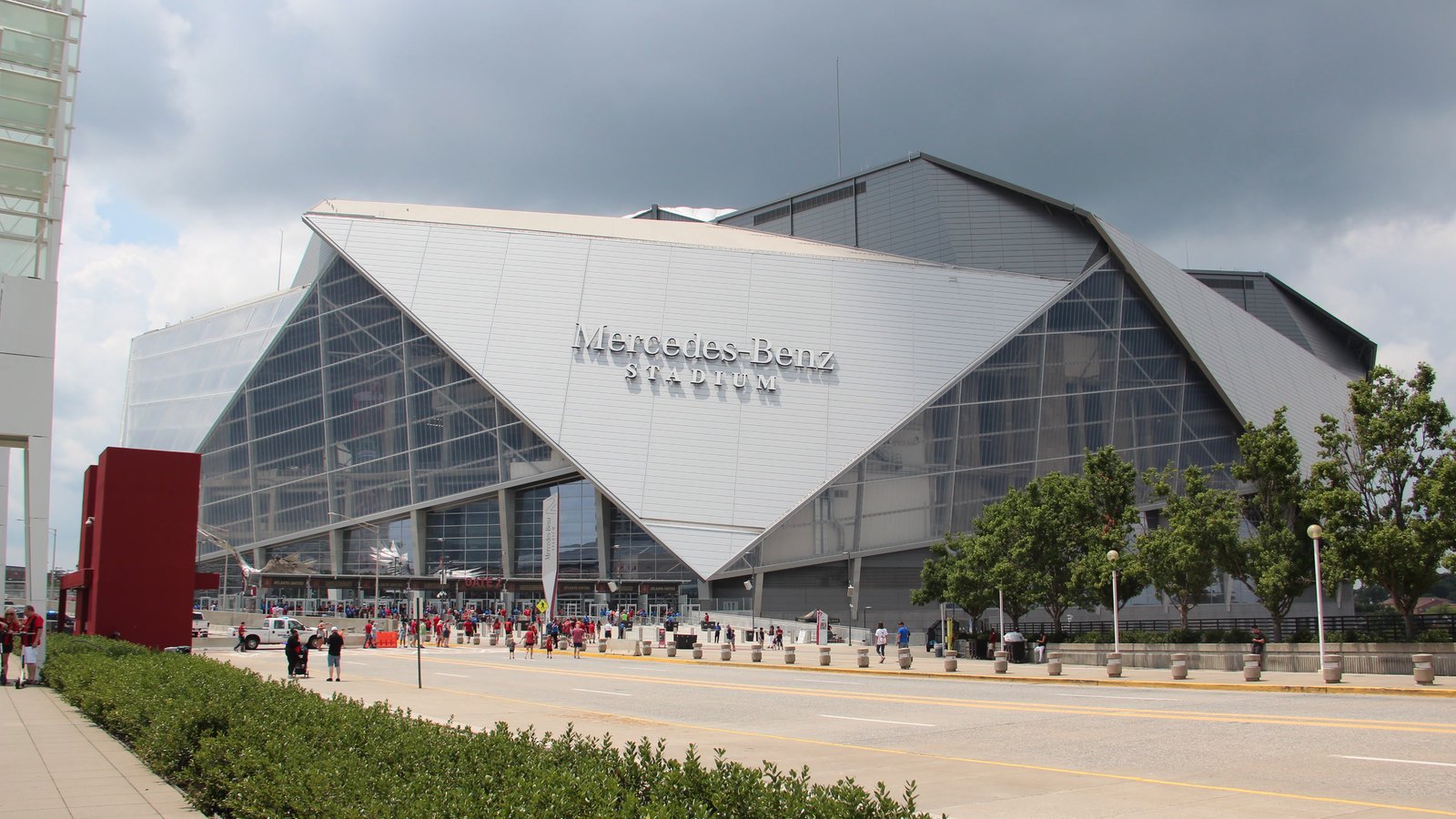
Image: Mercedes-Benz Stadium in Atlanta, July 2018; archival venue photograph, not the 2026 game. Photo by Thomson200 via Wikimedia Commons. License: CC0 1.0 Universal Public Domain Dedication. Modifications: cropped from 3:2 to 16:9 and resized.