By The TENS Magazine Editorial Staff
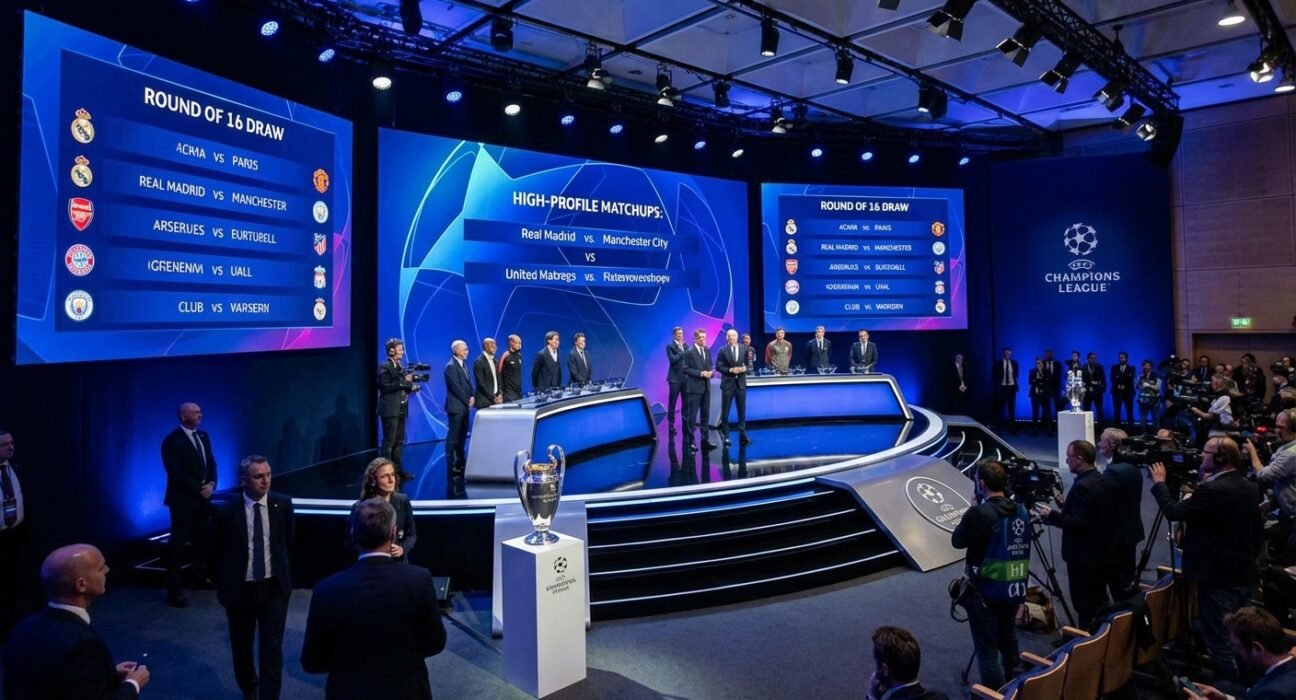
1. The headline fixture features a clash of European titans The confirmed draw for the UEFA Champions League Round of 16 has delivered a matchup of immense magnitude, pitting Real Madrid against Manchester City. This fixture represents a meeting between the competition’s most successful club in history and the reigning dominant force of English and European football. Pundits and fans alike view this early knockout confrontation as a premature final, given the caliber of talent on both squads and their recent history of high-stakes encounters in the tournament’s latter stages. The pairing ensures that one of the tournament favorites will be eliminated significantly earlier than anticipated, altering the landscape for the remaining contenders.
2. Scheduling and format for the two-legged ties The Round of 16 adheres to the traditional knockout format, consisting of home and away legs to determine which team advances to the quarter-finals. The first legs are scheduled to take place across mid-February, spread out over two weeks to maximize television viewership, while the decisive second legs will conclude in early March. As per UEFA regulations for this stage, the group winners are seeded and hold the advantage of playing the second leg at their home stadium, potentially providing a crucial edge if the aggregate score remains close after the initial encounter.
3. Abolition of the away goals rule significantly impacts strategy Teams approaching these high-profile matchups must navigate the tactical landscape without the away goals rule, which UEFA abolished prior to the 2021/22 season. In previous years, scoring on opposing turf carried extra weight in the event of a draw on aggregate, often leading home teams to play cautiously in the first leg. Under the current regulations, if the aggregate score is level after 180 minutes of play, the tie proceeds directly to extra time and, if necessary, a penalty shootout, regardless of how many goals were scored away from home. This change encourages teams to pursue victory more aggressively rather than relying on mathematical advantages.
4. Tactical battle between managerial legends The confirmed fixture between Real Madrid and Manchester City renews the tactical rivalry between two of the most decorated managers in football history, Carlo Ancelotti and Pep Guardiola. Ancelotti is renowned for his pragmatic adaptability and ability to manage big personalities, often relying on moments of individual brilliance and transition play. In contrast, Guardiola is celebrated for his structured positional play and dominance of possession. This strategic duality adds a layer of intrigue to the tie, as analysts dissect how each manager will adjust their systems to exploit the opponent’s weaknesses while mitigating their own defensive vulnerabilities.
5. Star power defines the on-field narrative Beyond the tactical setups, the draw highlights an incredible concentration of individual talent on the pitch. The fixture serves as a showcase for global superstars, including prolific strikers, creative midfielders, and world-class defenders who command the highest transfer values in the sport. The performance of key individuals—such as Jude Bellingham, Vinícius Júnior, Erling Haaland, and Kevin De Bruyne—will likely dictate the outcome of the tie. These players are accustomed to the pressure of elite European nights, and their ability to deliver match-winning contributions in tight spaces will be the focal point of global media coverage leading up to the matches.
6. Financial implications of early elimination The stakes of the Round of 16 extend beyond sporting prestige to significant financial consequences for the clubs involved. Progressing to the quarter-finals guarantees a substantial prize money payout from UEFA, in addition to increased revenue from broadcasting rights and matchday income. For heavyweights like Real Madrid and Manchester City, early elimination represents a potential loss of tens of millions of euros. This financial pressure adds intensity to the matchup, as club executives rely on deep runs in the competition to sustain their massive wage bills and fund future transfer market activities.
7. Implementation of advanced officiating technology The Round of 16 matches will feature the full suite of UEFA’s officiating technology, including Video Assistant Referee (VAR) and Semi-Automated Offside Technology (SAOT). The SAOT system utilizes specialized cameras to track limb points on players, allowing for faster and more accurate offside decisions compared to manual reviews. Given the high speed at which teams like Real Madrid and Manchester City operate, this technology is expected to play a pivotal role in ensuring that game-changing calls are correct, minimizing controversy in a fixture where the margins for error are razor-thin.
8. Historical context of recent meetings This specific matchup carries the weight of recent history, as the two clubs have developed a modern European rivalry. Their encounters in previous seasons have produced some of the most thrilling football in the competition’s history, characterized by high scoring and dramatic comebacks. The psychological aspect of these past meetings will influence the preparation for the Round of 16, with players drawing on previous experiences of victory or defeat. The narrative of revenge or reassertion of dominance will be a central theme in the build-up to kickoff.
9. Impact on domestic league campaigns The timing of the Round of 16 often complicates domestic title races, forcing managers to rotate squads and manage player fatigue carefully. Both Real Madrid and Manchester City are typically engaged in fierce battles for their respective league titles during February and March. The physical and mental exertion required to compete in such a high-intensity Champions League tie can lead to dropped points in domestic fixtures surrounding the European dates. Squad depth will be tested as managers attempt to field their strongest lineups in Europe without compromising their domestic ambitions.
10. The path to the final remains open for the victor The winner of this heavyweight clash will immediately be installed as the overwhelming favorite to lift the trophy. Eliminating a primary rival in the Round of 16 clears a significant hurdle on the road to the final, sending a strong message to the remaining teams in the competition. Following the conclusion of the Round of 16, UEFA will conduct a subsequent draw for the quarter-finals and semi-finals, mapping out the exact route to the final venue. For the victor of the Madrid-City tie, the momentum gained from such a significant triumph could prove decisive in the latter stages of the tournament.