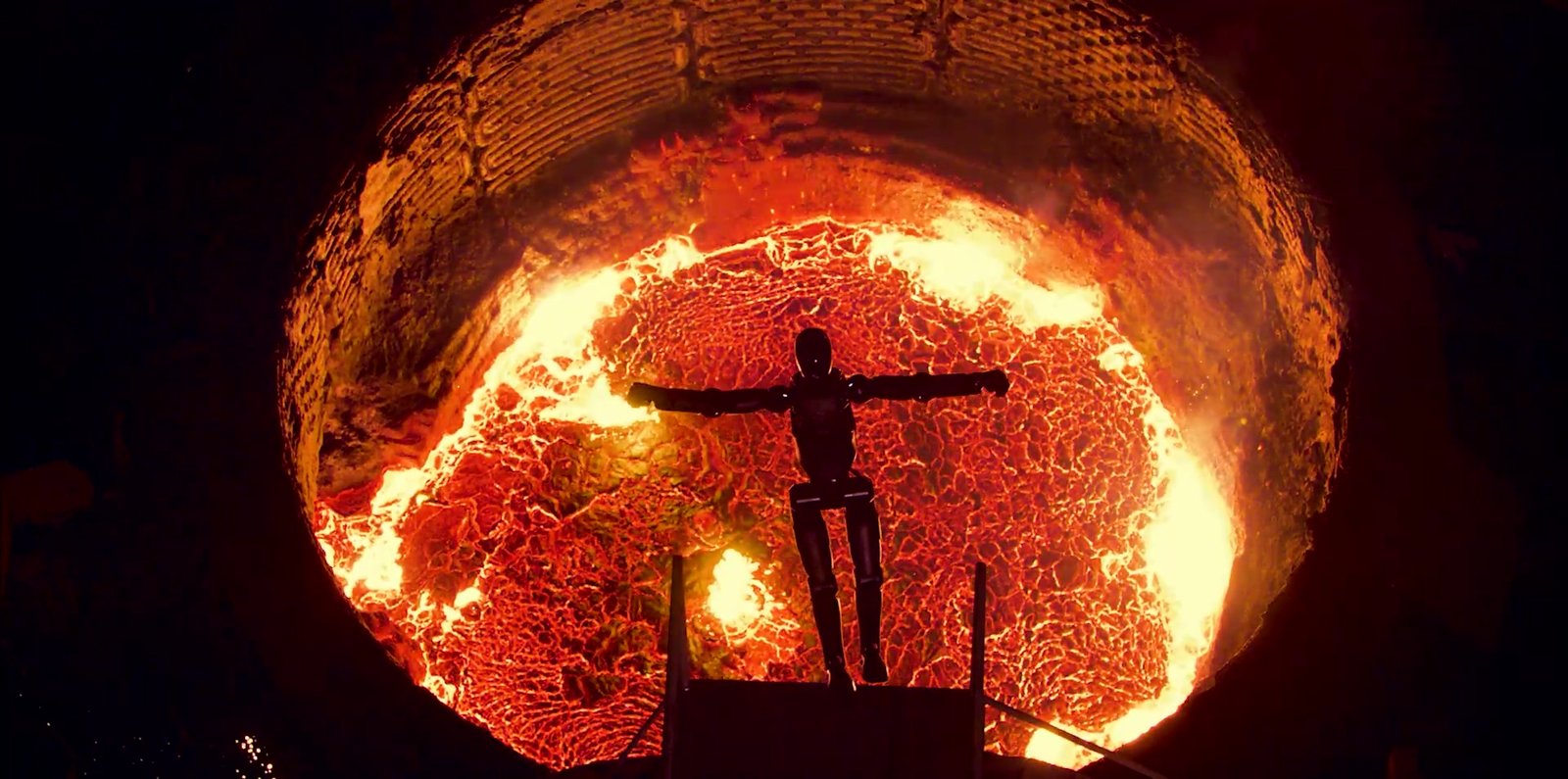
A humanoid robot, a steel furnace and Arnold Schwarzenegger: Figure has found a spectacular way to turn a hardware retirement into a cultural event. Its new F.02 Decommission film draws on the imagery of Terminator while raising a less cinematic question: what survives when an artificial intelligence company replaces the machines that helped teach it to operate in the real world?
Figure announced the project on September 30. The company says it trained older Figure 02 robots to jump autonomously into molten steel at a foundry in Imatra, Finland, with Schwarzenegger involved in the production. It describes the footage as a real operation, not an AI-generated sequence. That account comes from Figure itself; the film is not an independent technical audit.
A dramatic ending, not the beginning of retirement
The distinction matters. Figure 02 did not suddenly become obsolete because a dramatic video appeared. In November 2025, Figure had already announced its retirement following an eleven-month deployment at BMW’s Spartanburg plant.
Figure reported more than 90,000 parts loaded and more than 1,250 operating hours, contributing to production of over 30,000 BMW X3 vehicles. Those figures describe a component-handling role, not robots independently building entire cars. Their value lies in repeated work under production constraints, rather than the visual appeal of a single demonstration.
The company also identified the forearm as its leading hardware failure point at BMW and described changes to wrist electronics in Figure 03. That is the quieter story behind the furnace: a generation of machines can disappear while its operational lessons become part of the next design.
Why the Terminator reference works
Schwarzenegger’s involvement supplies instant cultural shorthand. Audiences do not need an explanation of humanoid robotics to recognize the combination of a human-shaped machine and glowing metal. It makes an engineering transition understandable in seconds.
But that familiarity also changes how the event feels. A discarded laptop rarely prompts the same reaction as a machine with a head, arms and a recognizable gait. The imagery invites viewers to read a hardware disposal process as a farewell, even though the footage provides no evidence of consciousness, fear or suffering.
That tension is useful to understand without exaggerating it. Human-shaped products carry human-shaped expectations. Companies developing them will have to communicate both what the systems can do and what viewers may mistakenly believe they are experiencing.
The industrial questions behind the spectacle
Figure says the disposal protected proprietary components and avoided a labor-intensive dismantling process. It reports that some F.02 machines remain in storage and that recovered metal will become limited commemorative artifacts. The company has not presented a lifecycle comparison establishing this approach as the cheapest or most environmentally responsible retirement method.
Nor does a successful furnace jump establish broad workplace readiness. A trained motion in a controlled production is a different test from an extended shift involving interruptions, unfamiliar objects and people moving through the workspace.
For readers assessing the technology, the relevant questions remain reliability, intervention frequency, maintenance and useful work completed. For operators retiring it, the questions also include battery handling, material recovery and whether valuable components can be reused. A compelling film cannot answer those questions by itself.
What comes after Figure 02
Figure introduced Figure 03 in October 2025 with redesigned sensing and hands, softer exterior materials and wireless charging. The company positioned that generation around its Helix AI system, domestic tasks and higher-volume manufacturing. These are stated design goals and capabilities, not proof that general-purpose household robots have become routine.
TENS Magazine’s assessment is that the strongest argument for Figure’s progress is not the destruction of an older robot. It is the connection between field experience and specific design improvements. The furnace supplies the memorable picture; sustained performance has to supply the evidence.
Figure has given its departing machines a cinematic ending. Whether their successors deserve a larger role in everyday life will be decided somewhere less theatrical: on the next shift, during the next difficult task, and in the record of how often a person still has to step in.