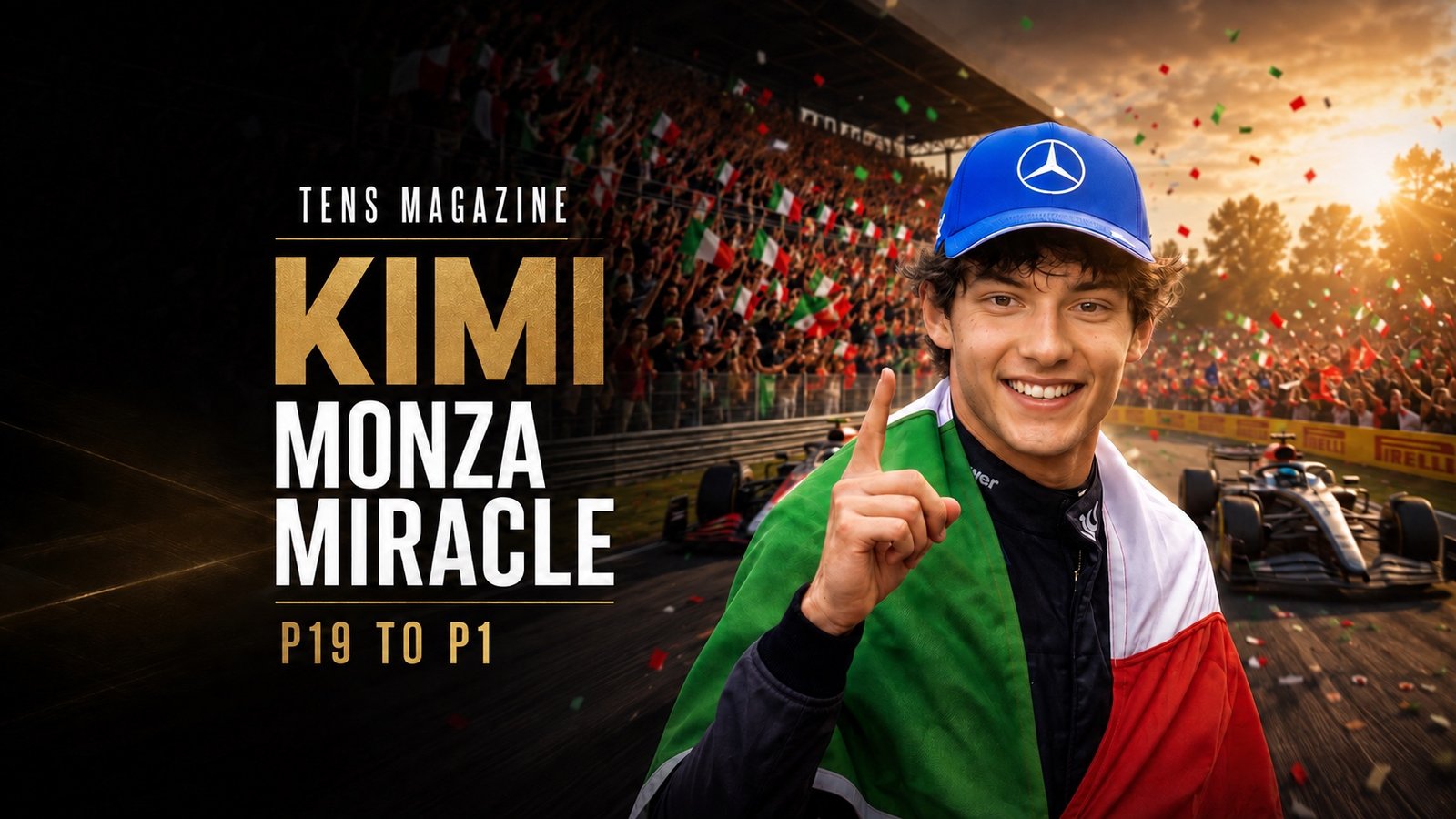
Monza has witnessed triumphs that belonged to Ferrari, champions and entire generations. On Sunday, September 6, it belonged to Kimi Antonelli. Starting nineteenth, the Mercedes driver won the 2026 Italian Grand Prix and ended a wait stretching back to Ludovico Scarfiotti in 1966: an Italian driver winning this particular race, on this particular stage.
The numbers are extraordinary enough. Eighteen positions gained. Fifty-three laps completed. George Russell beaten by 3.857 seconds in Formula 1’s provisional classification, with Max Verstappen third. Yet the finishing order cannot capture the afternoon’s defining quality: Antonelli had to recover not only from his starting position, but from a mistake when victory was already within reach.
A comeback built on more than bravery
There is a temptation to describe a charge like this entirely through courage. Antonelli supplied plenty, but racecraft also means recognising opportunity. A disrupted afternoon, an early red flag following Charles Leclerc’s accident, and a later virtual safety car changed the strategic landscape. Mercedes and its young Italian found a route through it.
Antonelli’s switch to medium tyres under the virtual safety car gave his pursuit a different shape. Russell continued on hard tyres; his teammate had fresher rubber and places to recover. That advantage mattered. It did not, however, execute the overtakes for him. Track position still had to be earned in traffic.
That distinction is worth preserving amid the celebrations. This was not magic replacing engineering. It was a driver converting a strategic opening into an exceptional result, repeatedly putting himself close enough to attack without allowing the scale of the task to overwhelm the next corner.
The gravel was not the ending
The emotional centre of the race came late. Attacking Russell, Antonelli ran into the gravel. A home victory that had seemed increasingly possible suddenly looked vulnerable again. Monza’s narrow margins had interrupted the charge, reminding everyone that ambition and execution are not always the same thing.
He recovered, remained in contention and returned to the battle. The decisive pass came on lap 51, leaving little time for the magnitude of it all to settle. Russell was no longer the final obstacle ahead; he was the Mercedes teammate behind.
For Antonelli, that sequence may prove more revealing than a flawless afternoon would have been. The error was real. So was the response. He did not need to erase what happened in the gravel; he needed to drive the remaining laps better. At the most emotionally charged venue on his calendar, he managed precisely that.
Sixty years, finally answered
Scarfiotti’s 1966 victory provides the historical frame, but accuracy matters here. Italian drivers have won on Italian soil since then, including Riccardo Patrese at Imola in 1990. Antonelli ended the Italian Grand Prix’s specific drought, not every version of an Italian home victory.
That narrower description loses none of its power. Monza carries a particular place in the national sporting imagination. For an Italian driver to win here is significant; to arrive at the front from nineteenth turns a result into a story that supporters can recount corner by corner.
Mercedes left with a one-two finish. Verstappen completed the podium, followed by Lando Norris and Oscar Piastri. Those results matter, but this Sunday’s lasting image will belong to the driver who refused to let either the grid or the gravel have the final word.
There will be time to debate strategy, tyre offsets and the championship consequences. First comes the simpler recognition: Antonelli won at Monza. Sixty years after Scarfiotti, an Italian name stands beside victory in the Italian Grand Prix again. For Italian supporters, the wait has finally become history.