
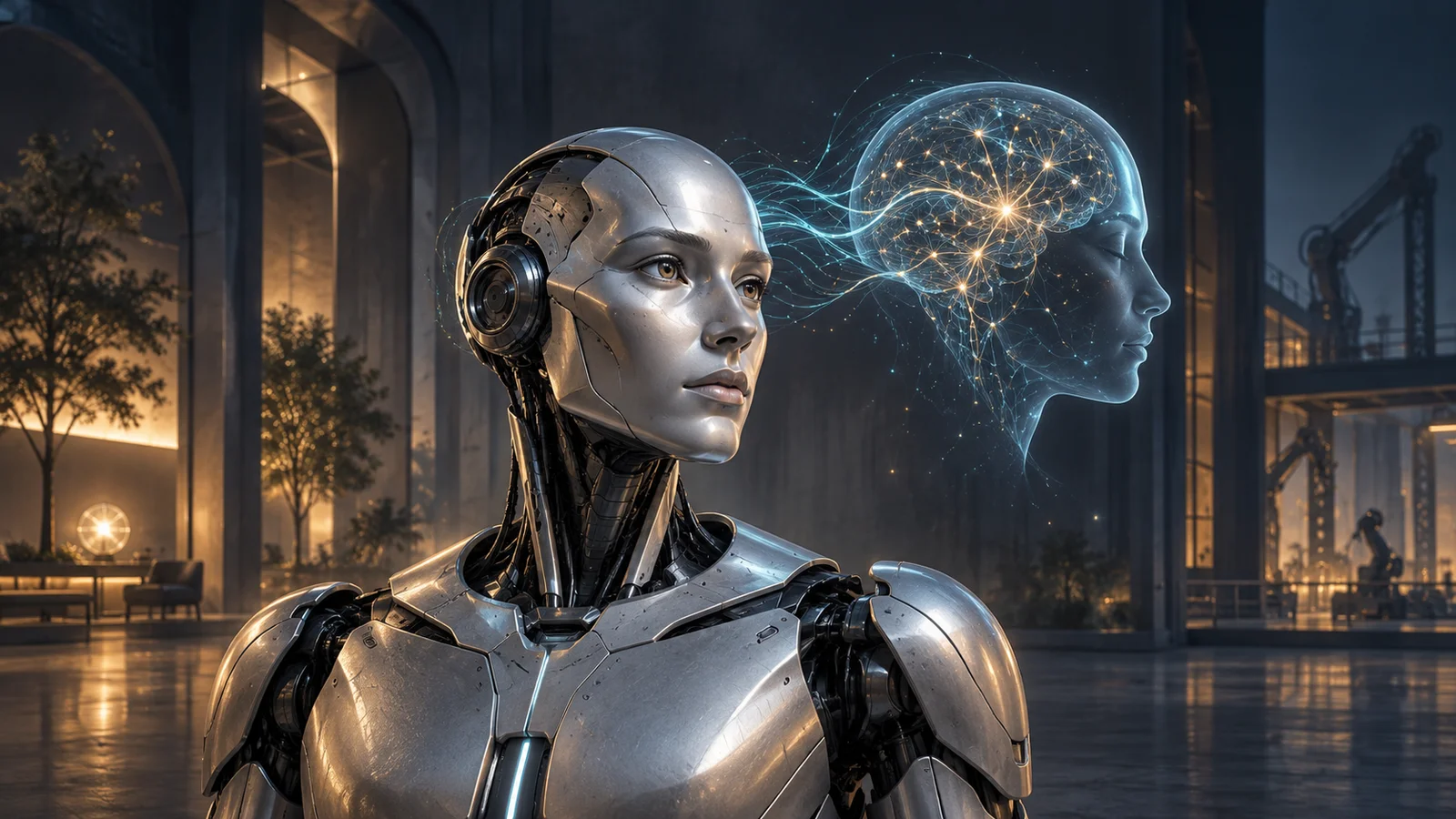
Imagine sending a machine into danger while your body remains somewhere safe. Imagine, too, someone else deciding where that machine goes, what it records, and whether you can disconnect. The possibility of using Neuralink to pilot humanoid robots contains both futures. The important question is not whether the idea looks extraordinary on Instagram. It is who would gain freedom, and who would gain power.
A reel shared by the unaffiliated account neura.link revisits Elon Musk’s vision of mentally operating an Optimus robot, potentially receiving information from its sensors. It is a striking prospect, but a vision is not a demonstrated product. Neuralink’s documented CONVOY study investigates control of an assistive robotic arm through its N1 implant. That is different from reliably controlling an entire humanoid in an unpredictable environment.
What the science supports
Brain-computer interfaces decode recorded neural activity into commands for external devices. They do not establish that every private thought can be read, nor does controlling a cursor prove that someone can safely walk a robot through a crowded hospital. Neuralink describes its implant as investigational. Its trials are evaluating safety and functionality, not offering a universally available enhancement.
The broader field nevertheless has substantial evidence behind it. A 2012 BrainGate study published in Nature demonstrated robotic reaching and grasping by people with tetraplegia. Research published in Science in 2021 found that artificial tactile feedback improved one participant’s robotic-arm performance, reducing median task time from 20.9 seconds to 10.2 seconds. That study was not a Neuralink trial, and its result cannot simply be transferred to Optimus.
These achievements make the ambition worth examining. They do not settle surgical risk, long-term reliability, affordability, or whole-body control. A useful system would probably combine human intention with onboard assistance: the person chooses an action while software handles balance, collision avoidance, and individual joints. Knowing where human control ends and machine autonomy begins would be essential.
The good begins with independence
Healthcare offers the strongest moral starting point. For someone with severe paralysis, independently handling an object or participating in household tasks could change daily life more profoundly than any theatrical robot demonstration. A future robotic body might extend that autonomy into workplaces and public spaces, provided patients help define the goals rather than being treated as promotional evidence.
Care settings could also benefit from remotely operated machines that fetch supplies, move equipment, or perform repetitive support tasks. But a robot should not become an excuse to remove human companionship. The value is giving caregivers more time for people, not reducing vulnerable residents to a cheaper service model. Reliability, consent, and clinical oversight would matter more than novelty.
Dangerous work, safer people
Energy, mining, construction, and industrial maintenance present another compelling possibility: separating expertise from physical exposure. A trained operator could potentially inspect contaminated machinery or work near hazardous infrastructure through a robotic platform. Disaster response could use remote machines to investigate unstable buildings or search environments that would otherwise endanger rescuers. These are prospective applications, not established Neuralink capabilities.
In manufacturing and logistics, physical telepresence might let workers with mobility limitations perform tasks previously inaccessible to them. Agriculture could benefit from remote inspection and difficult maintenance. Science might gain access to hostile environments. Yet an implant would need to outperform safer interfaces before surgery became justifiable. Cameras, joysticks, voice control, and wearable sensors remain serious alternatives, not primitive obstacles.
When assistance becomes exploitation
The same industries could use the technology badly. Employers might market implantation as optional while making promotion, desirable shifts, or continued employment depend on accepting it. A person controlling a machine from home could still face exhausting quotas, constant monitoring, and injury to their autonomy. Removing someone from a dangerous factory does not automatically create a decent job.
Insurance and finance raise a different concern: neural signals or unreliable inferences being used to classify people. A movement-control system is not a truthful window into personality or intention. Companies should not turn uncertain measurements into judgments about employability, creditworthiness, or trust. Advertising businesses should not treat intimate neural information as another audience segment available for sale.
A remote body can still cause real harm
Policing, private security, and warfare expose the sharpest ethical boundary. Remotely embodied machines could reduce danger to their operators while increasing distance from the people affected by their actions. That distance may weaken restraint. A human somewhere in the control chain is not sufficient accountability if nobody can establish who authorized a movement, what the system changed, or why force was used.
Criminal misuse is also imaginable: physical intimidation, unauthorized entry, impersonation, or surveillance conducted through remotely controlled hardware. These are risks to govern, not evidence that Neuralink currently enables them. Security must protect both the operator’s sensitive data and everyone near the robot. Connection loss, corrupted commands, and ambiguous intentions should trigger safe behavior rather than improvised movement.
The right to disconnect
UNESCO’s 2025 Recommendation on the Ethics of Neurotechnology provides a useful starting point for protecting dignity and mental privacy. Practical deployment would require voluntary participation, limits on secondary data use, independent safety evaluation, and accessible remedies when something goes wrong. Operators need an unmistakable way to stop. Bystanders need to know they are interacting with remotely controlled machinery.
Ownership is part of safety. If a manufacturer withdraws support, changes subscriptions, or restricts access, an operator could lose a tool that has become central to everyday independence. Maintenance, repair, portability, and long-term patient support therefore belong in the business model from the beginning, not in a reassuring promise added after launch.
TENS’s position is straightforward: develop this technology first around autonomy, accessibility, and measurable protection from harm. Judge each application against the least invasive workable alternative. Demand clear responsibility for the human, the robot, and the software between them. The future should not be celebrated merely because someone can inhabit a machine. It should be celebrated when that machine helps people remain fully in charge of their own lives.
Editorial illustration: Original AI-assisted conceptual artwork; it does not depict a verified Neuralink–Optimus demonstration.
