
Artificial intelligence is beginning to change more than the speed of office work. It may also be changing who performs particular tasks. A new OpenAI study finds that many workers use ChatGPT for activities historically associated with occupations other than their own, an early sign that the boundaries between roles are becoming more flexible.
The research released July 27 analyzed a random sample of more than 800,000 work-related messages from individual ChatGPT accounts belonging to U.S. users. Those users had provided occupation information through ChatGPT Business. OpenAI classified 16.8% of all sampled work messages as cross-occupation, while 43.5% of messages involving occupation-specific rather than generic work crossed a traditional job boundary.
Measuring work beyond the job description
OpenAI calls the pattern “task crossover.” The researchers compared the main activity in each message with the sender’s self-reported occupation. They used the U.S. Department of Labor-sponsored O*NET database, which maps occupations to tasks, work activities, skills, and other job characteristics, as the historical baseline.
The study separated messages into three groups. Generic work covered activities common to many roles, including writing, summarizing, and scheduling. Within-occupation messages matched the user’s own field. Cross-occupation messages were linked more closely to work historically assigned to another field.
That distinction matters because generic work accounted for 61.5% of the sample. Cross-occupation messages represented 16.8%, and within-occupation messages made up 21.8%. The larger 43.5% figure applies only after generic messages are removed. It should not be read as saying that nearly half of all work performed with ChatGPT falls outside a user’s job.
Marketing and engineering tasks travel widely
The full Work at the Frontier report focuses on eight occupation groups: customer experience, design, engineering, finance, human resources, legal, marketing, and sales. Among non-generic messages, cross-occupation work formed a majority in five groups, reaching 77% for customer-experience workers, 75% for designers, 69% for human-resources workers, 56% for legal workers, and 53% for marketers.
Some activities appeared across nearly every field. Calculating financial data ranked among the three most common finance-related crossover tasks for all seven non-finance groups. Troubleshooting computer applications or systems did the same for all seven non-engineering groups. Marketing work also traveled broadly, especially requests involving promotional materials, plans, and campaigns.
The movement was not symmetrical. Designers devoted 35.2% of all their sampled work messages to activities associated with other occupations, yet design tasks accounted for only 1.7% of messages from workers elsewhere. Engineering showed the opposite tendency: engineers brought in fewer outside tasks, while troubleshooting and other engineering activities appeared regularly in messages from other fields. Marketing moved strongly in both directions.
Small teams may be using AI as a generalist tool
Among users in the middle half of the message-volume distribution, cross-occupation work declined from 18.9% in workspaces with two to five seats to 16.3% in workspaces with more than 100 seats. OpenAI suggests that workers in smaller organizations may turn to AI when a specialist is not readily available.
That explanation is plausible, but the report treats it as an interpretation rather than a causal finding. Workspace seats are not the same as total company size, and the pattern was not consistent among the heaviest users. Industry, organizational maturity, access to colleagues, and the mix of occupations could also help explain the difference.
What the study does not prove
The results do not show that AI is eliminating jobs or making workers more productive. The sample is not representative of the entire U.S. workforce, covers only eight occupation groups, and excludes ChatGPT Enterprise users. A message is also not equivalent to an hour of work, a completed project, or a successful result.
Researchers did not observe whether users applied the model’s output, whether it was accurate, how much time it saved, or whether a qualified specialist reviewed it. ChatGPT itself was used to classify messages anonymously, with each selected message considered alongside as many as nine preceding messages for context. That process offers scale but also introduces model-based judgment into the measurement.
The most useful conclusion is narrower: workers are already experimenting with task combinations that older job descriptions may not capture. If that behavior becomes routine, companies will need clearer review standards, training for work that extends beyond an employee’s core expertise, and explicit accountability when AI helps a generalist attempt a specialist task.
Job titles may change slowly, but daily work can change one request at a time. This study offers an early view of that transition—and a reminder that expanding what people can attempt is not the same as proving they can do it safely or well.
Sources: OpenAI research announcement; OpenAI, Work at the Frontier report; O*NET Resource Center database overview.
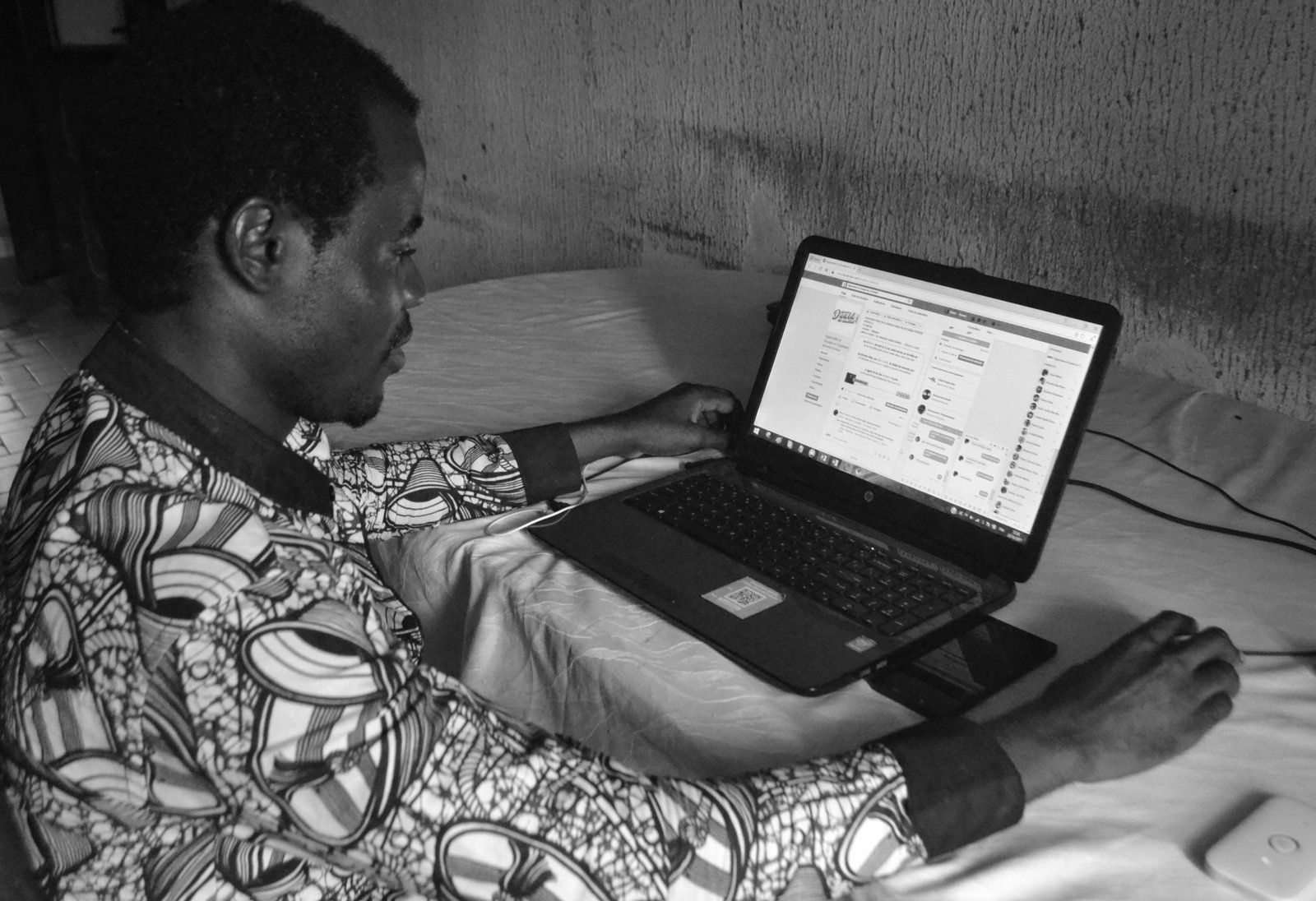
Featured image: A person in Cameroon working on a laptop computer. Photograph by Minette Lontsie via Wikimedia Commons, licensed under CC BY-SA 4.0. No modifications were made.

