
TENS Magazine’s Race Strategy Predictor had Max Verstappen winning the Singapore Grand Prix—and on Sunday, October 11, he delivered. The Red Bull driver won at Marina Bay ahead of Charles Leclerc and Kimi Antonelli, turning the model’s pre-race favorite into the race’s actual winner.
A winner, not a guarantee
Formula 1’s official classification records Verstappen completing the 62-lap Singapore Grand Prix in 1:42:00.785. Leclerc finished 7.335 seconds behind, with Antonelli third, 24.573 seconds off the winning time. Norris finished fourth.
The Singapore setup displayed here places Verstappen first across 500 simulations, with an illustrative 83.6 percent win probability. Norris occupies the second projected position and Antonelli the third. TENS’s publisher confirms that the model also selected Verstappen as its winner before the Grand Prix.
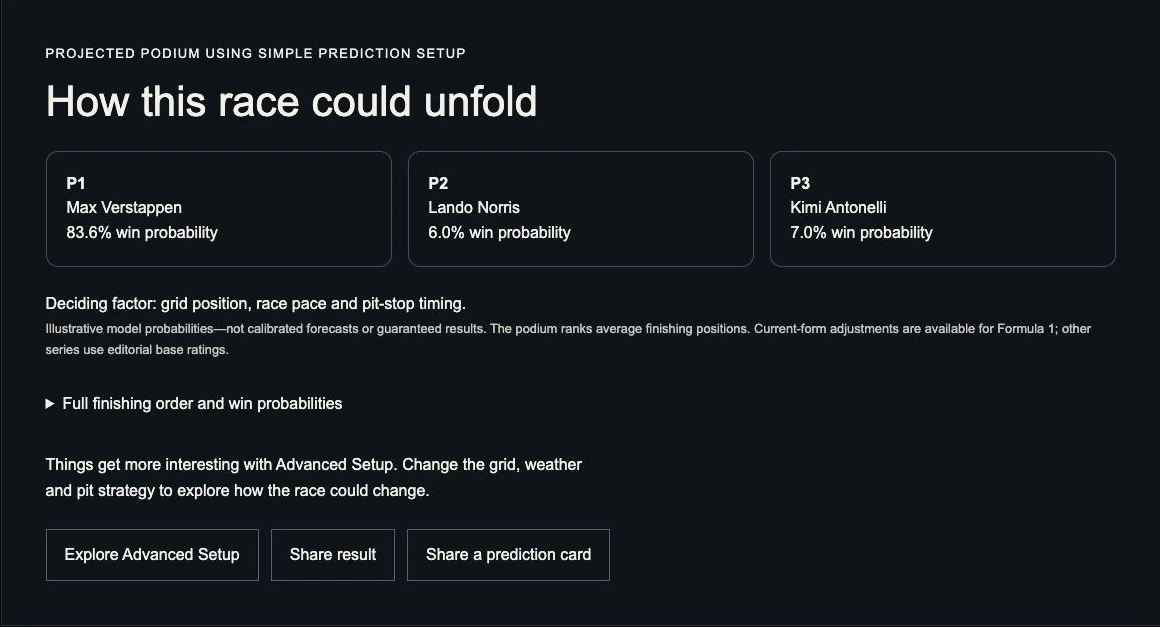
The distinction matters. The winner matched. The complete podium did not. Leclerc’s second place was an important difference between the race and this inspected model run. Presenting that honestly makes the successful call more credible, not less.
Why Singapore rewards strategic thinking
Marina Bay puts a premium on more than outright speed. Starting position, overtaking difficulty, tire management and the cost of a pit stop interact. A quick car can lose its advantage if a stop returns it to traffic; a slower stint can become valuable if it protects track position.
The predictor turns those relationships into editable assumptions. Its Singapore setup uses the 4.927-kilometer circuit and 62-lap race distance, alongside editorial estimates for tire degradation, pit-lane time loss and safety-car probability. Those estimates are model inputs, not measurements supplied by a team.
Verstappen’s strong modeled pace and tire-management ratings help explain why he emerges as the favorite. But the interface also makes the uncertainty visible. Mechanical failures, incidents, changing weather and different pit strategies can alter an outcome. In the checked run, a race-date weather forecast was unavailable, so the tool explicitly used editorial weather assumptions.
The map makes the model understandable
The circuit replay is one of the project’s most useful features. Readers can follow a representative simulated race lap by lap on an independently rendered outline of Singapore’s current 19-turn layout, checked against the FIA’s circuit map.
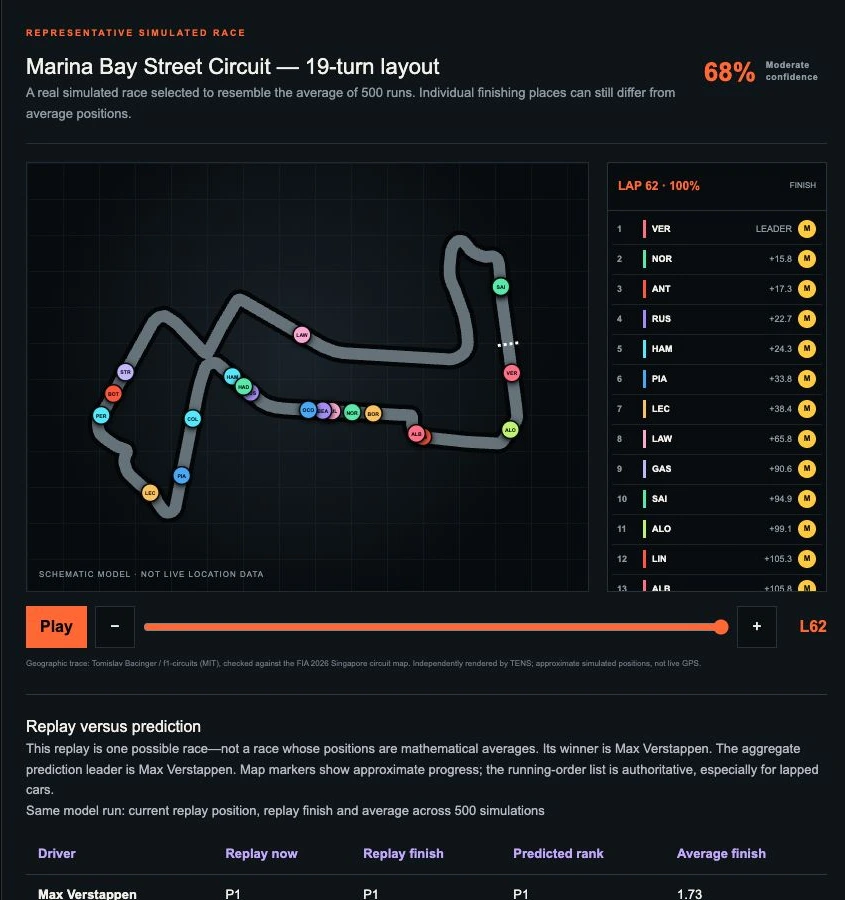
The moving markers are approximate simulated positions, not live GPS. The replay is one possible race drawn from the simulation batch. The projected ranking, by contrast, orders drivers using average finishing positions across the batch. Those two views answer different questions and should never be confused.
Try the next strategic question
Readers can explore the tool at strategy.tensmag.com. The simple setup offers an immediate starting point: select Formula One and choose “Predict This Race.” Advanced Setup is where the questions become more interesting. Move a pit stop, change a tire compound, test rain or adjust the starting order, then rerun the same scenario.
Singapore provides a compelling reason to explore the tool. The reported pre-race favorite won. The stronger long-term test, however, is whether predictions are recorded before the start, retained without revision and assessed across an entire season—including the misses.
Editorial note: TENS’s publisher confirms the winning prediction was viewed before the race but was not published ahead of the start. This article documents that call retrospectively. TENS’s predictor is independent, unaffiliated with Formula One or the FIA, and offers hypothetical analysis rather than guaranteed forecasts or betting advice. The cover is an AI-assisted editorial illustration.