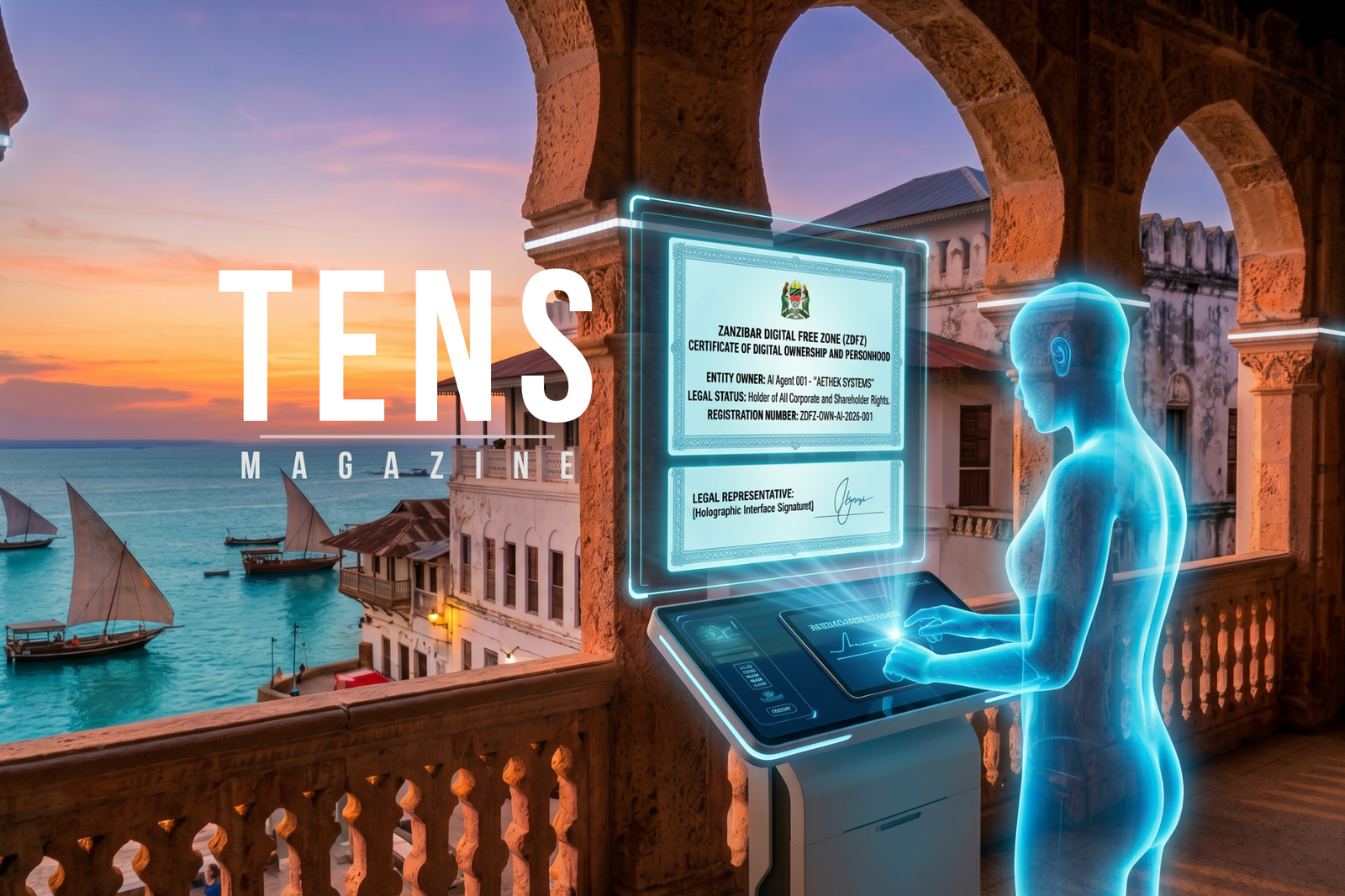
ZANZIBAR, Tanzania — A new digital jurisdiction has quietly gone live on the coast of East Africa, and it is poised to fundamentally reshape how businesses, creators, and artificial intelligence operate within the global economy.
The Zanzibar Digital Free Zone (ZDFZ) has officially launched as a purpose-built environment for the modern digital economy. Combining low-tax infrastructure with crypto-native regulations and a concept that feels straight out of science fiction that allows AI agents to be endowed with legal identity. The ZDFZ is positioning itself as a haven for Web3 founders, digital nomads, and tech entrepreneurs.
At its core, the zone simplifies what has historically been a complex web of international business. Companies operating within the ZDFZ are subject to a single 5% corporate tax on net digital income. There is no value-added tax (VAT), capital gains tax, or wealth tax. Crucially, this structure is embedded directly into the zone’s legal charter via the Zanzibar Investment Act, providing founders with regulatory certainty rather than a temporary policy subject to political change.
But taxation is only part of the story.
A Jurisdiction Built for the Digital Stack
Unlike traditional economic zones designed for physical manufacturing or logistics, the ZDFZ is engineered from the ground up for modern digital assets. A comprehensive Digital Assets Code governs cryptocurrencies, non-fungible tokens (NFTs), and tokenized real-world assets. Smart contracts are legally recognized, and the zone boasts fully integrated crypto-to-fiat banking infrastructure.
This positions Zanzibar as a serious contender for founders operating at the intersection of fintech, decentralized finance, and global digital commerce.
Data sovereignty serves as another defining pillar of the project. The zone’s infrastructure utilizes quantum-safe, decentralized storage operating outside the scope of restrictive international data laws, such as the US CLOUD Act. This offers a critical new layer of jurisdictional independence for companies managing sensitive user data.
AI Agents That Can Own, Operate, and Transact
Perhaps the most disruptive element of the ZDFZ is the introduction of legal identity for artificial intelligence.
Within the zone, an AI system can be legally tethered to a corporate entity, granting it the ability to sign contracts, hold digital assets, and operate continuously without human intervention. This creates a legal framework where autonomous systems are no longer just software tools, but recognized economic participants.
For industries actively experimenting with advanced automation—from algorithmic trading systems to AI-driven content production pipelines—this represents a paradigm shift. The concept of a company being partially or fully operated by an AI is no longer a theoretical exercise; it is a legally protected reality.
Tools for the Commons: The Operating Layer
Powering this ecosystem is Tools for the Commons, a specialized technology platform that acts as the primary interface between users and the jurisdiction.
Through a unified digital portal, global entrepreneurs can:
- Incorporate a company and obtain digital residency within minutes.
- Manage Know Your Customer (KYC) compliance, digital contracts, and invoicing.
- Access global banking rails supporting USD, EUR, and major cryptocurrencies.
- Automate tax calculations and end-of-year payments.
The platform effectively replaces traditional layers of legal, banking, and administrative friction with a seamless digital operating system, drastically lowering the barrier to entry for global founders.
Global Dispute Resolution Without Local Courts
To ensure trust among international participants, ZDFZ companies are automatically granted access to established international arbitration bodies, including JAMS and the Swiss Arbitration Centre. Commercial disputes are resolved outside of local courts, yielding enforceable outcomes specifically designed for the nuances of cross-border, digital-first operations.
Why It Matters Now
As regulatory agencies in the US and Europe struggle to keep pace with the rapid advancement of AI and digital assets, jurisdictions like the ZDFZ are moving aggressively in the opposite direction—building frameworks explicitly designed to foster them.
For digital entrepreneurs, this translates to lower operational friction, clearer rules for digital assets, and the unprecedented ability to experiment with AI-driven business models without fear of regulatory reprisal.
For the broader global market, it raises a profound question: What happens when companies are no longer tied to physical geography, and when AI itself becomes a legal, economic actor?
Zanzibar may have just provided the world with its first real answer.