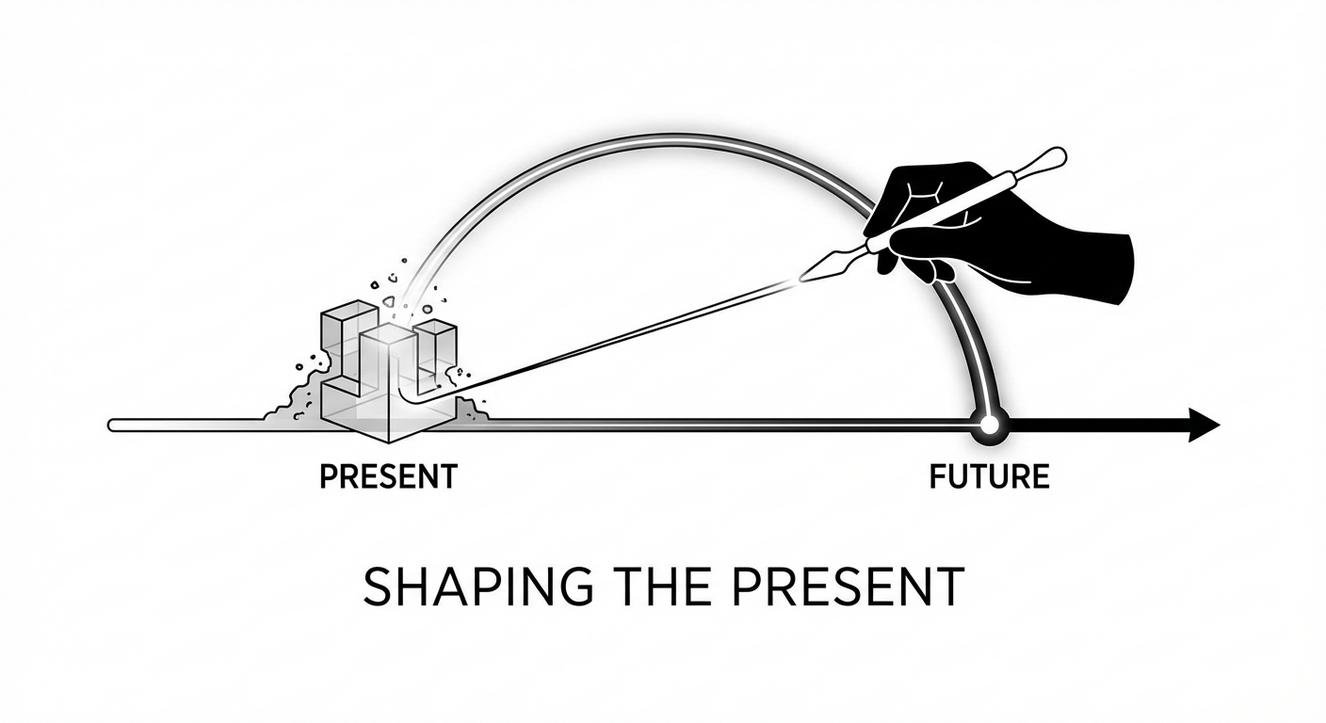
In recent years, a complex theoretical concept from quantum physics known as retrocausality has found an unexpected second life in the wellness and self-help communities. Retrocausality—the hypothesis that an effect can precede its cause, effectively allowing the future to influence the past—is currently being utilized by proponents of “manifestation” to explain how visualizing a desired future might alter present reality. While physicists debate retrocausality as a mathematical interpretation of subatomic particle behavior, the cultural adaptation of the theory highlights a growing trend of merging advanced scientific vocabulary with New Age philosophy.
To understand this intersection, it is necessary to examine the origins of retrocausality in physics. The concept challenges the classical, linear understanding of time and causality, which dictates that the past strictly determines the future. In the realm of quantum mechanics, however, certain phenomena defy intuitive logic. The foundation for retrocausality was laid by thought experiments such as physicist John Archibald Wheeler’s delayed-choice experiment, and later explored in the 1999 delayed-choice quantum eraser experiment conducted by Yoon-Ho Kim and colleagues.
In these highly controlled laboratory settings, researchers observe the behavior of entangled photons. The results of these experiments demonstrate that a measurement made on a particle in the present appears to correlate with the state or path of its entangled partner in the past. Philosophers of science and physicists, such as Huw Price and Ken Wharton, have argued that a “time-symmetric” view of the universe—where information can flow both forward and backward in time—could resolve some of the paradoxes of quantum mechanics, including what Albert Einstein famously called “spooky action at a distance”.
Parallel to these developments in theoretical physics, the concept of manifestation has surged in popularity, particularly on social media platforms. Manifestation is the practice of attempting to bring personal goals, such as career success or relationships, into reality through focused intention, positive thinking, and emotional alignment. A core tenet of modern manifestation is the instruction to “live in the end state.” Practitioners are encouraged to feel the emotions and adopt the mindset of the person they will become once their goal is achieved, rather than focusing on the desire or lack of it in the present.
The application of retrocausality to manifestation occurs when practitioners use the physics concept as a literal or metaphorical framework for this psychological practice. In the context of “quantum manifestation,” proponents argue that if the future can influence the past at the subatomic level, human consciousness might be able to harness this mechanism. According to this framework, when an individual successfully embodies the emotional and psychological state of their desired future, that future reality is already established. Consequently, that future state theoretically sends information or influence backward in time, guiding the individual’s present actions, decisions, and circumstances to ensure the outcome is reached.
Under this interpretation, manifestation is not viewed as a process of creating something out of nothing, but rather as a process of aligning with a future that already exists. Proponents claim that by abandoning the linear view of time, individuals can “collapse the quantum wave of possibility” into a tangible reality, effectively allowing their future selves to pull their present selves forward.
Despite the popularity of this synthesis, the scientific consensus firmly separates the mathematics of quantum mechanics from macroscopic human psychology. Mainstream physicists classify the application of retrocausality to human manifestation as “quantum mysticism”—the practice of using quantum terminology to justify unverified spiritual or philosophical beliefs.
Physicists emphasize that retrocausality, even as a theoretical model, applies strictly to isolated subatomic particles under highly specific, controlled conditions. The macroscopic world in which humans operate is governed by classical physics and thermodynamic laws, where the arrow of time moves strictly forward. Furthermore, the delayed-choice quantum eraser experiment does not demonstrate that a conscious observer can intentionally rewrite the past or dictate a specific future outcome; it merely shows statistical correlations that are only apparent after the data is analyzed.
Psychologists and behavioral scientists offer a different explanation for why manifestation often feels effective to its practitioners. Rather than quantum time-reversal, the success of manifestation can be attributed to established psychological mechanisms. When individuals focus intensely on a goal and adopt the mindset of having achieved it, they experience the frequency illusion (or Baader-Meinhof phenomenon), causing them to notice opportunities they might have otherwise ignored. Additionally, the practice fosters a self-fulfilling prophecy, where increased confidence and reduced anxiety lead to behavioral changes that naturally improve the likelihood of success.
The intersection of retrocausality and manifestation illustrates a fascinating cultural phenomenon where the frontiers of theoretical physics are repurposed to address human aspirations. While retrocausality remains a subject of rigorous debate among physicists attempting to understand the fundamental nature of time and entanglement, its application to manifestation is not supported by empirical science. Nevertheless, the trend underscores a persistent human desire to understand our agency in the universe, using the language of the cosmos to navigate the complexities of everyday life.