The Philadelphia Eagles opened training camp by securing one of the defining players on their defense. The team announced Tuesday that defensive tackle Jalen Carter agreed to a four-year contract extension that keeps him under contract through the 2031 season.
That is the confirmed scope of the transaction. Philadelphia’s announcement identifies the length and endpoint of the extension but does not publish financial terms. Reported dollar figures are therefore not necessary to evaluate the football decision: the Eagles have made a long-term commitment to a 25-year-old interior defender who has already earned two Pro Bowl selections and an All-Pro honor.
A commitment built on three NFL seasons
The Eagles’ official announcement, published July 28 as players reported for camp, says Carter is entering his fourth NFL season. Philadelphia selected him ninth overall in the 2023 draft after his college career at Georgia, and he immediately joined a defensive front designed to create pressure without relying on one alignment or one rusher.
The team credits Carter with 121 quarterback pressures, 108 total tackles, 13.5 sacks and 12 passes defensed across his first three regular seasons. Those totals are useful evidence of production, but the extension is also a bet on how an interior disruptor changes the work around him. Offenses can answer a dangerous defensive tackle with double teams, slides and quicker throws; each response can alter the opportunities available to the rest of the front.
Carter’s early résumé has developed quickly. He made the Pro Bowl after the 2024 and 2025 seasons and was a second-team All-Pro in 2024. The Eagles also identify him as a contributor to their Super Bowl LIX championship. None of those honors guarantees the next stage of his career, but they explain why Philadelphia chose to act well before Carter approached the open market.
Why the timing matters
In April, the Eagles exercised the fifth-year options on Carter and edge rusher Nolan Smith, placing both under contract through 2027. The new extension pushes Carter’s team control four seasons beyond that point. This was not a deadline-day response to imminent free agency; it was an early roster-building decision.
That timing gives Philadelphia continuity at a position where premium talent is difficult to replace. Interior defenders must handle run fits on early downs, compress the pocket on passing downs and remain coordinated with edge rushers and linebackers. Carter’s combination of power and quickness gives the Eagles flexibility to move him across the front rather than confine him to a single matchup.
The agreement also arrives in an offseason when Philadelphia has continued to invest in its defensive line. The team extended Jordan Davis earlier in the year, keeping Carter’s former Georgia teammate in the same interior rotation. In the Eagles’ official training-camp defensive-tackle preview, the club lists Carter, Davis, Moro Ojomo, Ty Robinson and Byron Young among the group preparing for camp.
That depth matters because line play is rarely a one-player operation. Rotations help preserve power across long drives, while different combinations allow a coordinator to answer changes in down, distance and offensive personnel. Carter’s extension establishes the centerpiece, not the complete solution.
Production and projection are different questions
The NFL’s official player record provides the league-level career log for Carter, while the Eagles’ announcement supplies additional pressure and usage context. Together, those records establish what he has done. They do not settle how productive he will be in 2026 or across the full term of the extension.
That distinction is important with any long contract. Availability, scheme, supporting personnel and opponent adjustments all change over time. Carter appeared in 11 games in 2025, according to the team, and still received a second Pro Bowl selection. Philadelphia is projecting that his disruption and development will remain valuable through 2031, but the contract itself cannot guarantee health, performance or team results.
What the extension does provide is clarity. Carter can enter camp without an unresolved long-term negotiation, and the Eagles can build their defensive plan knowing that a foundational interior player is secured beyond the current roster cycle. It also reinforces a familiar Philadelphia philosophy: the defensive front is a place to retain premium homegrown talent.
What comes next
The next stage will be measured on the field. Carter must translate the commitment into consistent work across a full season, while Philadelphia must continue building a rotation that prevents opponents from directing every protection toward him. The contract does not make those challenges disappear.
It does, however, resolve one consequential question before the first training-camp practice. The Eagles identified Carter as a long-term defensive cornerstone and acted early enough to keep the focus on football. For a team that has repeatedly built from the line outward, extending him through 2031 is less a change in philosophy than a clear continuation of it.
Sources: Philadelphia Eagles contract-extension announcement; Philadelphia Eagles 2026 defensive-tackle preview; Philadelphia Eagles fifth-year-option announcement; NFL.com career statistics for Jalen Carter.
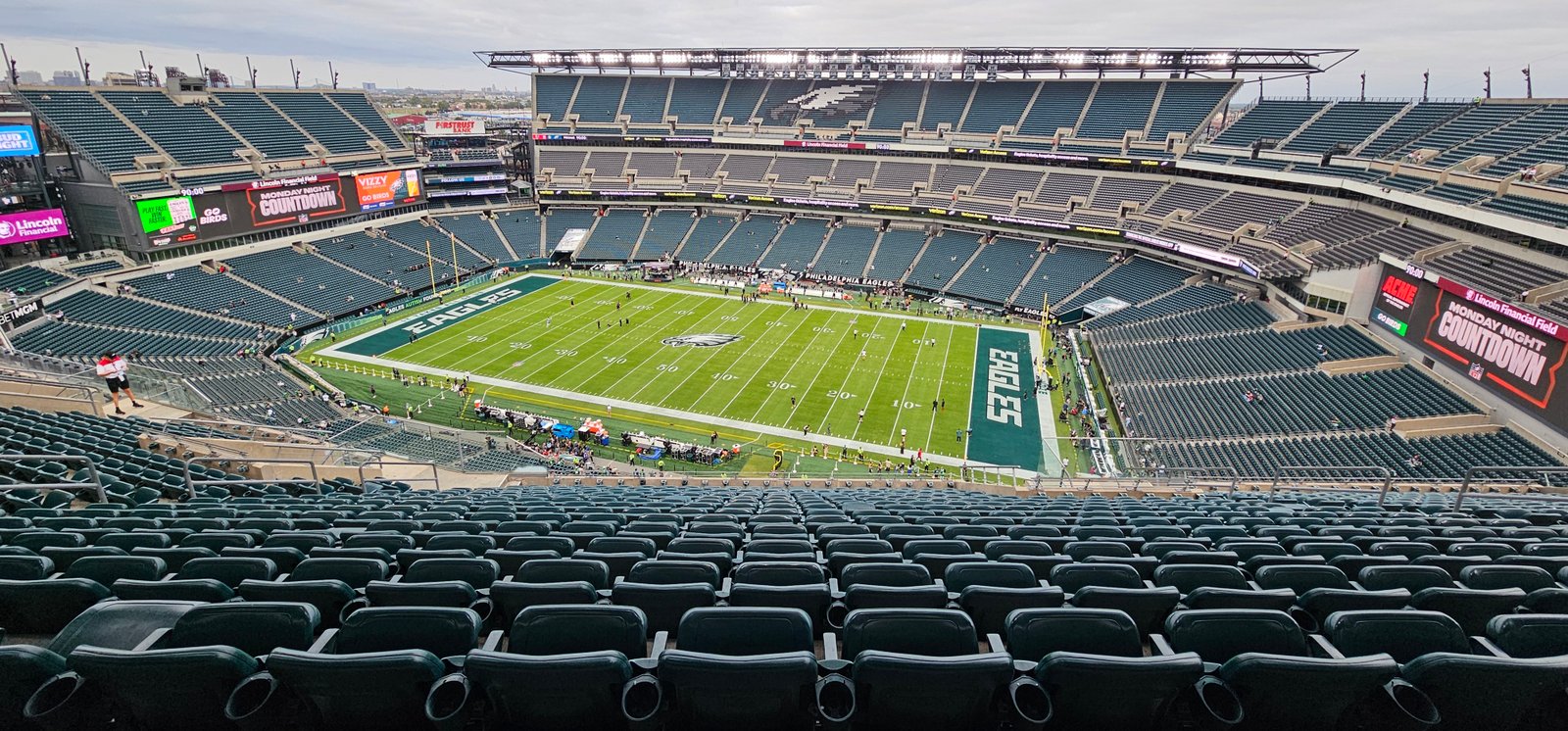
Featured image: Lincoln Financial Field, home of the Philadelphia Eagles, before a September 2024 game. Photograph by JJonahJackalope, via Wikimedia Commons. Source: Own work. License: CC BY-SA 4.0 (Creative Commons Attribution-Share Alike 4.0). Modifications: None.