Philadelphia’s returning offensive line is entering a different kind of continuity test. Sean Mannion’s first regular-season game as an NFL playcaller brings a new offensive system and a new route for information from the coaches’ booth. Familiar personnel will have to make those changes work together when the Eagles host Washington on September 13.
The Eagles’ September 11 report confirmed that Mannion chose the booth after trying both locations during the preseason. He described the decision in terms of communication and the view of the field. His offense also retains elements that previously worked for Jalen Hurts while adding new concepts. Those are confirmed features of the preparation, not proof of how efficiently the finished operation will run.
TENS analysis: three forms of continuity
The useful distinction is between continuity of personnel, continuity of assignments and continuity of communication. A team can preserve the first while changing the other two. That is why counting returning starters offers only a partial description of Philadelphia’s transition. The practical question is whether shared experience helps players absorb different instructions without losing the speed and clarity that made the familiarity valuable.
Offensive line coach Chris Kuper’s September 8 update supplies the personnel context. The five returning starters are Jordan Mailata, Landon Dickerson, Cam Jurgens, Tyler Steen and Lane Johnson. Kuper described a group learning a different system and still making progress. His account gives reason to recognize the value of experience while resisting the assumption that the same names mean the same operation.
That distinction changes how the opener should be judged. A productive play can show that one combination worked. Repeating it after the defense responds is evidence of something more durable. Neither observation alone identifies every player’s assignment, which is why apparent coordination should be discussed carefully rather than converted into a confident diagnosis of the blocking scheme.
The booth decision connects preparation to adjustment
Hurts’ comments, published by the Eagles on September 10, add the quarterback’s perspective. He said he had not worked with a coordinator in the booth since college. He also emphasized fundamentals and shared execution against a Washington defense now coordinated by Daronte Jones. The change therefore involves both the flow of information inside Philadelphia’s offense and uncertainty about the opponent.
Mannion’s September 11 explanation makes the connection clearer: staff communication on the sideline helped support his choice to work upstairs. The editorial significance is the handoff between observation and action. Seeing the defense from a different vantage point has value only if useful information reaches the players in a form they can apply. The location itself is not an offensive advantage that can be presumed in advance.
Consider a defensive look that differs from the preparation. The offense must recognize it, agree on the response and execute that response. Returning teammates may help with the agreement, while a new coordinator supplies a different process for choosing the answer. This is a framework for evaluating the transition, not a claim that TENS has seen Philadelphia’s private communication procedures.
Depth tests whether the system travels
Kuper’s earlier report also praised the camp consistency of interior reserves Willie Lampkin and Drew Kendall. Coaching confidence is meaningful evidence about preparation, but it remains different from an established record in regular-season assignments. Those comments should neither be dismissed nor promoted into certainty about a reserve’s future role.
Depth in this setting has two dimensions: having another player available and having the surrounding unit function with that player. A substitution can change the amount of shared experience within a combination even when the playbook stays the same. That makes reserve readiness part of the installation question, not merely a separate count of bodies behind the starters.
If a reserve appears, the useful question is whether the offense preserves its ability to communicate and adjust. If the starters play throughout, that question remains unanswered. Absence of a test is not proof of a weakness, and one successful appearance would not settle the quality of the entire reserve group.
The sources together point toward a disciplined way to read Philadelphia’s opener: separate the personnel advantage from the new assignments, then examine how information connects the two. A sack total or rushing total cannot independently explain that process. Nor can one game establish where the offense will stand later in the season. The first meaningful evidence will be how the Eagles translate familiar relationships into workable answers when Washington gives them something to solve.
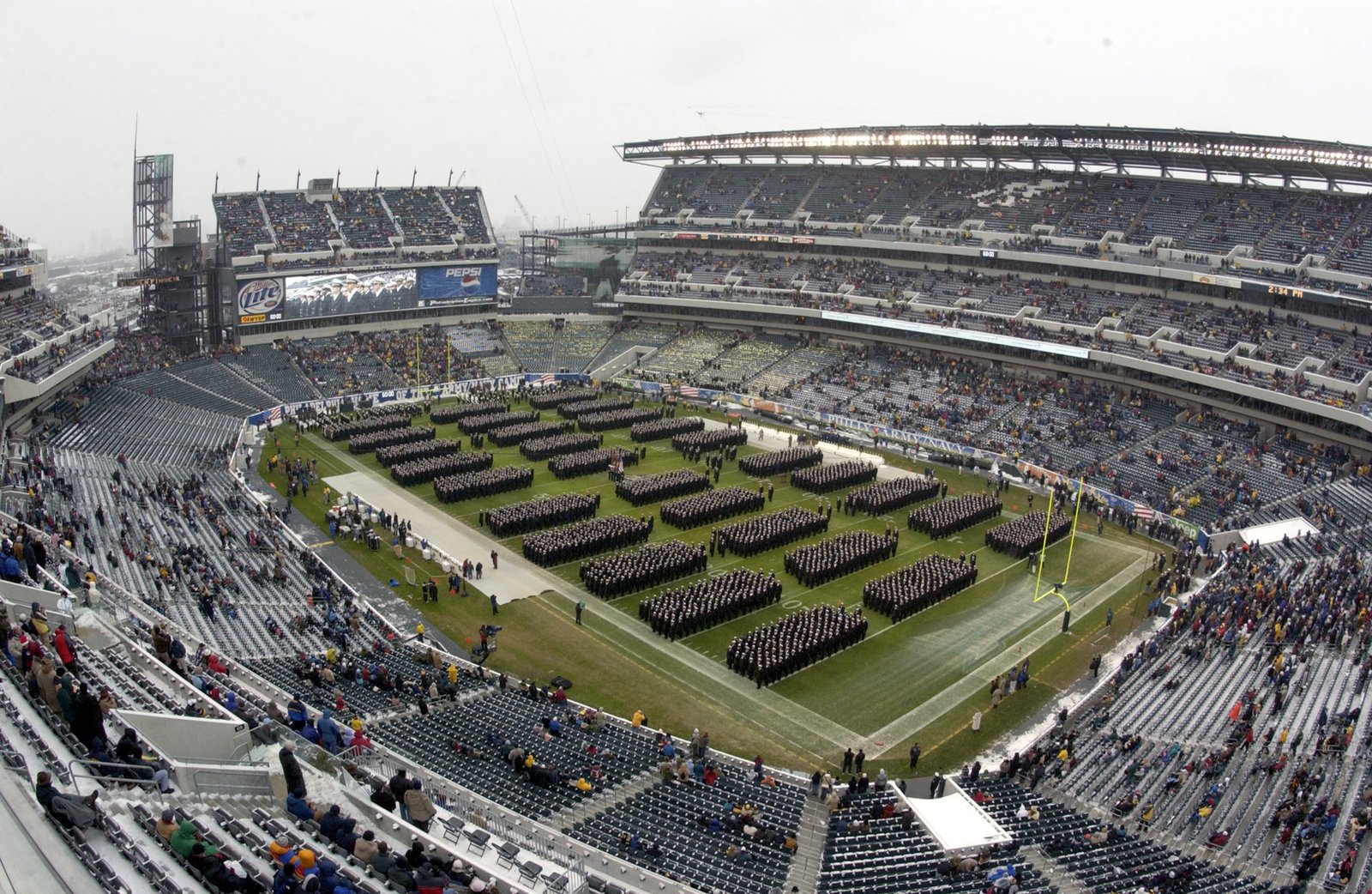
Image credit: Damon J. Moritz, U.S. Navy, via Wikimedia Commons. Public domain. Unmodified archival photograph of Lincoln Financial Field before the 2003 Army-Navy game; it does not depict the 2026 Eagles.