Philadelphia’s decision to place Jalen Hurts on injured reserve on October 17 changed more than the quarterback depth chart. The Eagles used the resulting active-roster opening for running back Jaydon Blue, after adding quarterback Joe Milton a day earlier. Read together, those moves show a team addressing an absence through the whole roster rather than treating each departed player’s spot as the property of his position.
The confirmed transactions establish who is available to the organization. They do not establish how well the revised offense will function. TENS Magazine’s analysis is that Philadelphia’s most revealing personnel decision is the connection between the quarterback and running-back rooms: securing another quarterback first gave the team room to direct its next opening toward a different shortage.
What the sequence establishes
The Eagles’ official transaction record lists Milton’s arrival from the Dallas practice squad on October 16, alongside Will Shipley’s placement on injured reserve. On October 17, Philadelphia added Blue to the active roster and moved Hurts to injured reserve. The team’s accompanying announcement identified Tanner McKee as its starter against Carolina. The league’s own reporting also confirmed Hurts’ move.
That chronology matters because a roster is a shared allocation of places, even though football responsibilities remain specialized. The Eagles did not need to turn Hurts’ opening directly into another quarterback signing: they had already added Milton. Blue’s promotion therefore belongs in the explanation of how Philadelphia reorganized around the absence, even though a running back cannot replace the quarterback’s work.
This is an interpretation of the published sequence, not a claim about private deliberations. The documents do not reveal every alternative the coaches and personnel staff considered. They do let readers distinguish the order of the decisions from a simplistic one-player-out, same-position-player-in account.
The practice squad is now part of the operating plan
Blue’s promotion also fits a broader pattern in Philadelphia’s official ledger. Dameon Pierce moved from the practice squad to the active roster on October 7; Carson Steele followed on October 9. The club placed Tank Bigsby on injured reserve on October 6. Those entries provide context for the latest addition without requiring a prediction about the eventual distribution of carries.
For TENS Magazine, the significant comparison is between replenishing numbers and establishing a dependable rotation. Bringing several backs onto the roster supplies options. A working rotation requires the coaches to decide which combinations can execute the assignments needed on a particular down. The transaction list cannot tell us that those decisions have been settled, or that the newest arrival will receive the largest role.
Nor should repeated promotions automatically be read as evidence that the earlier ones failed. A team can need additional capacity because other players become unavailable. Evaluating each move solely by the next signing would confuse the reason for adding depth with a verdict on the players already there. Philadelphia’s dated record is useful precisely because it keeps the incoming and outgoing changes visible together.
Read each roster announcement at its own scale
Saturday’s announcement also included practice-squad elevations for outside linebacker Keyshawn James-Newby and safety Cole Wisniewski. Those game-specific additions were described separately from Blue’s active-roster signing. The distinction deserves to survive the headline: the club was making several kinds of personnel decision, not announcing one uniform wave of permanent replacements.
The practical editorial test is to ask what each announcement actually resolves. Blue’s signing establishes his place on the active roster. The elevations identify additional personnel for the Carolina game. Naming McKee establishes the announced starting choice. None of those statements, by itself, settles the number of offensive opportunities, defensive responsibilities or future starts a player will receive.
That is especially important when judging a newly assembled group. A box score can show production, but opportunity and responsibility help explain it. A reserve who gets few offensive touches has not necessarily failed his assignment; a player with one conspicuous gain has not necessarily established a lasting role. Those are questions for the game evidence and subsequent coaching decisions, not conclusions contained in a transaction notice.
Keep the health question separate
Hurts’ roster designation is confirmed. This analysis makes no assessment of his condition and no forecast of his return. The team’s October 15 statement had already ruled him out against Carolina while it determined treatment; the October 17 transaction is the later personnel development. An administrative roster decision should not be converted into a medical prognosis.
Philadelphia’s challenge is consequently broader than finding a temporary name at quarterback. The club must turn additions made on different dates and for different purposes into a functioning group. Its published moves explain how it created options. Whether those options produce reliable football remains a separate test, and the evidence should be judged at the level of the jobs the players actually perform.
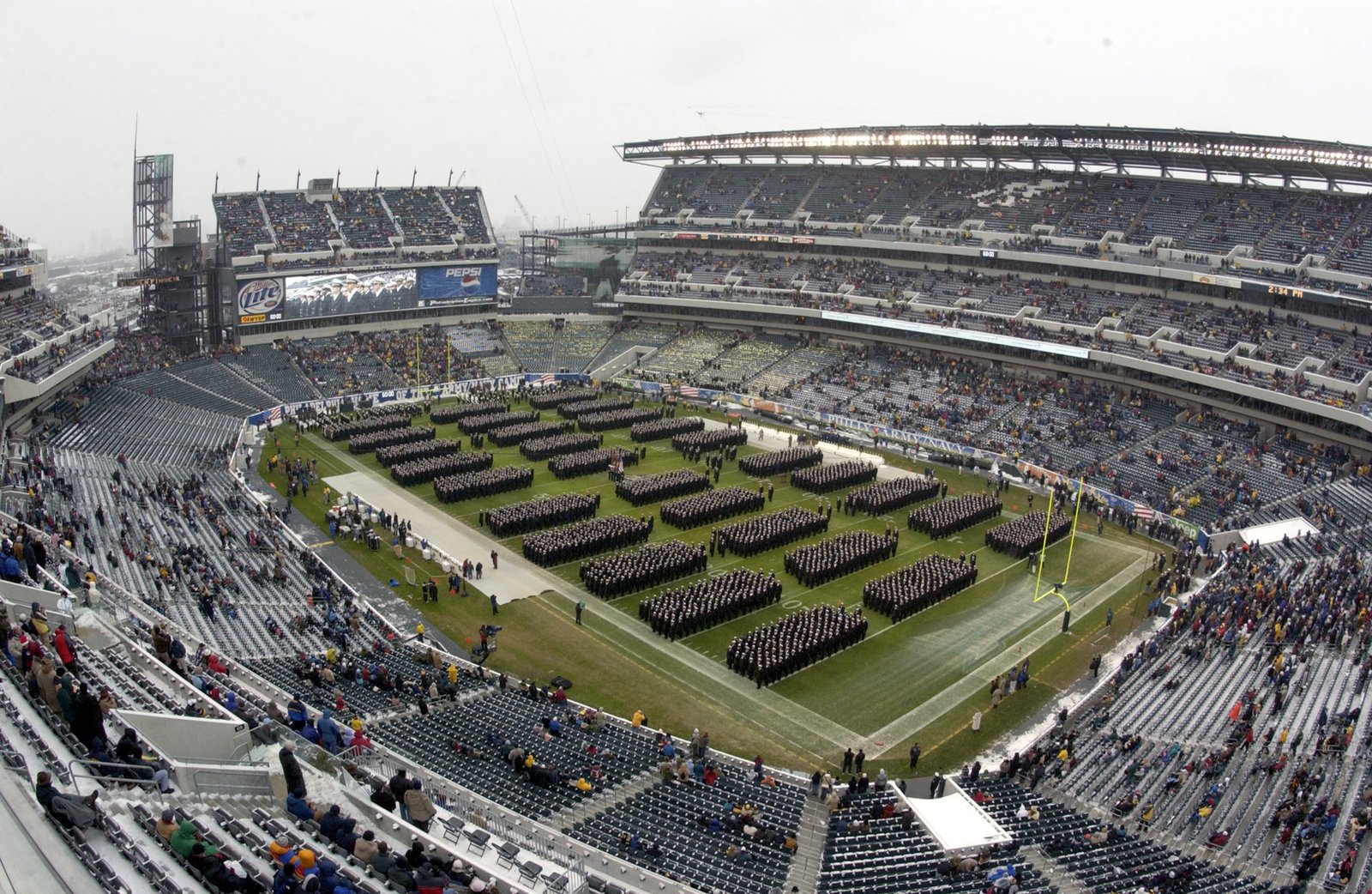
Image credit: Damon J. Moritz, U.S. Navy, via Wikimedia Commons. Public domain. Archival photograph of Lincoln Financial Field before the 2003 Army-Navy game; it does not depict the 2026 Eagles. No editorial alterations; resized and cropped for display.