Bralen Trice is finally taking regular training-camp work with the Atlanta Falcons, a development that matters less as a comeback slogan than as a change in how the club can build its defensive front. Atlanta’s official team site reported Friday that the third-year edge defender is on the field and feeling strong after injuries erased his first two NFL seasons.
The confirmed news is deliberately narrow. Trice is practicing. He participated in full 11-on-11 work during mandatory minicamp in June, and veteran defensive end Samson Ebukam has praised the economy and fluidity of his movement. None of that guarantees a role, a roster position or production in September. It does, however, move Trice from the rehabilitation column into a crowded football competition.
What Atlanta actually has
Trice entered the league as Atlanta’s third-round selection in 2024 after twice earning defensive MVP honors at Washington. A knee injury in his first preseason game ended his rookie season. He returned the following summer, made the initial 53-man roster and then went to injured reserve after the knee was aggravated. He did not appear during the 2025 season.
That history makes one distinction essential: availability is now a fact, while effectiveness remains an open question. The Falcons can evaluate Trice in live football situations again. They cannot treat two summers of interrupted evidence as proof that he will reproduce the promise he showed as a rookie.
TENS analysis: a roster addition without a transaction
Atlanta did not sign a player Friday, but Trice’s return has some of the same roster-building effects. It adds another usable body to a position group that lost meaningful snaps and pressure production during the offseason. Leonard Floyd and Arnold Ebiketie departed after combining for 60 pressures in 2025, according to figures published by the Falcons.
The front office answered with volume rather than a single replacement. Azeez Ojulari, Cameron Thomas and Ebukam arrived as veterans. Jalon Walker, James Pearce Jr. and DeAngelo Malone returned. Trice now joins that mix as a player whose professional résumé is almost entirely projection but whose familiarity with the system and organization is already established.
That creates a useful asymmetry for Atlanta. The defense does not need Trice to rescue an empty depth chart. It needs him to compete for a defined share of a rotation. A modest role that preserves speed across a long game could be valuable even if he never becomes a full-time starter.
Why the rotation matters
The Falcons’ edge group generated pressure on 13.5 percent of its pass-rush snaps in 2025, 10th among NFL edge units, according to NFL Next Gen Stats cited by the team. The group also averaged 4.5 seconds to record a sack, the league’s third-fastest mark, while the defense set a franchise season record for sacks.
Those numbers describe a functioning ecosystem, not a vacancy waiting for one player. Defensive coordinator Jeff Ulbrich can distribute assignments by situation, keep rushers fresher and force opponents to prepare for different movement profiles. The return of Trice expands those choices. It does not automatically improve them.
The practical question is therefore not whether Trice can “replace” Floyd or Ebiketie. Their combined 2025 work cannot be assigned to one returning player by declaration. The better test is whether Atlanta can divide those vacated snaps among several defenders without losing the pressure rate and finish speed that made the front productive.
TENS analysis: the tape must replace the projection
Training camp offers a clean evaluation sequence. First comes repeated participation, then work against starting-caliber blockers, then assignment discipline in padded practices, and finally preseason snaps. Each checkpoint supplies evidence the previous one cannot.
That sequence also protects the analysis from outrunning the facts. Trice’s presence is consequential because Atlanta finally gets to judge him as a football player instead of as a rehabilitation timeline. His college résumé and rookie-camp flashes explain why the evaluation is interesting; they do not settle it.
For the Falcons, the encouraging part is structural. A defense that produced pressure last season can audition Trice without making him the entire plan. For Trice, the opportunity is simpler and harder: stack healthy practices, earn rotational snaps and let current tape replace two years of unanswered questions.
Sources: Atlanta Falcons training-camp report published July 31, 2026; Atlanta Falcons 2026 outside-linebacker training-camp preview; Atlanta Falcons mandatory-minicamp practice report.
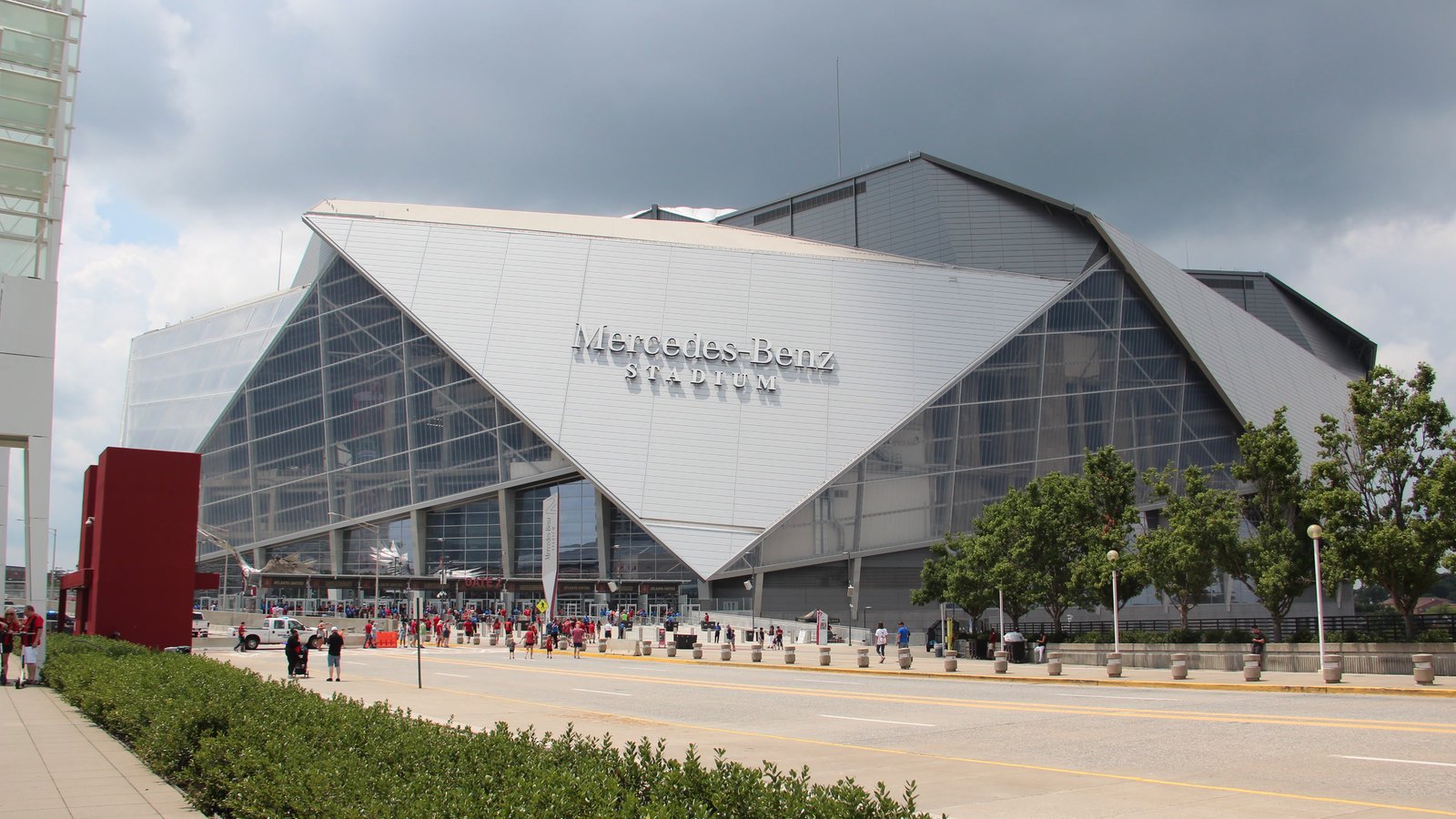
Featured image: Mercedes-Benz Stadium in Atlanta. Photo by Thomson200 via Wikimedia Commons. License: CC0 1.0 Universal Public Domain Dedication. Cropped from the original 3:2 photograph to 16:9 and resized.