Tampa Bay’s claim of cornerback Kevin Knowles looks modest on a transaction list. Read as a sequence, it is a useful example of how the first 53-player roster becomes a working document almost immediately. Kansas City kept Knowles through the initial reduction, then waived him after winning two claims of its own. Tampa Bay claimed Knowles and opened his place by waiving rookie linebacker Caden Fordham. One roster decision therefore moved through three clubs and several position groups before the week was over.
The confirmed facts are narrow. The Buccaneers announced on September 2 that they had claimed Knowles from the Chiefs and waived Fordham. Kansas City’s official August 31 roster notice records that it claimed defensive tackle Bryson Eason and defensive end Jack Pyburn while waiving Knowles and defensive tackle Marcus Harris. The NFL transaction ledger provides the league-level record. None of those entries promises Knowles a defensive package, a game-day uniform or a permanent place on Tampa Bay’s roster.
A claim built around two jobs
The football logic is broader than the position label. Tampa Bay’s official roster report said the club had reduced the active secondary to eight players, while allocating five practice-squad places to defensive backs. Knowles adds an active-roster cornerback, but head coach Todd Bowles identified his immediate attraction in the kicking game. With Josh Hayes on injured reserve, Bowles said Tampa Bay was short of a gunner and described Knowles as capable in punt and kickoff coverage.
That makes the claim a two-job transaction. Knowles supplies another cornerback to a deliberately lean active secondary and a candidate for a coverage role that can determine field position without appearing in a defensive snap count. The two functions should not be collapsed into a prediction that he will become a regular defender. His place in the secondary remains an evaluation; his prior special-teams work explains why Tampa Bay was willing to alter the 53 now.
The Buccaneers reported that Knowles appeared in 13 games for Kansas City as a rookie in 2025, played 70 percent of the Chiefs’ special-teams snaps when active and recorded 10 kick-coverage tackles. A later Tampa Bay update split that total into eight solo coverage tackles and noted a fumble recovery. Those figures do not forecast the same production in a new system. They do show that the claim is supported by recent NFL work in the phase Bowles emphasized.
The waiver chain matters
The move is best understood as a three-stage allocation chain. Kansas City first valued Knowles highly enough to keep him through the initial cut. The Chiefs then prioritized two defensive waiver claims and released Knowles as one of the corresponding moves. Tampa Bay used its own waiver position a day later to move him onto its active roster, displacing Fordham. That chronology separates the transaction from the familiar but inaccurate idea that an initial 53 is a finished depth chart.
It also prevents a simplistic winner-and-loser reading. Kansas City did not merely discard a cornerback; it used two roster spots for Eason and Pyburn after the league-wide cut exposed new options. Tampa Bay did not acquire Knowles without cost; it surrendered its current control of Fordham, who had also survived the first reduction. The relevant comparison is not Knowles against an empty slot. It is Knowles’ combined secondary and coverage utility against the developmental linebacker option Tampa Bay placed on waivers.
Three observable tests will determine whether the claim works as intended. First is game-day activation: special-teams value only reaches the field if Knowles dresses. Second is assignment share: his coverage snaps will show whether the gunner need identified by Bowles becomes a real role. Third is roster durability: Tampa Bay’s decisions after injured players become eligible to return will reveal whether the claim solved a temporary shortage or earned a longer place. These are evaluation points, not promised outcomes.
Why the timing is the story
The timing carries the larger lesson. Cutdown weekend creates a temporary league-wide market in which clubs are evaluating their own players and everybody else’s at once. A player can make one initial roster and still become available after that team succeeds on another claim. The next club is then deciding not only whether it likes the player, but whether his role is more useful than the player it must expose in response.
For Tampa Bay, that role crosses defense and special teams at a moment when the active secondary is light and a proven coverage contributor is unavailable. For Kansas City, the same roster space became part of a different defensive reallocation. The claim does not settle Kevin Knowles’ place in the Buccaneers’ defense. It shows how quickly a team can turn a narrow special-teams need into an active-roster decision—and how every answer on the 53 creates another question somewhere else.
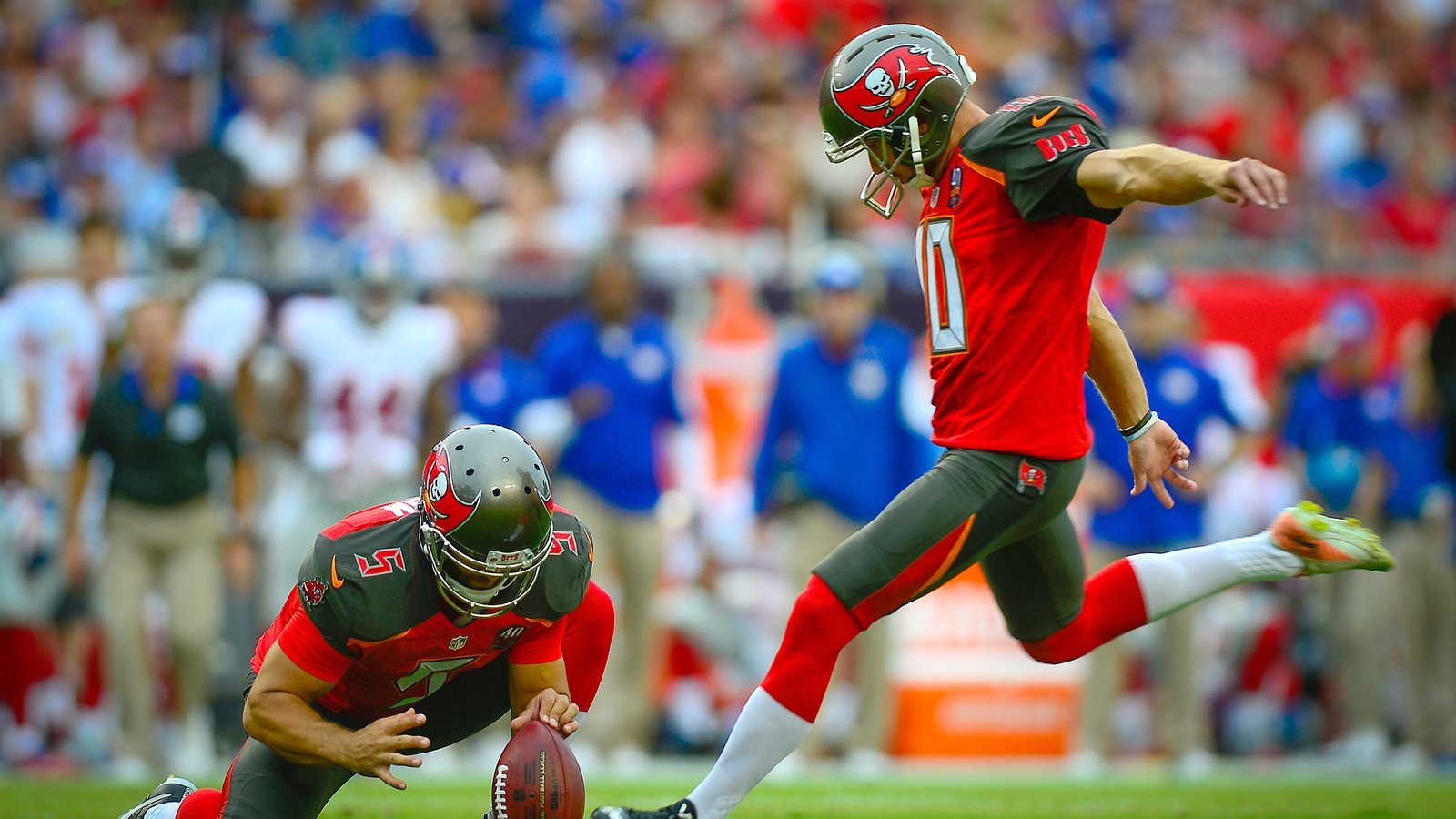
Image credit: Connor Barth attempts a field goal for Tampa Bay at Raymond James Stadium. U.S. Air Force photo by Senior Airman Ned T. Johnston via Wikimedia Commons. License: Public domain, U.S. Air Force work. Modifications: cropped from 3,509 × 2,335 pixels to a 3,509 × 1,974-pixel 16:9 frame, then resized to 2,400 × 1,350 pixels.