Dallas left Philadelphia with a 38–21 win on October 26 and a rushing performance that deserves a closer look than the final total. Javonte Williams gained 155 yards on 25 carries, while the Cowboys finished with 204 rushing yards. Those numbers describe a productive night. The more consequential question is what kind of evidence they offer for an offense trying to make its ground game dependable.
TENS Magazine’s analysis is that Dallas demonstrated two different uses for the run: creating opportunities while the result remained unsettled, then completing a short field after the defense supplied it. Separating those jobs gives the Cowboys a more useful standard for their next performance than simply demanding another large carry total.
A big run did not account for the whole night
The Eagles’ official box score lists Williams’ longest run at 34 yards. Subtracting that gain from his 155-yard total leaves 121 yards on 24 attempts, or about 5.0 yards per carry. This is a TENS calculation from the published figures. It shows that his production was not confined to one unusually long gain.
The same check on Dallas’s team total leaves 170 yards on 37 carries after removing that run, approximately 4.6 yards per attempt. Neither calculation is an advanced efficiency metric, and removing the best play is deliberately selective. Its value is narrower: it tests whether one highlight supplied most of the statistical case for a strong rushing performance. Here, it did not.
Averages still cannot tell us how often a runner gained enough for the situation. Five yards on first down and five yards on third-and-eight appear identically in a rushing average while producing different football outcomes. The appropriate follow-up is to examine down, distance and field position, rather than turn the adjusted average into proof that every series stayed on schedule.
NFL reporting provides another piece of that picture. Its account, citing Next Gen Stats, credits Williams with four carries of at least 10 yards and eight forced missed tackles. That supports a combination of repeated gains and work beyond the initial contact opportunity. It does not allocate credit precisely between blocking, defensive mistakes and the runner’s decisions.
The lead still required passing finishes
The official scoring summary provides an important counterweight to the rushing totals. Dallas’s first three touchdowns came on Dak Prescott passes: two to CeeDee Lamb and one to George Pickens. The box score records three passing touchdowns without an interception. The running game gave this offense a productive way to advance, but the touchdown passes remained central to converting that movement into points.
That distinction should shape how the performance is reviewed. A team can become more balanced without asking both phases to produce identical yardage or identical scoring totals. The useful question is whether the available calls offer credible answers in different situations. Monday’s outcomes support the value of both phases; they do not establish which specific defensive reactions caused each completion.
The third quarter is the clearest example of the challenge Dallas answered. Philadelphia went ahead 21–20 before the Cowboys moved back in front on Lamb’s 16-yard touchdown reception and Prescott’s two-point conversion. Dallas’s official recap reports 24 rushing yards on that answering drive. The ground game contributed while Dallas needed to reclaim the lead, rather than only after the score made running convenient.
That matters because a high final carry count can reflect several things: early effectiveness, a coaching commitment, available possessions or a favorable late score. The answering drive establishes a specific role for the run during a competitive moment. It is stronger evidence of offensive flexibility than the carry count considered alone.
Closing work deserves its own evaluation
Dallas’s final touchdown came in a different setting. The Eagles’ scoring summary records a six-play, 16-yard possession lasting 2:27. The Cowboys’ recap identifies six consecutive Williams carries after Philadelphia failed on fourth down. By then Dallas led 31–21. The assignment was to capitalize on excellent field position and make Philadelphia’s remaining time less useful.
A short-field finish should therefore be evaluated differently from a drive across most of the field. It demands fewer yards, but converting it can remove a plausible route back into the game. Counting that possession as ordinary evidence of sustained, long-field offense would overstate what it demonstrates; dismissing it because the distance was short would miss its practical importance.
For Philadelphia, the review must separate those situations too. The defense needs answers for the ground gains that helped Dallas move before the final short field, as well as the passing plays that finished earlier touchdowns. For Dallas, the next test is whether the running game continues to provide usable choices when field position and score are less accommodating. Monday supplied substantial evidence of progress. The standard worth carrying forward is a run game that helps create favorable circumstances and can then exploit them.
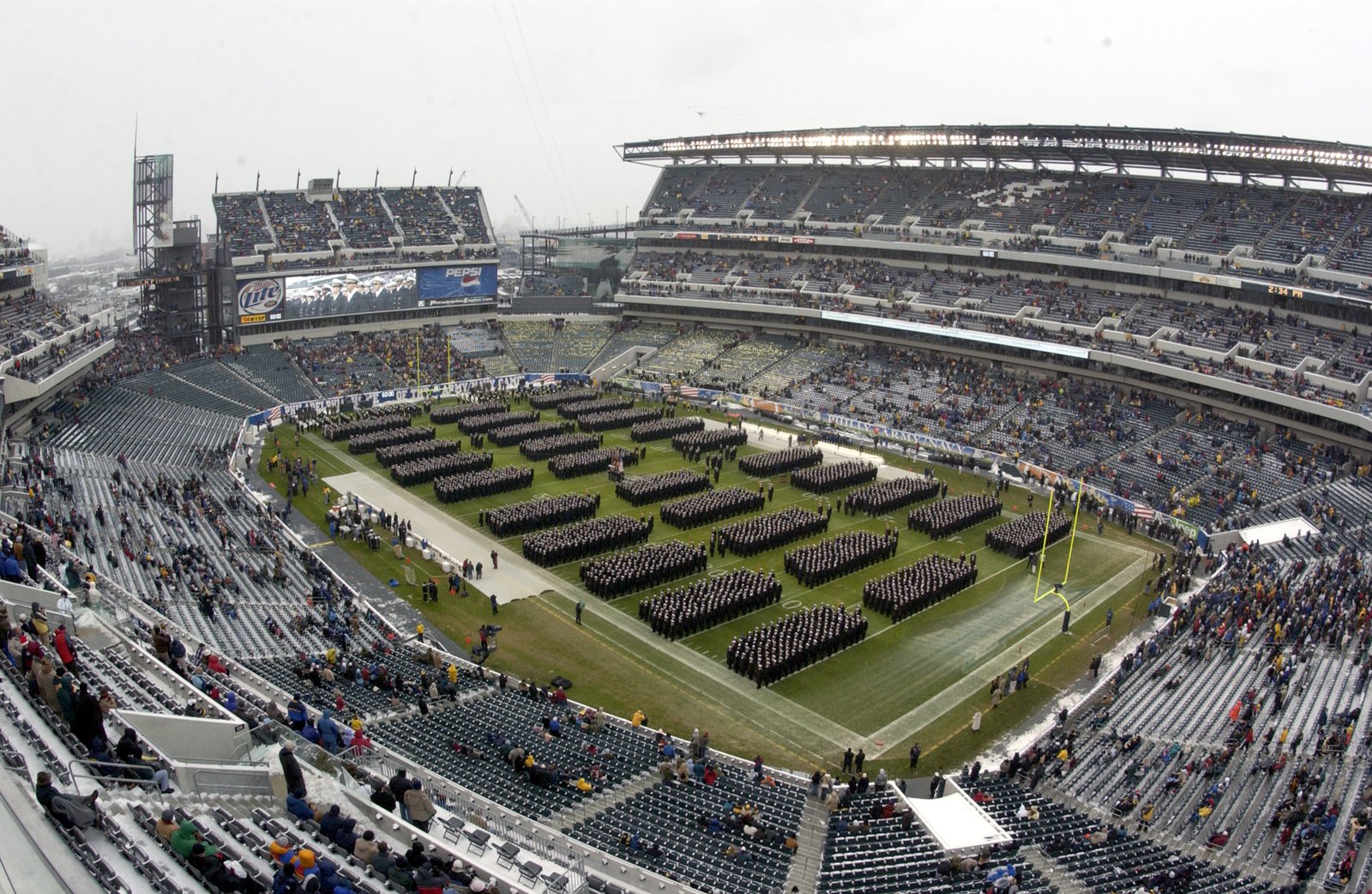
Archive image: Lincoln Financial Field before the 2003 Army-Navy game; this photograph does not depict the October 2026 game. Photo by Damon J. Moritz, U.S. Navy, via Wikimedia Commons. License: Public domain. Modifications: no editorial alterations; resized and cropped for display.