A new irrigation-AI paper puts a useful distinction in focus: keeping farm sensors communicating efficiently and deciding how much water a crop needs are connected engineering problems, but they require different evidence. Treating success in the first as proof of success in the second would make a promising system harder to judge.
Published October 8 in Scientific Reports, the study by Ze Luo and colleagues introduces IrrigaDL-FL. Its abstract describes a framework combining deep learning and fuzzy logic for network routing with a separate controller for irrigation decisions. The publisher identifies the release as an early version of accepted, peer-reviewed research that remains subject to editing.
TENS Magazine’s analysis is that irrigation AI should be evaluated with a linked record of communication reliability, watering decisions and crop outcomes. That comparison makes the new work relevant without turning its reported simulation results into an unsupported claim about water saved on farms.
Follow the decision beyond the sensor
The researchers describe routing designed to choose efficient paths between network nodes. Their irrigation controller uses information including soil moisture, weather, rainfall history and crop development to determine watering programs and sprinkler duration. The abstract reports simulations comparing network lifetime, remaining energy, energy variation, transmitted packets and path length with other approaches.
Those are useful measures of the communications layer. They do not, by themselves, tell a reader how much irrigation water reached a field or what happened to its harvest. A network can become more economical while the watering rule remains unchanged. Conversely, a better watering rule could depend on communications that prove difficult to maintain. These possibilities should remain separate in any assessment.
A practical evaluation would therefore attach each irrigation decision to the measurements that informed it. It should record when the measurements were taken, whether any were missing, what duration the controller requested and what the equipment actually delivered. This is a proposed test of the whole system, not a claim that the paper’s authors have already performed it.
Agronomy provides a reference point
The Food and Agriculture Organization’s crop-water guidance supplies a useful baseline. Under its stated standard conditions, crop evapotranspiration is calculated by multiplying reference evapotranspiration by a crop coefficient. The guidance adjusts the coefficient across growth stages and explains that local observations should inform development timing. Evapotranspiration accounts for water leaving through plant transpiration and soil evaporation.
This matters because a sophisticated controller still needs an interpretable account of changing crop demand. If an AI system recommends a different schedule from a conventional crop-water calculation, the difference should be explainable through the conditions it observed or the objective it was given. Disagreement is an opportunity for investigation, rather than automatic evidence that either method is superior.
TENS proposes that comparisons retain the underlying inputs alongside the final recommendation. A reviewer should be able to distinguish a changed weather estimate from a changed crop-stage assumption or an actual change in the controller’s behavior. Otherwise, a performance comparison risks crediting the algorithm for advantages supplied by fresher or more detailed measurements.
Automation already has a field benchmark
Earlier U.S. Department of Agriculture research helps place the new framework in context. An Agricultural Research Service account published in April 2013 describes automated irrigation based on crop-temperature sensing and work on soil-water sensors. Its account of a two-year sorghum study reports similar grain yields and water-use efficiency for automated and manual scheduling at both full and deficit irrigation levels.
That historical result is not a direct comparison with IrrigaDL-FL. It involved another system, crop and experimental setting. Its value here is methodological: an automated controller can be assessed through harvest and water-use outcomes, rather than only through the operation of its electronics. It also shows why automation itself should not be treated as a new agricultural result.
A future evaluation of the new framework could compare it with a clearly specified conventional scheduler under matched conditions. Reporting water applied, yield, measurement coverage and operator intervention together would make tradeoffs visible. Using less water would need to be considered alongside crop performance; maintaining performance with less manual work would be a different benefit worth measuring in its own right.
Make failure behavior part of the result
The most revealing comparison may include imperfect operation. TENS would look for an explicit account of what happens when a soil measurement is stale, a communication path disappears or requested watering does not occur. A system that reports its uncertainty gives an operator a basis for intervention. A successful simulation cannot substitute for observing those situations in deployment.
The October study brings communications and irrigation control into the same design. The next useful evidence would connect their results without collapsing them into one score. Readers should be able to see which improvement belongs to the network, which belongs to the decision rule and which survives measurement in the field. That is how an AI architecture can become an assessable agricultural tool.
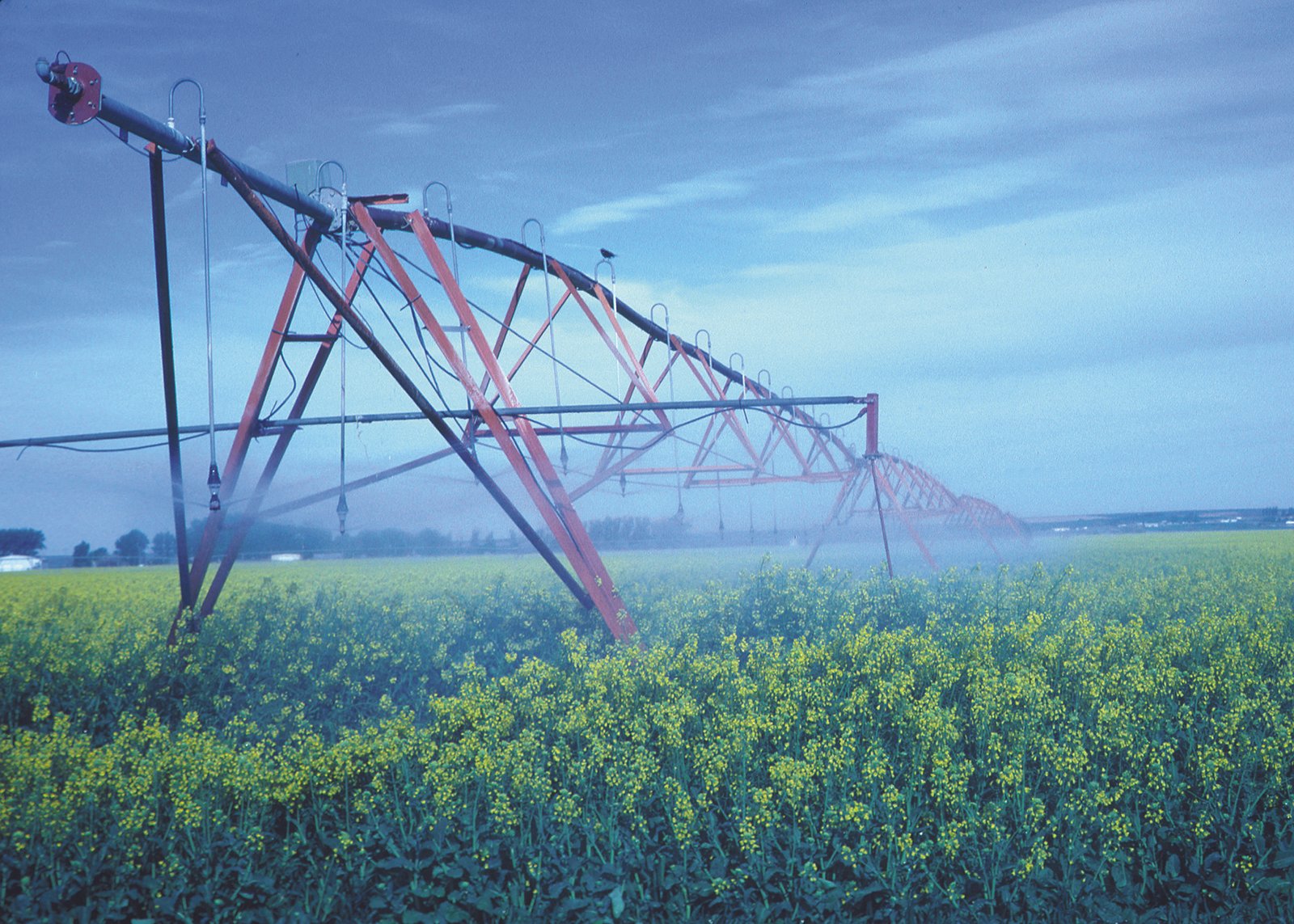
Image: Archival center-pivot irrigation photograph by Chad Swank, USDA Natural Resources Conservation Service, via Wikimedia Commons. Public domain. Original uploaded without alteration; cropped by the site for display. The photograph does not depict the study’s system.