
Microsoft is pushing artificial intelligence from the role of security assistant toward a more active place in cyber defense. The company has introduced Project Perception, a system that coordinates specialized AI agents to identify weaknesses, investigate threats, and help remediate problems across an organization’s digital environment.
The July 27 announcement describes a closed-loop structure with three teams. Red agents search for routes an attacker could use. Blue agents investigate signals and decide which findings represent meaningful risk. Green agents act on those findings by correcting weaknesses and hardening defenses. Microsoft says Project Perception will enter public preview on August 3.
From isolated alerts to coordinated action
The architecture reflects a familiar problem for security operations centers: a single alert rarely provides enough context for a good decision. Defenders must connect identities, devices, applications, cloud services, previous incidents, policy choices, and threat intelligence before deciding what deserves attention.
According to the Project Perception product overview, the agents share a continuously updated security context drawn from endpoints, identities, clouds, and applications. An orchestration layer coordinates agents and models, while “actuators” connect a decision to an action inside Microsoft’s security products. At launch, Microsoft says the coordinated defense system will be available through Microsoft Defender.
That design makes governance central rather than optional. Microsoft says defenders set objectives and guardrails, critical actions remain subject to human approval, and decisions can be traced and replayed. Those controls will matter because an automated remediation can be consequential: disabling an account, changing a configuration, or applying the wrong patch can interrupt legitimate work even when the system is trying to reduce risk.
A specialized model for vulnerability work
Project Perception is designed to use multiple models instead of routing every problem to the largest available system. Its first specialized component is MAI-Cyber-1-Flash, a compact, code-focused model integrated into MDASH, Microsoft’s multi-agent system for finding, validating, and remediating software vulnerabilities.
In a separate Microsoft AI technical announcement, the company says MAI-Cyber-1-Flash can handle as much as 90% of MDASH tasks, leaving the hardest 10% for larger models. Microsoft reports that a configuration combining MAI-Cyber-1-Flash with GPT-5.4 scored 95.95%, rounded to 96%, in its CyberGym evaluation. It also says the configuration cut costs by 50% compared with its previous MDASH model mix.
Those figures are vendor-reported results for a particular model-and-agent configuration, not a universal measure of cybersecurity performance. The independent CyberGym research project, created by UC Berkeley researchers, contains 1,507 historical vulnerabilities across 188 software projects. Its main task asks an agent to generate proof-of-concept tests that reproduce known vulnerabilities from descriptions and unpatched code. That is a demanding and useful test, but it is narrower than operating a live enterprise defense program.
Why the multi-model approach matters
Cyber defense is continuous, so the cost and speed of each model call can become operational constraints. Sending routine analysis to a smaller specialist and escalating difficult cases resembles the way human security teams divide work by complexity. If the routing is reliable, the approach could let agents examine more code and signals without applying frontier-model costs to every step.
Specialization also creates new evaluation questions. A high aggregate score can hide which vulnerability classes remain difficult, how often an agent produces a false alarm, or whether a proposed fix introduces a regression. Security teams will need evidence that covers detection, validation, remediation, rollback, and normal software behavior—not only a single success percentage.
The same caution applies to the red, blue, and green agent loop. Coordination can reduce handoffs, but it can also propagate an early mistake from discovery into investigation and action. Human approval, audit trails, constrained permissions, and sandboxed execution are therefore part of the product’s substance, not administrative details around it.
What the preview will need to prove
Project Perception represents a larger shift in enterprise AI: systems are being asked to perform sequences of work rather than simply answer questions. Cybersecurity is a revealing test because speed has real value, but errors can have immediate consequences.
The public preview should make it possible to judge whether Microsoft’s agents can prioritize genuine threats, explain their reasoning clearly enough for defenders to review it, and recommend actions that hold up in production. It should also show how much human attention the system saves after false positives, exceptions, and approvals are counted.
Microsoft’s announcement does not establish that autonomous security has arrived. It does show where the industry is heading: teams of specialized models sharing context, dividing work, and connecting analysis to action. The important measure will be whether that coordination makes defenders more effective while preserving the judgment and control that consequential security decisions require.
Sources: Microsoft Project Perception announcement; Microsoft AI announcement for MAI-Cyber-1-Flash and MDASH; Microsoft Security Project Perception overview; UC Berkeley CyberGym research project.
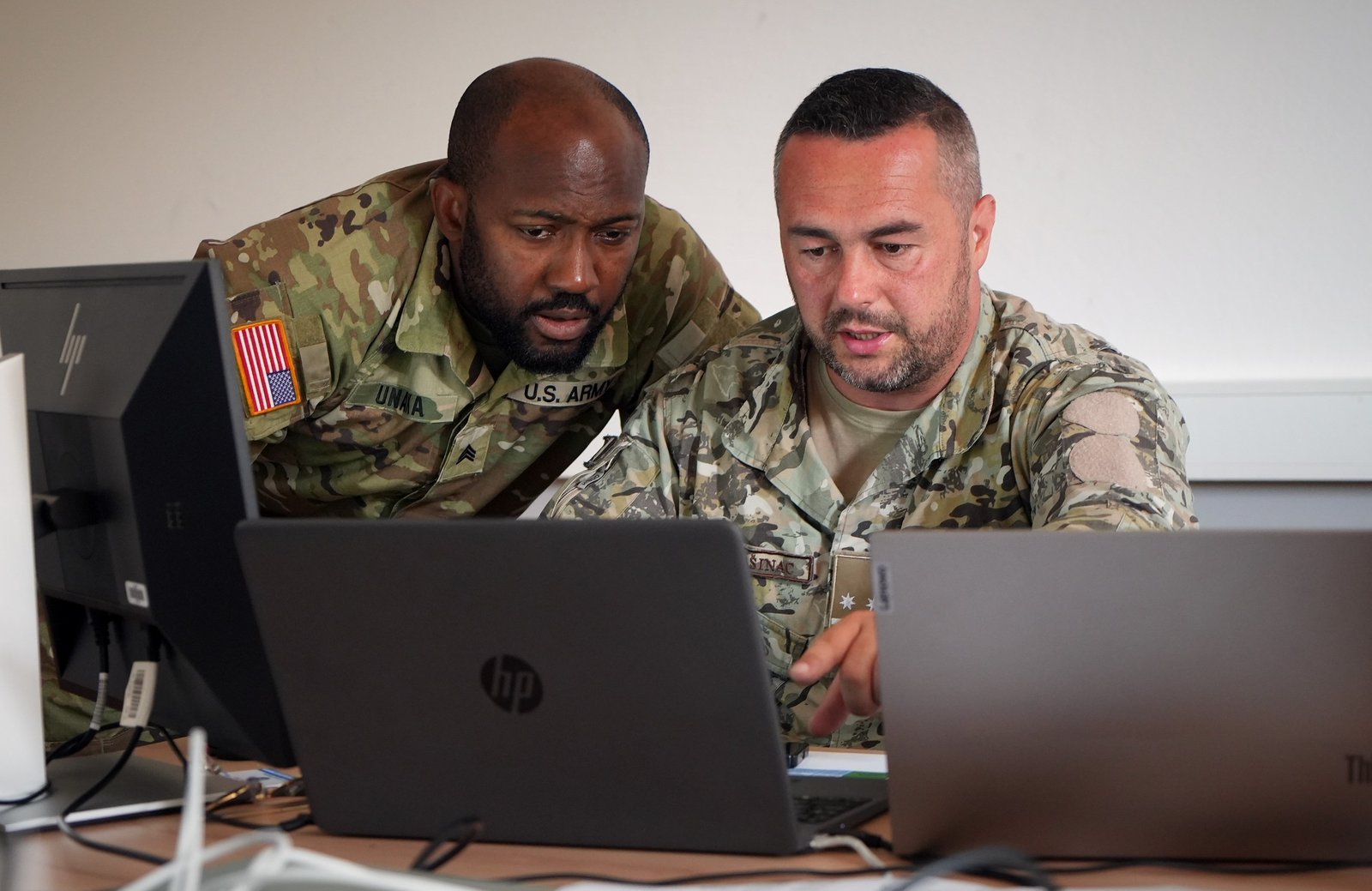
Featured image: Cyber threat intelligence analysts from the Maryland Army National Guard and the Armed Forces of Bosnia and Herzegovina work as a blue team during the Adriatic Regional Security Cyber Cooperation exercise in Slovenia in July 2024. Photograph by Maj. Benjamin Hughes, U.S. Air National Guard, via Wikimedia Commons. Original source: DVIDS. License: Public domain (PD-USGov-Military-National Guard). Modifications: None.

.jpg)