By The TENS Magazine Editorial Staff
OpenAI has sharply reduced the price of two GPT-5.6 models, turning an infrastructure improvement into a direct challenge to how businesses budget for artificial intelligence. Beginning July 30, the company says GPT-5.6 Luna costs 80 percent less and GPT-5.6 Terra costs 20 percent less in the API. One million input tokens now cost 20 cents with Luna, while one million output tokens cost $1.20. Terra charges $2 for the same input volume and $12 for that output volume.
The pricing headline is dramatic, but the strategic change is larger: AI competition is moving from model capability alone toward the cost of completing an entire job. For companies deploying agents, the important unit is no longer a token in isolation. It is a successful task after the model reads context, calls tools, corrects mistakes and produces a usable result.
Lower prices come from more than a smaller model
OpenAI attributes the reductions to work across model training, inference software and the agent system that manages tools and context. In an engineering account published July 29, the company said GPT-5.6 Sol helped rewrite production computing kernels and that the resulting work reduced end-to-end serving costs by 20 percent. It also reported more than a 15 percent improvement in token-generation efficiency from experiments on speculative decoding.
Those are company-reported figures, not an independent audit of OpenAI’s infrastructure. Still, they reveal the mechanism behind the price move. Better routing can keep accelerators busy, caching can avoid recomputing repeated prompts, and more efficient code can produce more output from the same hardware. The model’s behavior matters too: an agent that reaches a result with fewer requests and less repeated context can be cheaper even before the list price changes.
OpenAI also replaced its Priority Processing option with a Fast mode for GPT-5.6 Sol. The company says Fast mode can deliver up to 2.5 times the speed of standard processing at twice the price, without changing model intelligence. That creates a clear trade: a customer can pay a premium when waiting has a business cost, while routine workloads stay on standard service.
TENS analysis: what the new rates mean in practice
Consider a monthly workload that sends 100 million input tokens and receives 10 million output tokens. At OpenAI’s new published rates, that workload would cost $32 on Luna or $320 on Terra. Based on the announced percentage cuts, the same token volumes would have cost $160 on Luna and $400 on Terra before July 30. This TENS Magazine calculation excludes caching discounts, batch pricing, tool charges and any premium processing.
The calculation exposes a detail that the percentage headline can obscure. Output costs six times as much as input on both models. In the example, output represents only about 9 percent of all tokens but 37.5 percent of the bill. If output rises from 10 million to 25 million tokens while input stays fixed, the Luna bill climbs from $32 to $50 and the Terra bill from $320 to $500—a 56.25 percent increase in either case.
That means cheaper models do not eliminate the need for disciplined system design. Long answers, repeated retries and poorly bounded agent loops can consume the savings. Evaluation therefore has to measure task success, latency and total tokens together. A low-priced model that needs several attempts may be more expensive than a higher-priced model that succeeds once.
Benchmarks help, but they do not settle the budget
OpenAI compares the GPT-5.6 family on Agents’ Last Exam, an independent project led by UC Berkeley’s RDI. The benchmark is designed around long-running professional workflows with verifiable outcomes across 55 sub-industries. Its site says more than 1,500 tasks have been collected toward a target of 5,000, with contributions from more than 300 experts.
That breadth makes the benchmark more relevant than a narrow question-answering test, but it does not reproduce every company’s software, data quality, approval process or tolerance for error. OpenAI’s cost-per-task comparisons also depend on model settings and benchmark execution choices. Buyers should treat them as evidence to test, not as a substitute for their own evaluations.
The most important consequence of the July 30 change is therefore operational. Luna’s 80 percent cut makes it more plausible to assign high-volume classification, document handling and routine agent steps to a capable lower-cost model. Terra’s smaller reduction strengthens the middle tier. Sol remains the option for harder decisions, with Fast mode available when time is worth more than the processing premium.
This creates a portfolio approach to AI: use the least expensive model that reliably clears a defined quality bar, escalate when uncertainty rises and measure the entire workflow rather than the advertised token rate. OpenAI’s new prices widen the room for that strategy. Whether customers realize the savings will depend on how carefully they control outputs, retries and model routing.
Sources: OpenAI’s July 30 pricing announcement; OpenAI’s July 29 engineering account of GPT-5.6 efficiency; UC Berkeley RDI’s Agents’ Last Exam benchmark.
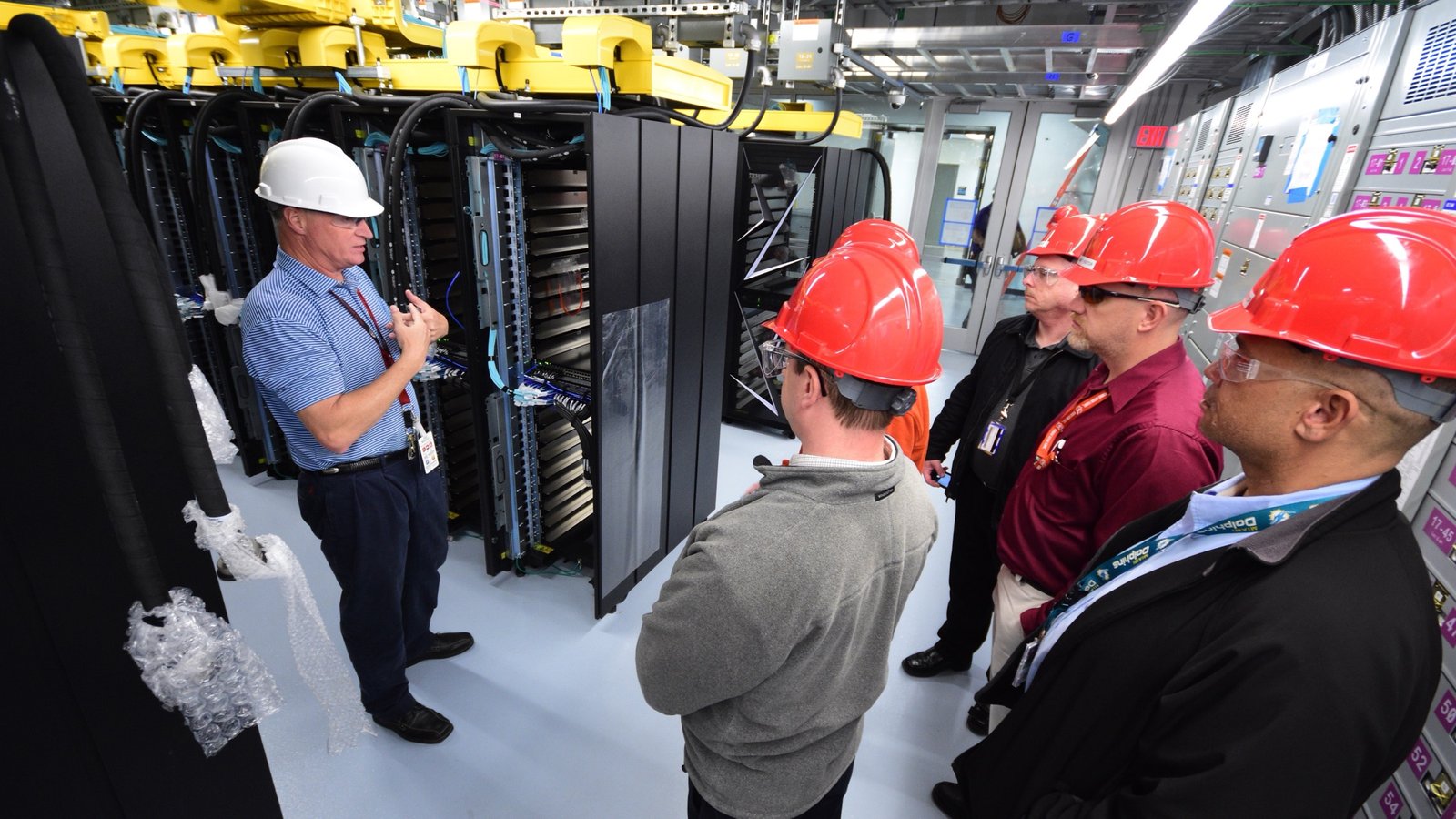
Featured image: A U.S. Department of Energy team views Summit supercomputer equipment at Oak Ridge National Laboratory. Credit: Lynn Freeny, U.S. Department of Energy Oak Ridge, via Wikimedia Commons. License: Public domain (U.S. Department of Energy). Modifications: cropped from 3:2 to 16:9 and resized to 2400 × 1350 pixels; no generative edits. The photograph is illustrative and does not depict OpenAI infrastructure.