By The TENS Magazine Editorial Staff
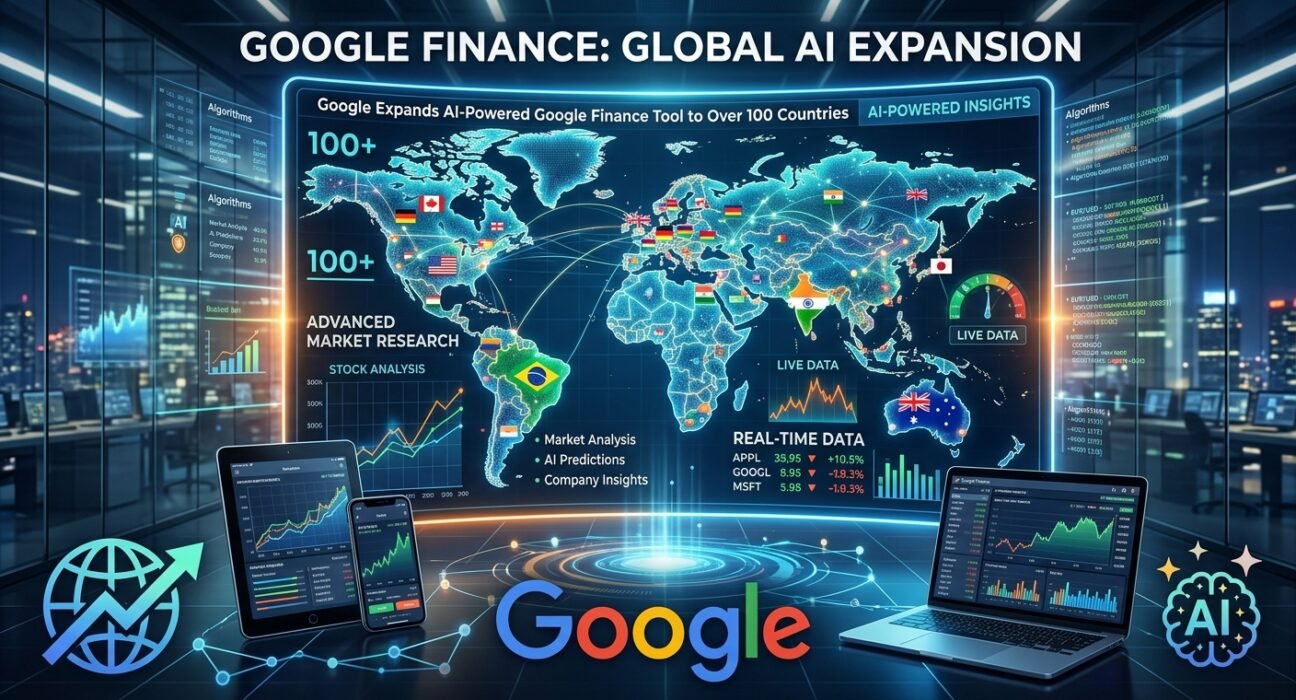
Google has officially expanded its artificial intelligence-powered Google Finance platform to users in more than 100 countries. The technology company is integrating advanced market research capabilities and real-time data processing into the financial tracking tool, marking a significant update to its consumer-facing financial services. This global rollout aims to provide both retail investors and financial professionals with enhanced access to comprehensive market analytics and economic data.
The integration of artificial intelligence into Google Finance represents a structural shift in how the platform processes and presents economic information. By utilizing machine learning algorithms and natural language processing, the updated tool can synthesize vast amounts of financial data, earnings reports, and market news. This allows users to access concise summaries of complex market movements and company performance metrics without needing to manually aggregate data from multiple financial publications.
Expanding the service to over 100 countries significantly broadens the reach of the financial technology infrastructure developed by Google. Previously, advanced features and specific real-time data sets were often restricted to select regional markets, primarily within North America and parts of Europe. The current expansion ensures that users across diverse geographic regions, including emerging markets in Asia, Latin America, and Africa, can access the same level of sophisticated market research and real-time equity tracking.
Real-time data delivery is a central component of the newly expanded Google Finance platform. The system tracks global stock indices, individual equities, mutual funds, currency exchange rates, and commodity prices with minimal latency. For investors operating in highly volatile markets, the ability to monitor real-time price fluctuations and immediate market reactions to geopolitical or economic events is a critical requirement. The artificial intelligence framework supports this by instantly contextualizing sudden market shifts, providing users with automated insights into the potential catalysts behind specific asset price movements.
The advanced market research functionalities introduced in this update are designed to streamline the investment analysis process. Users can utilize the AI-powered tools to compare historical performance data, evaluate company fundamentals, and assess broader macroeconomic trends. The system aggregates data from global stock exchanges, regulatory filings, and financial news networks, utilizing artificial intelligence to filter out noise and highlight relevant data points. This functionality bridges the gap between basic stock tickers and professional-grade financial terminals.
This expansion aligns with the broader corporate strategy of Alphabet Inc., the parent company of Google, to embed artificial intelligence across its entire software ecosystem. Following the deployment of generative AI models in Google Search and Google Workspace, the enhancement of Google Finance demonstrates the company’s commitment to applying these technologies to specialized, data-heavy domains. The financial sector, characterized by its reliance on rapid data processing and pattern recognition, serves as an optimal environment for demonstrating the practical utility of advanced machine learning models.
The competitive landscape for financial information services is highly saturated, with established entities such as Bloomberg, Reuters, and Yahoo Finance offering robust market research tools. By leveraging its proprietary artificial intelligence capabilities and its massive global user base, Google is positioning its finance platform as a highly accessible alternative. The integration with existing Google accounts allows users to seamlessly sync their investment portfolios, watchlists, and financial preferences across multiple devices, including smartphones and desktop computers.
Ensuring the accuracy and reliability of financial data remains a primary operational focus for the expanded platform. Because artificial intelligence models require strict parameters to avoid generating inaccurate information, Google has implemented rigorous data verification protocols within the Google Finance architecture. The AI tools are programmed to source information exclusively from verified financial exchanges, official corporate disclosures, and reputable financial news organizations, thereby mitigating the risk of presenting erroneous market data to investors.
The global deployment of the AI-powered Google Finance tool is currently underway, with the new features becoming progressively available to users in the supported countries. As the artificial intelligence models continue to process more global financial data, the system is expected to refine its analytical capabilities, offering increasingly precise market research and real-time insights to its expanding international user base.