Siemens’ latest factory AI announcement raises a practical question for manufacturers: how much of a simulated improvement survives contact with the production line? The company’s October 19 presentation at its Erlangen electronics plant connects AI-assisted inspection preparation with agent-assisted production planning. Those applications address different problems, and their results need different measures.
TENS Magazine’s analysis is that the useful unit of progress is a verified production decision. Preparing an inspection system sooner, choosing a workable schedule and reproducing those gains at another plant are separate achievements. Treating them separately makes the announcement more useful to readers than a single headline about autonomous factories.
Keep the two savings claims separate
Siemens says virtual preparation for new printed circuit board assemblies can reduce engineering effort by up to 85 percent. It also describes potential cost savings of up to 20 percent from agent-based production planning. These are company-reported upper-bound claims, not independently established averages across factories.
The denominators matter. Engineering effort measures work spent preparing production; planning costs concern a different activity and accounting boundary. Adding the two percentages would produce a meaningless figure. Even presenting them side by side without identifying the measured work could imply a factory-wide reduction the announcement does not establish.
Our proposed comparison starts with a fixed batch of products and orders. Count preparation hours, inspection outcomes, schedule changes and completed deliveries over the same period. Include the work needed to build and maintain the models. That would show whether time saved in one department reappears as extra checking or adjustment elsewhere.
Earlier inspection needs a later reality check
For inspection preparation, Siemens describes generating images of circuit board assemblies from digital twins so that vision systems can be trained before physical prototypes arrive. This moves an activity earlier in the development process. It does not, by itself, establish how reliably the resulting system distinguishes acceptable boards from defective ones.
A paper by Guodong Shao, Joe Hightower and William Schindel, hosted by the National Institute of Standards and Technology, provides a useful distinction. A digital twin needs evidence that it fulfills its intended purpose, together with an account of uncertainty. Its credibility must be assessed through its working life.
Applied here, that means separating preparation speed from inspection performance. Our suggested test would reserve real boards that were not used to develop the inspection system, then record missed defects and unnecessary rejections. Results should be broken down by defect type and product variant, because a strong overall score could conceal a weak spot that matters on the line.
This is an editorial proposal, not a claim that Siemens has failed such a test. The public announcement does not supply that detailed evaluation. Publishing it would help potential users judge where synthetic training images are sufficient and where additional physical examples remain necessary.
A better schedule still needs an accountable decision
In the planning workflow, Siemens says an AI agent produces alternative production scenarios and shows their effects to planners. Proposals are checked in a digital twin before implementation. This describes a process involving planners and simulation; readers should not infer that every production decision has become autonomous.
TENS proposes recording three points for each changed schedule: what the agent recommended, what the planner approved and what the factory actually delivered. Differences between those records would be informative. An operator’s correction might reveal a missing constraint, while a late delivery could expose an assumption about materials or equipment that no longer held.
Consider a hypothetical order arriving while a machine is unavailable. A simulation could favor a schedule that looks efficient using yesterday’s capacity data. The relevant question is whether the workflow detects the changed condition before work is committed. A faster recommendation has limited value if the underlying factory description is out of date.
The second factory is a different test
NIST’s research on standardized digital twins also identifies a broader obstacle: customized implementations can be expensive to develop, difficult to integrate and hard to reuse. Its manufacturing program emphasizes data management, validation and interfaces between systems. Those concerns explain why success at a development site does not automatically establish easy adoption elsewhere.
For a second plant, our proposed scorecard would distinguish reusable software from local reconstruction. Record how much machine information must be remapped, how many constraints need manual entry and how long validation takes before production staff trust the recommendations. A deployment that needs extensive rebuilding may still be valuable, but its economics differ from a readily transferable product.
The most consequential follow-up to Erlangen would therefore connect the advertised savings to observable outcomes: reliable inspections, schedules that remain workable as conditions change, and a measured effort to reproduce the system elsewhere. That evidence would let manufacturers assess which parts of factory intelligence are becoming reusable and which still depend on detailed knowledge of one particular floor.
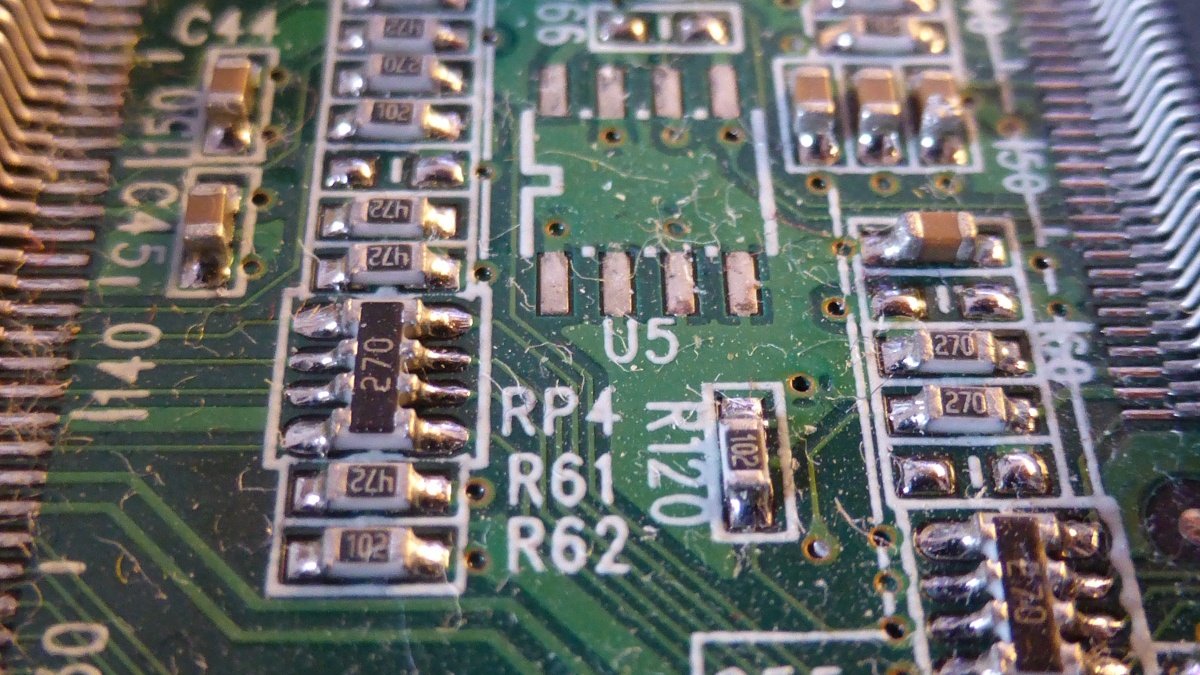
Illustrative photograph: circuit board from a D-Link 604 router, not Siemens equipment or the Erlangen factory. Photo: MartinThoma via Wikimedia Commons. CC0 1.0 Universal Public Domain Dedication. Cropped from 1,200 × 1,600 to 1,200 × 675 pixels; no generative edits.