CERN and Mistral have agreed to explore a shared AI model for particle physics. The consequential question is whether learning shared across scientific tasks can also produce evidence that scientists can check separately for each task. A model that helps identify particles has cleared a different hurdle from one that flags an unfamiliar collision as potentially interesting.
The October 15 announcement describes a statement of intent for a long-term partnership. Its proposed Large Physics Model would train on billions of simulated proton-proton collisions and support work including collision reconstruction, particle identification, searches for unexpected signals and detector design. Those are intended uses, not reported experimental achievements of a released system.
TENS Magazine analysis: The partnership should be assessed through the relationship between shared training and separate scientific accountability. Combining tasks can make an AI system more useful, but it does not make the evidence for those tasks interchangeable. Earlier research and CERN’s implementation roadmap help explain where the next meaningful demonstrations should occur.
Transfer needs a destination
There is already a concrete research precedent for transferring learned representations between physics tasks. In their 2024 OmniJet-alpha paper, Joschka Birk, Anna Hallin and Gregor Kasieczka demonstrated transfer from generating particle jets to tagging them. The paper also examined how physics data should be encoded for a transformer model, connecting the representation of the input to the quality of the resulting work.
That earlier result matters because it gives the new ambition a more demanding comparison than simply showing that AI can process collision data. The relevant question becomes what additional tasks benefit from common training, how much adaptation each requires, and what happens when the shared model is compared with a strong specialist.
Our proposed test is to publish a separate comparison for each intended use, keeping the evaluation data and available computing resources explicit. An improvement in one task should not conceal a regression in another. This would let researchers distinguish a broadly useful foundation from a collection of capabilities that happen to share a model name.
Simulated experience needs an independent check
The choice to train on simulated collisions creates a second distinction. CERN’s LHC@home explanation describes simulations as a theoretical reference against which accelerator measurements can be compared. Disagreements can point toward new phenomena, but they can also reveal where the description of known physics needs refinement. Simulation is therefore part of the scientific argument, not an automatic substitute for observation.
For a model intended to flag unexpected signals, that distinction is especially important. In our analysis, evaluation should ask whether an unusual output reflects an interesting measured event, a limitation of the simulation, or a weakness in the learned representation. Treating all three as the same kind of surprise would make an impressive anomaly score difficult to interpret.
A useful reporting format would pair headline performance with tests under changed simulation assumptions and checks against measured data where appropriate. The goal would be to expose dependence on the training world. A system can be valuable even when that dependence is substantial, provided scientists can see which conclusions remain stable and which need further investigation.
A roadmap is not a release date
CERN’s published Lighthouse Initiatives page places its Physics Foundation Model within a wider programme and lists first models in 2029, with maturation beyond 2030. The same page distinguishes shared infrastructure, fast simulation and longer-term ambitions such as an AI agent for particle physics. Its common infrastructure initiative includes a model registry and support for the model lifecycle.
These dates provide institutional context. They should not be read as a separately guaranteed delivery schedule for every capability in the Mistral agreement. Nor does an intention to investigate detector design mean an autonomous detector designer is ready. The documents describe related work at different levels of specificity.
For readers following progress, we would track two kinds of milestone. One is scientific: a reproducible improvement on a clearly defined task. The other is operational: a versioned model, documented data and an evaluation process that another team can use. A milestone in one column does not fill the other. A promising experiment can precede dependable infrastructure, while a working platform can host models whose scientific benefits remain unproven.
What would make the partnership matter
The strongest case for a shared physics model would be repeated, inspectable gains across different uses, with the costs of adaptation and verification visible. That is a higher bar than the size of a training collection or the breadth of an announcement. It also gives the project room to succeed incrementally: a well-supported improvement in reconstruction would be meaningful without requiring an immediate discovery claim.
CERN and Mistral have announced a direction for research. The next evidence should show where shared learning helps, where simulation limits it and how other scientists can reproduce the result. Those distinctions will determine whether a common model becomes useful scientific infrastructure.
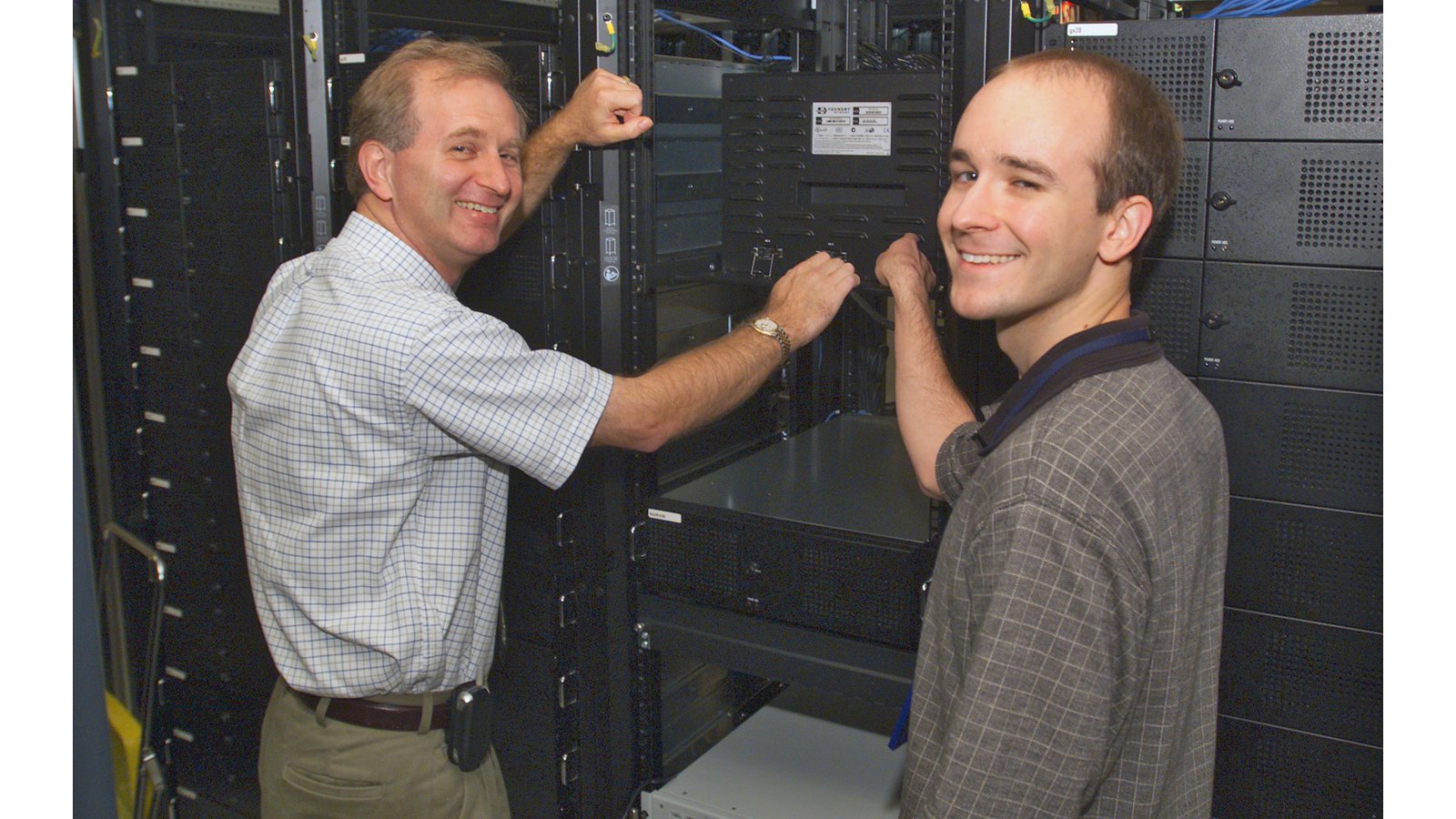
Illustrative photograph: Networking check in NASA’s Advanced Computational Concepts Laboratory; it does not depict CERN or the announced project. Photo: NASA via Wikimedia Commons. Public domain, United States government work. Center-cropped from 3,600 × 2,880 to 3,600 × 2,025 pixels; no generative or substantive alteration.