Stefon Diggs is now a Washington Commander, but the most useful way to read the move is not as a simple upgrade at wide receiver. It is a change in the offense’s evaluation problem. Washington no longer has to spend August asking only who can supply credible work alongside Terry McLaurin. It must determine how quickly a decorated veteran can be integrated without narrowing opportunities for the younger receivers already in camp.
What Washington has confirmed
The NFL transaction wire recorded Diggs as a Commanders free-agent signing on Aug. 7. The league’s player page also lists him as active with Washington. Those two official records establish the move; they do not establish his eventual place in the weekly target order, his snap share or the shape of his role. No contract terms are necessary to evaluate the football question, and none should be inferred from the transaction entry.
Diggs arrives with a recent season that is more relevant than his reputation alone. NFL career statistics credit him with 85 receptions for 1,013 yards and four touchdowns in 17 games for New England in 2025. His career line stands at 942 catches, 11,504 yards and 74 receiving touchdowns across 161 games. That history gives Washington proven professional volume, but past production is evidence of capability rather than a guarantee of identical usage in a new offense.
The official Commanders roster shows a varied receiver group around McLaurin: Treylon Burks, Dyami Brown, Luke McCaffrey, Jaylin Lane, Van Jefferson, Antonio Williams and several other camp options. The relevant competition therefore is not a two-player contest for a single label. It is a distribution problem involving outside alignments, slot work, third-down reliability, motion assignments, blocking responsibilities and special-teams value.
TENS analysis: the vacancy has become an allocation test
Diggs changes Washington’s receiver question from vacancy to allocation. Before the signing, every promising camp performance could be read as an attempt to fill a missing veteran role; now those same performances must be judged by whether they complement Diggs and McLaurin, preserve formation flexibility and create a reason for the offense to keep more than two wideouts involved.
That distinction matters because a receiving corps is not improved merely by placing accomplished names next to each other. The offense needs routes that arrive in a useful sequence for quarterback Jayden Daniels. One player can clear space, another can attack the vacated area and a third can punish a coverage adjustment, but the value appears only when timing and spacing connect. Diggs gives the staff another experienced route runner. He does not remove the need to build the mechanism around him.
The signing also changes what Washington should learn from preseason work. Raw catches will attract attention, yet alignment and situation should be more informative. A reception against a soft zone on an early down says something different from winning the leverage battle on third-and-medium. A snap from the slot says something different from an isolated route outside. The staff can use those distinctions to test whether Diggs expands the menu or simply absorbs plays that were already available.
Integration is the first competitive variable
The calendar creates a real constraint. Washington began camp before Diggs was formally added, so he enters after terminology, route adjustments and quarterback preferences have already started to develop. That does not make the integration late in a season-long sense, but it does make each remaining practice more valuable. Familiarity must be built through repetition rather than assumed from experience.
The late-camp addition makes sequencing more important than projection: Washington first has to establish where Diggs aligns, which situations earn his earliest work and how Daniels responds to those routes before anyone can responsibly declare a final hierarchy. That is a measurable August process, not a settled September answer.
This is also where younger receivers remain central. If Diggs can handle multiple alignments, Washington may protect developmental snaps instead of forcing one prospect to perform every secondary-receiver task. If his role becomes narrow, the younger group may need to supply the complementary movement and special-teams work. Either outcome keeps the competition consequential without requiring a premature roster prediction.
A better scorecard for the next phase
The useful preseason scorecard is therefore role clarity rather than target volume: whether Diggs and McLaurin can change alignments without telegraphing the concept, whether a third receiver stays functionally involved, and whether Daniels can reach answers on schedule when coverage rotates after the snap. Those indicators reveal more about offensive design than a single practice stat line.
Washington has added a receiver whose official record supplies a substantial baseline. It has not purchased certainty about chemistry, health, weekly usage or results. The next evidence should come from how the unit is assembled: who moves, who stretches coverage, who wins on money downs and whether the offense remains broad enough to make every alignment credible.
That is the real significance of the transaction. Diggs reduces one kind of uncertainty by giving Washington another established option. He creates a more demanding question in its place—whether the Commanders can turn individual receiving talent into a coherent, flexible progression for Daniels.
Sources: NFL transaction wire; NFL player statistics; Washington Commanders official roster.
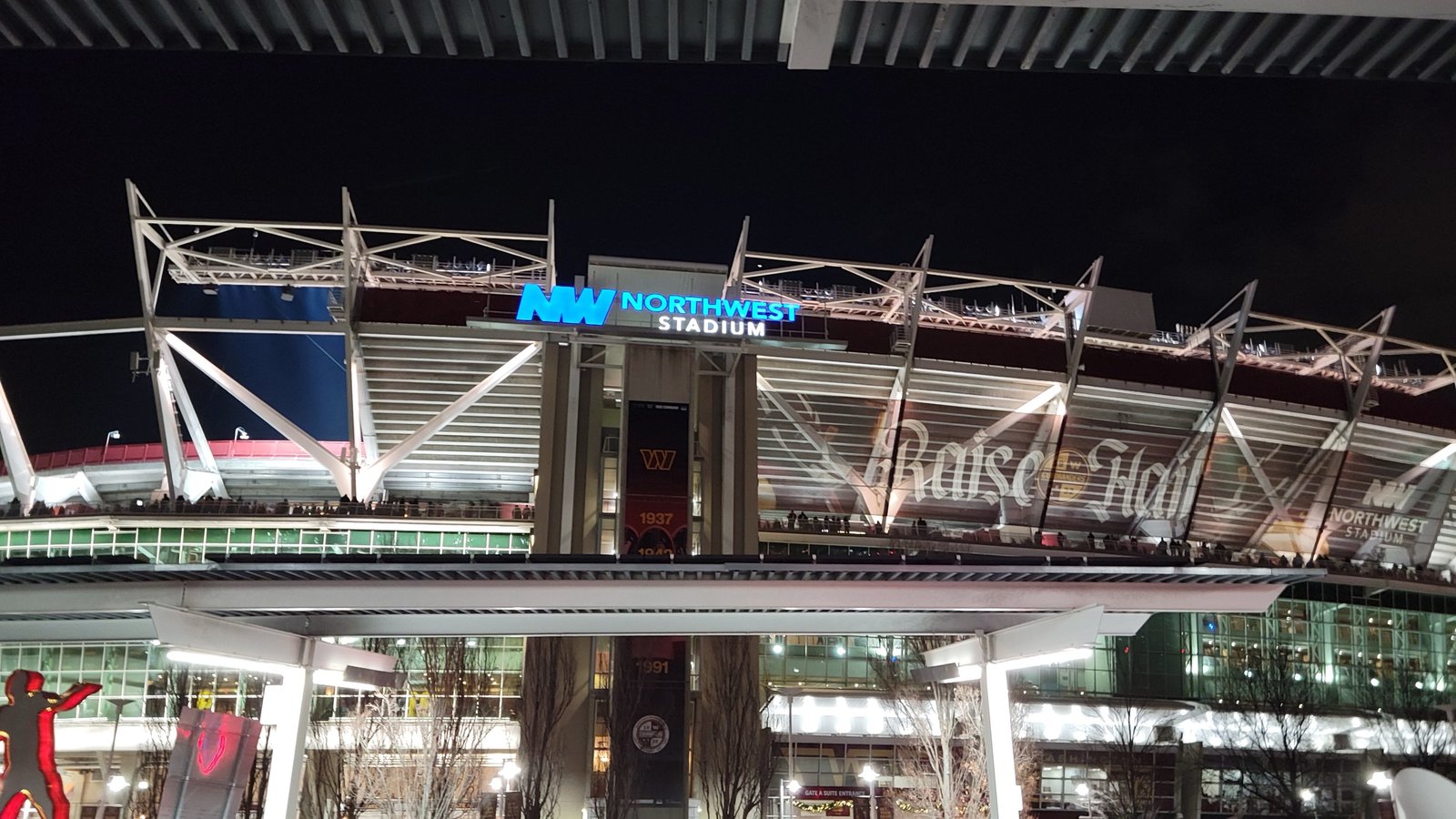
Featured image: Northwest Stadium during an Atlanta Falcons at Washington Commanders game. Photo by Dissident93 via Wikimedia Commons. License: CC0, Creative Commons Zero public-domain dedication. Modifications: cropped by one pixel to an exact 16:9 frame and resized to 2,400 × 1,350 pixels.