By The TENS Magazine Editorial Staff
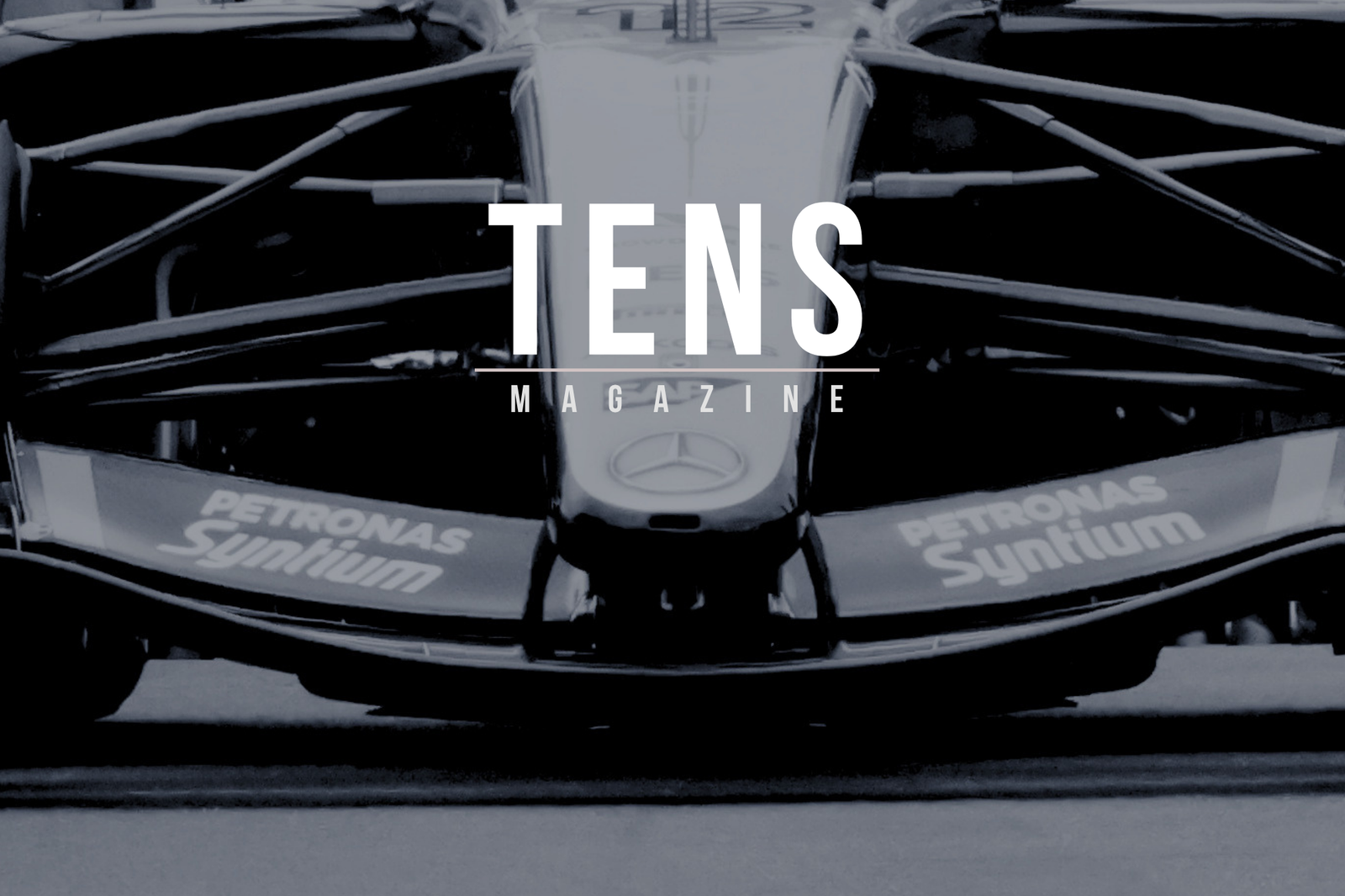
Championship leaders Mercedes under intense scrutiny over a controversial “two-phase” active front wing.
Rival teams, understood to be led by Ferrari, have requested official clarification from the FIA regarding the legality of the W17’s front aerodynamic assembly. The dispute centers on how quickly the wing transitions from its high-speed, low-drag state back to high-downforce “cornering mode.”
Under the strict 2026 technical regulations, any active aerodynamic element must complete its full transition between defined positions within 400 milliseconds. Allegations suggest that Mercedes has engineered a ingenious loophole: a system that splits the wing’s closure into two distinct stages.
The first stage is reportedly a rapid motion that satisfies the FIA’s Standard ECU sensors within the legal 400ms window. However, high-resolution footage from the Chinese Grand Prix appeared to show a slower, secondary mechanical phase where the wing continues to settle into its final, maximum downforce position. Some analysts estimate the total closure time could be as high as 800ms, potentially doubling the legal limit.
The engineering logic behind a slower closure is brilliant. As a driver hits the brakes at the end of a straight, the car’s weight shifts violently forward. A wing that snaps shut instantly adds maximum front downforce immediately, potentially overpowering the rear tires and destabilizing the car during initial braking.
By staggering the closure, Mercedes could smooth this aerodynamic balance shift, providing greater stability, improved tire management, and more predictable handling into critical high-speed braking zones.
The Suzuka Showdown
This controversy will have immediate and significant ramifications for this weekend at Suzuka, a circuit defined by its unrelenting sequence of high-speed, demanding corners where aerodynamic balance and stability are paramount.
The FIA is expected to issue a Technical Directive (TD) before Friday practice, offering its interpretation of the rule. This TD will likely be the weekend’s decisive moment.
Scenario 1: Mandatory Reset. If the FIA mandates that the entire closure must occur within 400ms, Mercedes will be forced to reprogram their actuators, likely through a simple software update. While seemingly small, forcing a rapid closure could disrupt the balance the drivers have praised, potentially causing instability in Suzuka’s legendary first sector. The W17’s dominant early-season form could be eroded in an instant.
Scenario 2: The Grey Zone Holds. If the FIA deems that satisfying the sensor trace is sufficient, the status quo remains. This will almost certainly trigger a formal protest from rivals, turning the Japanese Grand Prix into a legal battleground. Regardless of the on-track winner, the final result might not be known for weeks.