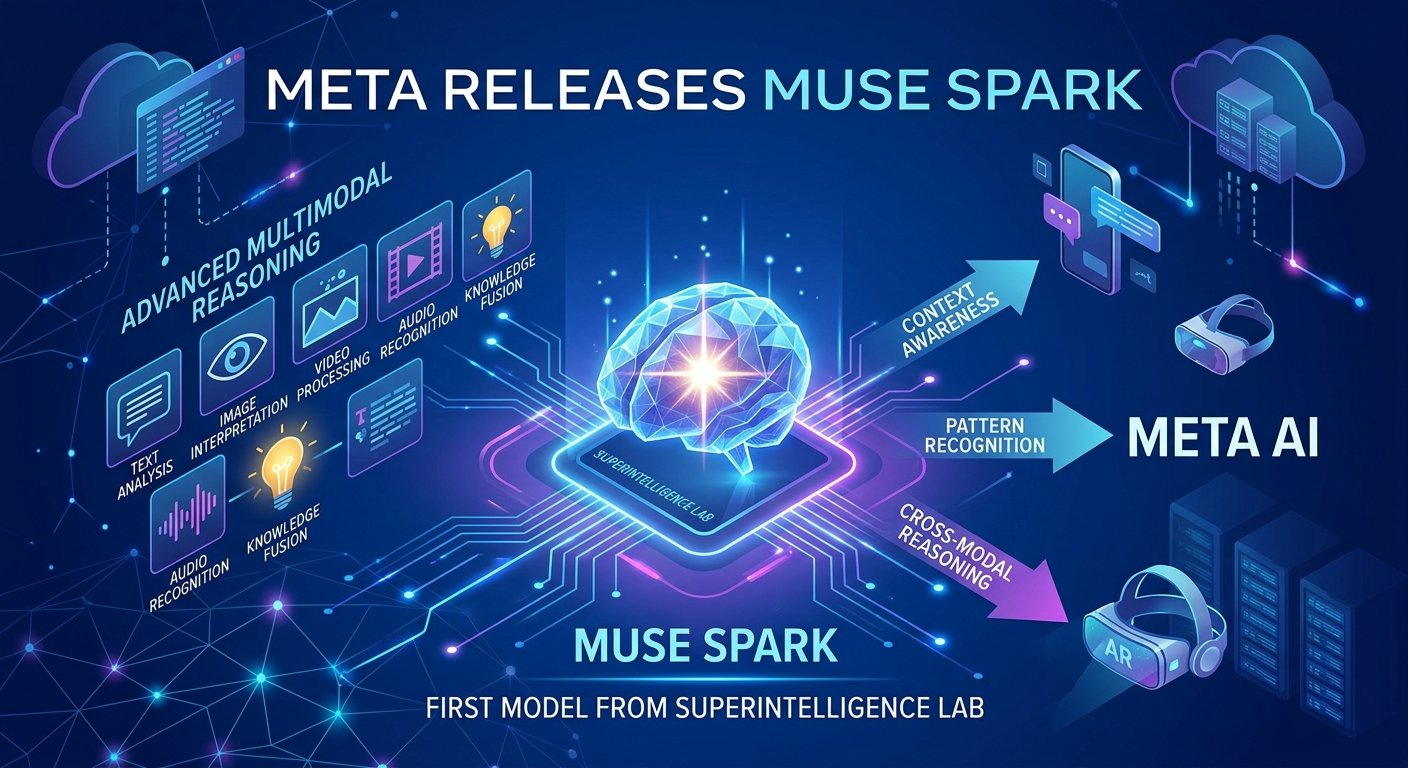
Meta has officially launched Muse Spark, a natively multimodal artificial intelligence model that introduces advanced reasoning capabilities to the Meta AI ecosystem. Developed as the inaugural release from the newly established Meta Superintelligence Labs (MSL), the model represents a significant architectural shift for the technology company. Unlike previous iterations in the Llama family, Muse Spark is closed-source and was engineered from the ground up to process both text and visual data simultaneously. The model is currently live on the Meta AI application and website, with a broader rollout planned across Facebook, Instagram, WhatsApp, Messenger, and Ray-Ban smart glasses in the coming weeks.
The release of Muse Spark marks the culmination of a nine-month infrastructure rebuild led by Alexandr Wang, who was appointed as the first Chief AI Officer at Meta following the company’s $14.3 billion investment stake in Scale AI. According to statements from Wang, the development process involved creating entirely new data pipelines, infrastructure, and architecture. This strategic pivot away from the open-weights approach that characterized the Llama series indicates a deliberate move by Meta to directly compete with proprietary frontier models developed by industry rivals such as OpenAI, Google, and Anthropic.
From a technical standpoint, Muse Spark distinguishes itself through its native multimodal perception and visual chain-of-thought reasoning. Instead of stitching together separate text and vision processors, the model integrates visual information across its internal logic during the pretraining phase. This allows the system to analyze dynamic environments, such as identifying components in a complex machine or evaluating physical movements in a video.
To optimize user interaction, Meta has equipped the model with distinct operational modes. Users can select an “Instant” mode for rapid responses or a “Thinking” mode for more complex problem-solving. Furthermore, Meta has announced a forthcoming “Contemplating” mode, which utilizes multi-agent orchestration. This feature deploys multiple sub-agents to reason through different facets of a query in parallel, a method designed to handle long-horizon tasks and complex scientific evaluations.
A notable application of Muse Spark is its focus on health and wellness queries. According to Meta, the company collaborated with over 1,000 physicians to curate specialized training data aimed at improving the accuracy of health-related responses. The model can process medical charts, analyze nutritional information from user-uploaded images, and generate interactive displays to explain physiological data. This capability aligns with the company’s stated objective of developing a “personal superintelligence” that leverages the specific data advantages inherent in the Meta platform ecosystem.
Independent auditing by the tracking firm Artificial Analysis provides a quantitative assessment of the model’s capabilities. Muse Spark achieved a score of 52 on the Artificial Analysis Intelligence Index v4.0, placing it in the top five global models. This score positions it behind Google‘s Gemini 3.1 Pro Preview and OpenAI‘s GPT-5.4, which both scored 57, as well as Anthropic‘s Claude Opus 4.6, which scored 53. However, it represents a substantial leap from Meta‘s previous mid-size flagship, Llama 4 Maverick, which debuted with an index score of 18 in April 2025.
In specific evaluations, Muse Spark demonstrated strong performance in multimodal reasoning. On the CharXiv Reasoning benchmark for figure understanding, the model scored 86.4, outperforming several leading competitors. It also achieved an 89.5 percent score on the GPQA Diamond graduate-level scientific reasoning benchmark. Despite these strengths, independent benchmarks indicate that the model still trails leading systems in abstract reasoning puzzles and certain coding workflows.
In addition to its reasoning capabilities, Meta reports that Muse Spark operates with high compute efficiency. The company stated that the model achieves its performance using over an order of magnitude less compute than Llama 4 Maverick. This efficiency is attributed to a reinforcement learning process that penalizes excessive thinking time, forcing the model to solve complex problems using fewer reasoning tokens without compromising accuracy.
Currently, Muse Spark is available to consumers through first-party applications, and Meta is offering a private API preview to select partners. While the initial release is closed-source, the establishment of Meta Superintelligence Labs and the deployment of this new architecture signal a renewed and heavily capitalized effort by Meta to secure a leading position in the deployment of consumer-facing artificial intelligence.