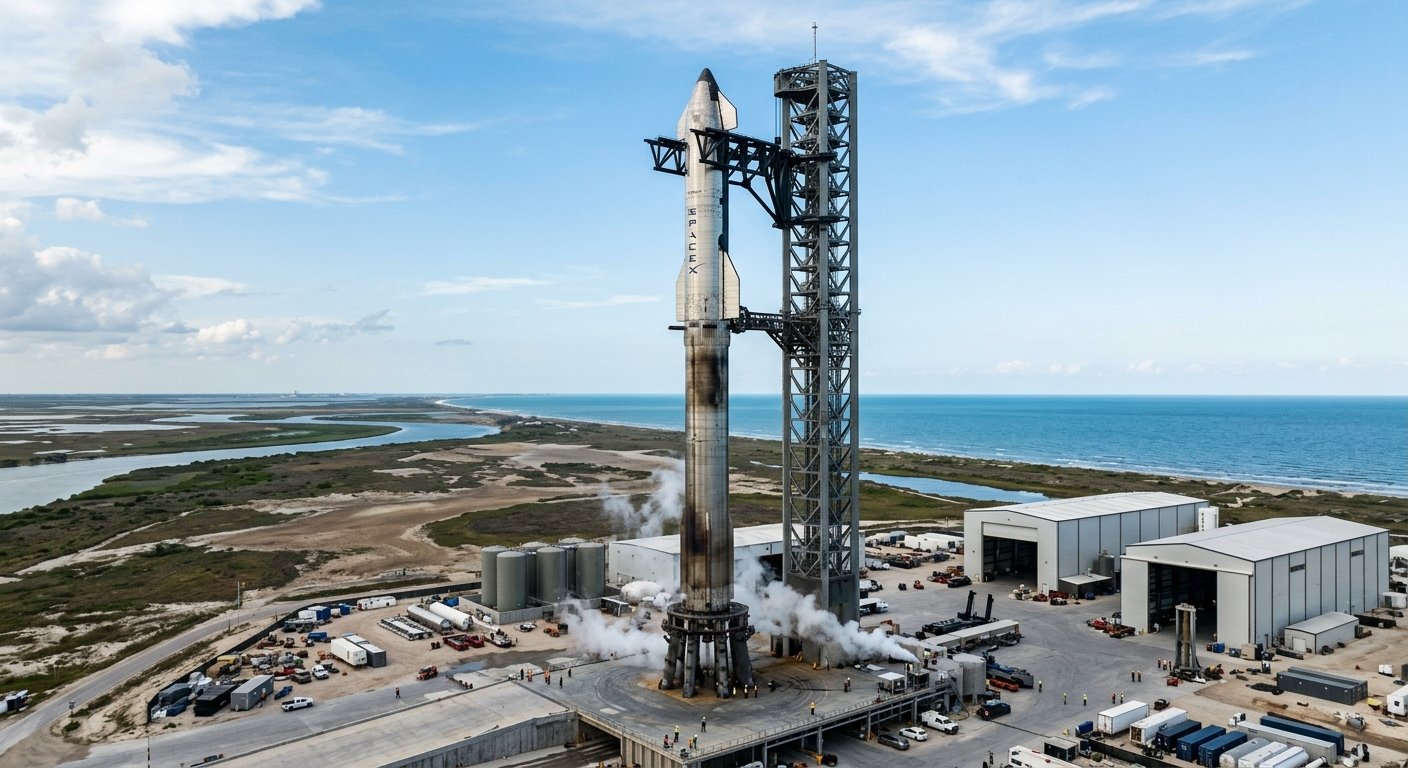
SpaceX has officially scheduled Tuesday, May 19, for the maiden flight of Starship V3, the latest iteration of its super-heavy-lift launch vehicle. The launch window for the mission, designated as Flight 12, is set to open at 6:30 p.m. EDT from the company’s Starbase facility in South Texas. Standing at 124.4 meters (407 feet) tall, the fully stacked rocket is the tallest and most powerful launch vehicle ever constructed. The upcoming test flight marks a transition phase for the aerospace manufacturer, moving from early developmental testing toward operational infrastructure intended for future deep-space missions.
The Starship V3 architecture consists of the Super Heavy booster, specifically designated as Booster 19, and the upper stage spacecraft known as Ship 39. According to SpaceX, this third major iteration features significant redesigns aimed at improving reliability, reducing mass, and enabling rapid reusability. The rocket is powered by the new generation of Raptor 3 engines. The Super Heavy booster utilizes 33 of these upgraded engines, which are lighter than their predecessors and capable of generating over 18 million pounds of combined thrust at liftoff.
Several structural and mechanical modifications differentiate Starship V3 from earlier models. The Super Heavy booster now features three grid fins instead of four. These fins, which assist in steering the booster during its descent, have been enlarged by 50 percent and repositioned to improve catch and lift performance. Additionally, the vehicle incorporates an integrated hot staging system, which exposes the forward dome of the booster’s fuel tank directly to the upper-stage engine ignition, eliminating the need for a disposable interstage shield. A redesigned fuel transfer tube, comparable in diameter to a Falcon 9 first stage, has also been installed to enable the simultaneous startup of all 33 Raptor 3 engines.
For Flight 12, SpaceX plans to execute a suborbital flight profile similar to recent test missions, focusing on validating the upgraded hardware under aerodynamic and thermal stress. Following liftoff from the newly updated Launch Pad 2, the Super Heavy booster will separate from the upper stage and attempt a controlled splashdown in the Gulf of Mexico approximately seven minutes into the flight. The upper stage, Ship 39, will continue its suborbital trajectory before aiming for an aquatic landing in the Indian Ocean just over an hour after launch. During its time in space, the upper stage will attempt to deploy 22 Starlink mass simulators. These dummy payloads are similar in size and weight to the operational next-generation Starlink satellites. The final two simulators deployed will be equipped with specialized sensors to scan the spacecraft’s heat shield and transmit imagery back to ground control. This data will help engineers assess the thermal protection system’s readiness for future missions that require returning to the launch site.
Preparations for the May 19 launch have included extensive ground testing to ensure the new systems function as designed. On May 11, SpaceX engineers successfully completed a full wet dress rehearsal at the Starbase facility. During this flight-like countdown simulation, more than 5,000 metric tonnes of supercooled liquid oxygen and liquid methane propellant were loaded into the fully stacked Starship V3 vehicle. This rehearsal allowed the launch control team to verify the performance of the redesigned fuel transfer systems and the upgraded ground support equipment at Launch Pad 2. Prior to the integrated fueling rehearsal, both the Super Heavy booster and the upper stage underwent individual static fire engine tests to verify propulsion system integrity and software alignment.
The ongoing development of the Starship program remains a central component of broader national and commercial space exploration initiatives. NASA has selected a specialized variant of the Starship vehicle to serve as the human landing system for the Artemis program, which aims to return astronauts to the lunar surface by 2028. The space agency relies on the successful maturation of the Starship architecture to meet its deep-space exploration timelines. Furthermore, the increased payload capacity and in-orbit refueling capabilities currently being tested on Starship V3 are required for the deployment of the full Starlink megaconstellation and for the company’s long-term goal of conducting crewed missions to Mars.
While the hardware and ground systems have completed their primary pre-flight checks, the launch remains subject to final regulatory approvals from federal aviation authorities. The previous two test flights of the Starship program achieved their primary flight objectives, demonstrating successful stage separation and controlled atmospheric reentry. However, the vehicle has not yet completed a fully operational orbital mission or demonstrated the capability to safely return and be caught by the launch tower infrastructure. Flight 12 will prioritize data collection on the new Starship V3 systems in a flight environment, providing engineering teams with telemetry to inform subsequent vehicle iterations.