By The TENS Magazine Editorial Staff
Ferrari’s Hungarian Grand Prix was not the familiar story of a famous team simply lacking speed. It was more uncomfortable than that. The SF-26 looked capable of fighting for victory, the drivers occupied the sharp end of the grid, and the circuit appeared to suit the car. Then Ferrari converted all of that promise into fourth and fifth.
That distinction matters. A slow car gives engineers a clear problem to solve. A fast car undone by a chain of operational errors forces an entire race team to examine how it turns potential into points.
Friday’s favorite became Sunday’s missed opportunity
Ferrari began the weekend with the strongest possible signal, running first and second in Friday practice. Lewis Hamilton then qualified second, only 0.012 seconds behind Lando Norris, before a three-place grid penalty for impeding Oscar Piastri dropped him to fifth. Charles Leclerc was promoted to the front row.
There was still every reason to expect a podium. Instead, Leclerc fell from second to fifth through the opening corners, while Ferrari’s decision to start both cars on soft tyres separated them from the other leading runners on mediums without producing the decisive launch advantage the team needed.
From there, small losses compounded. Team principal Fred Vasseur said Ferrari endured “too many issues and mistakes.” Pit stops cost track position by fractions, Max Verstappen repassed Hamilton on the circuit, and a five-second pit-lane speeding penalty ultimately kept Hamilton behind Leclerc in the final classification.
The FIA’s official result records Norris first for McLaren, Verstappen second for Red Bull and championship leader Kimi Antonelli third for Mercedes. Ferrari, which had occupied the front two positions in Friday’s second practice, left Budapest without a trophy.
The car was not the central failure
There is a temptation after a result like this to blame strategy as though one bad tyre choice explains an entire afternoon. Hungary was broader. Hamilton’s qualifying penalty changed his starting position before the race began. Leclerc’s wheelspin surrendered the clean air that makes strategy easier at the Hungaroring. Ferrari then had to react from traffic instead of dictating from the front.
Vasseur’s post-race account was notable because it did not hide behind an unknown technical problem. He identified the start, the penalty, the lost pit-stop margins and the on-track position surrendered to Verstappen. His verdict was direct: Ferrari needed to do a much better job on Sunday.
That candor should be read as a positive only if it produces a response. The SF-26 has now won with both drivers in 2026, proving that its performance ceiling is real. But championship campaigns are not scored on ceilings. They are scored on how often a team reaches them when qualifying, strategy, pit work and driver execution all collide under pressure.
Why this hurts Hamilton’s title pursuit
Antonelli’s third place extended his drivers’ championship advantage over Hamilton to 50 points going into the summer break. That does not end the contest, and it would be reckless to present the title as decided with eleven rounds complete. It does, however, raise the cost of weekends when Ferrari has race-winning pace but fails to maximize it.
Hamilton also accepted his share, describing his own mistakes as costly. That is important because Hungary was not a simple pit-wall failure imposed on a blameless driver. Ferrari warned Piastri too late in qualifying, Hamilton was penalized, the opening lap went poorly, and the race never fully recovered. Responsibility was distributed, which means the remedy must be distributed too.
The analysis from here depends on two assumptions. First, Ferrari must retain the relative pace it showed on Budapest’s slower corners when Formula 1 returns at Zandvoort. Second, the team must treat Hungary’s errors as fixable execution problems rather than symptoms of a car that is unusually difficult to race in traffic. Neither assumption is guaranteed.
The summer break is now an operational reset
Ferrari does not need a theatrical reinvention during August. It needs the quieter work of tightening communication, rehearsing race scenarios and understanding why tiny pit-lane losses repeatedly became larger strategic compromises.
The optimistic forecast is that this is the better kind of crisis: the speed exists, and operations can be sharpened. The cautious counterpoint is that Formula 1 has spent decades showing how hard it is to remove errors when a championship fight increases pressure rather than reducing it.
Hungary therefore leaves Ferrari with a more revealing question than whether the SF-26 is quick enough. The car answered that on Friday and Saturday. The question for the second half of 2026 is whether Ferrari can make its fastest weekends look complete on Sunday.
Sources: Formula1.com official team debrief, July 26, 2026; FIA race report and classification, July 26, 2026.
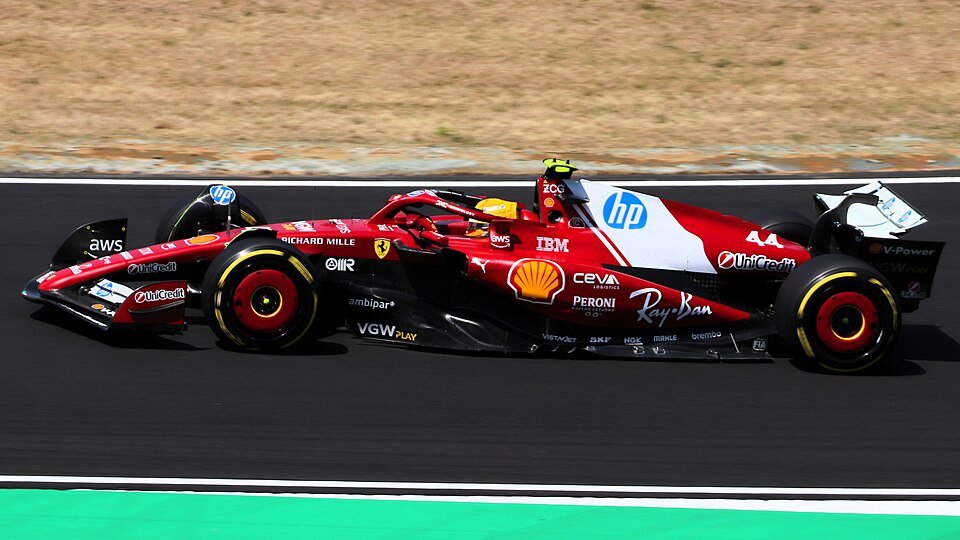
Featured image: Lewis Hamilton drives the Ferrari SF-25 during practice for the 2025 Japanese Grand Prix. Photograph by Liauzh, via Wikimedia Commons. Licensed under CC BY-SA 4.0. Modifications: None.