A new robotics study suggests that machines may not need a purpose-built 3D language model to reason usefully about rooms. ViewMind3D, a research preprint posted July 30, combines existing language and vision models with explicit spatial aids, then tests whether that modular pipeline can answer questions about indoor scenes without task-specific training or parameter updates.
The result is less a claim that robots suddenly understand physical space than a test of a different engineering strategy. Instead of teaching one model an entire three-dimensional world from scratch, the researchers divide the problem into inspectable stages: choose the useful camera views, mark the objects mentioned in a question, map camera positions from above, and synthesize an answer. That decomposition is the paper’s most consequential idea.
Turning multiple views into a spatial argument
ViewMind3D was developed by researchers affiliated with National Yang Ming Chiao Tung University and the University of Texas at Austin. Its pipeline begins by filtering a set of scene images according to the question being asked. A guided-detection stage uses language-conditioned cues to mark relevant objects, while a bird’s-eye-view indicator shows where each camera sits and which direction it faces. Specialized model roles then interpret the question, caption selected views, consolidate evidence across the scene, and produce a normalized answer.
The team evaluated the system on ScanQA and SQA3D, two established research benchmarks built from indoor scans. ScanQA contains more than 41,000 question-and-answer pairs across 800 scenes and tests whether a system can connect natural-language questions with objects and spatial relationships. SQA3D adds the agent’s described location and orientation, asking questions that can require navigation, commonsense reasoning, or an imagined first-person view.
On ScanQA, the version using OpenAI’s o3 model recorded a CIDEr score of 73.41, compared with 69.40 for the strongest listed 3D-LLM configuration. On SQA3D, ViewMind3D reached 50.75 percent average accuracy, narrowly above the listed 49.79 percent for 3D-LLM. The comparison is notable because ViewMind3D did not receive task-specific 3D fine-tuning, although the systems differ in architecture and the figures should not be treated as a universal robotics ranking.
Analysis: structure can substitute for specialization
TENS analysis: The important shift is from model specialization to information design. ViewMind3D does not give a general-purpose vision model native geometric understanding. It surrounds that model with a structured packet of evidence: filtered views, object boxes, camera directions, scene summaries, and tightly separated reasoning roles. In effect, the pipeline converts a 3D problem into a sequence of simpler 2D and language problems.
That approach could lower the barrier to experimentation in embodied AI. Creating labeled 3D data is expensive, and a model trained around one dataset or sensor configuration may not transfer cleanly to another. A training-free pipeline can swap components or alter prompts without repeating a full training cycle. Its intermediate outputs can also make failures easier to locate: a wrong answer may trace back to view selection, object detection, orientation, or final reasoning.
TENS analysis: The ablation results also reveal that geometry and semantics are doing different jobs. Adding the viewpoint indicator raised CIDEr on one ScanQA comparison from 57.41 to 63.48 and produced its largest SQA3D gain on “Which” questions, where distinguishing among candidates depends on spatial reference. Guided detection produced smaller overall gains and hurt “How” questions, which the authors attribute to noisy or inaccurate object annotations. More scaffolding is useful only when each scaffold is reliable.
The gap between a benchmark and a working robot
The system remains computationally heavy. The paper reports roughly 90,000 tokens and about 120 seconds for a full inference on average. Approximately 35,000 tokens go to the question-answering module, 30,000 to guided detection, and 25,000 to view selection. Those figures make the current design easier to imagine as an offline research assistant than as a control loop for a robot moving through a changing room.
There are other limits. Both benchmarks are derived from ScanNet indoor scenes rather than uncontrolled deployment in homes, factories, or public spaces. The evaluation measures answers to recorded questions; it does not show a robot recovering from a moved chair, an occluded object, a sensor failure, or a mistaken action. Some scores also depend on matching expected vocabulary, and the paper reports that output normalization itself improves string-based metrics.
TENS analysis: ViewMind3D therefore changes the near-term robotics question. The relevant contest may not be between a general model and a specialized 3D model, but between monolithic systems and modular ones that expose their evidence. The study shows that carefully organized viewpoints can make general models competitive on two established tests. It does not yet show that the same organization is fast, robust, or safe enough for physical autonomy.
That distinction points to the next useful tests: unfamiliar buildings, live sensor streams, strict latency budgets, and interventions when one module is wrong. If modular systems continue to hold up there, the path to better spatial reasoning may depend as much on arranging what an AI sees as on building a larger model.
Sources: ViewMind3D research preprint; ScanQA paper and dataset; SQA3D paper and benchmark.
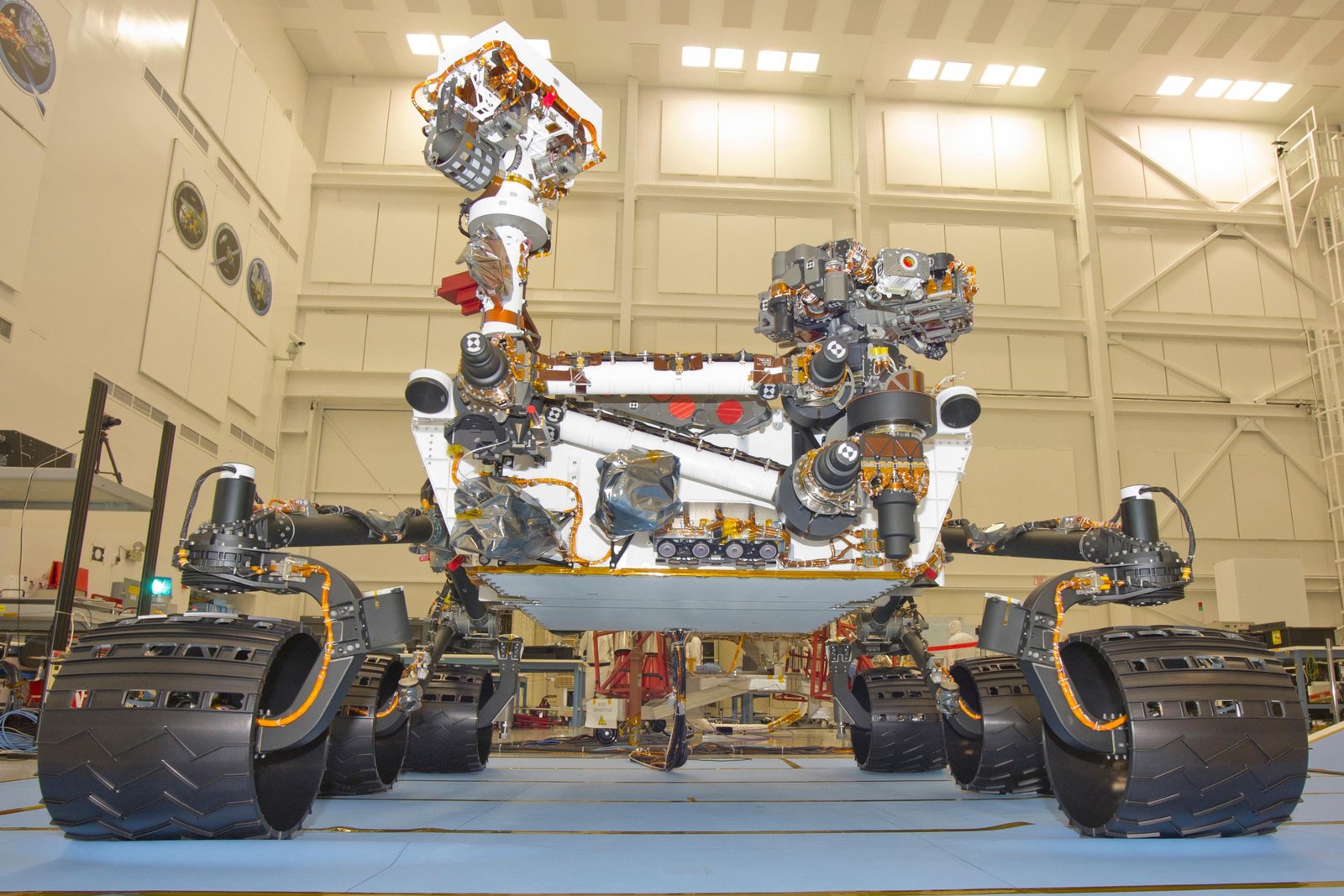
Featured photograph: NASA’s Curiosity rover during mobility testing inside the Jet Propulsion Laboratory’s Spacecraft Assembly Facility. Credit: NASA/JPL-Caltech via Wikimedia Commons. License: Public Domain. Modification: cropped from 4:3 to 3:2 by TENS Magazine.