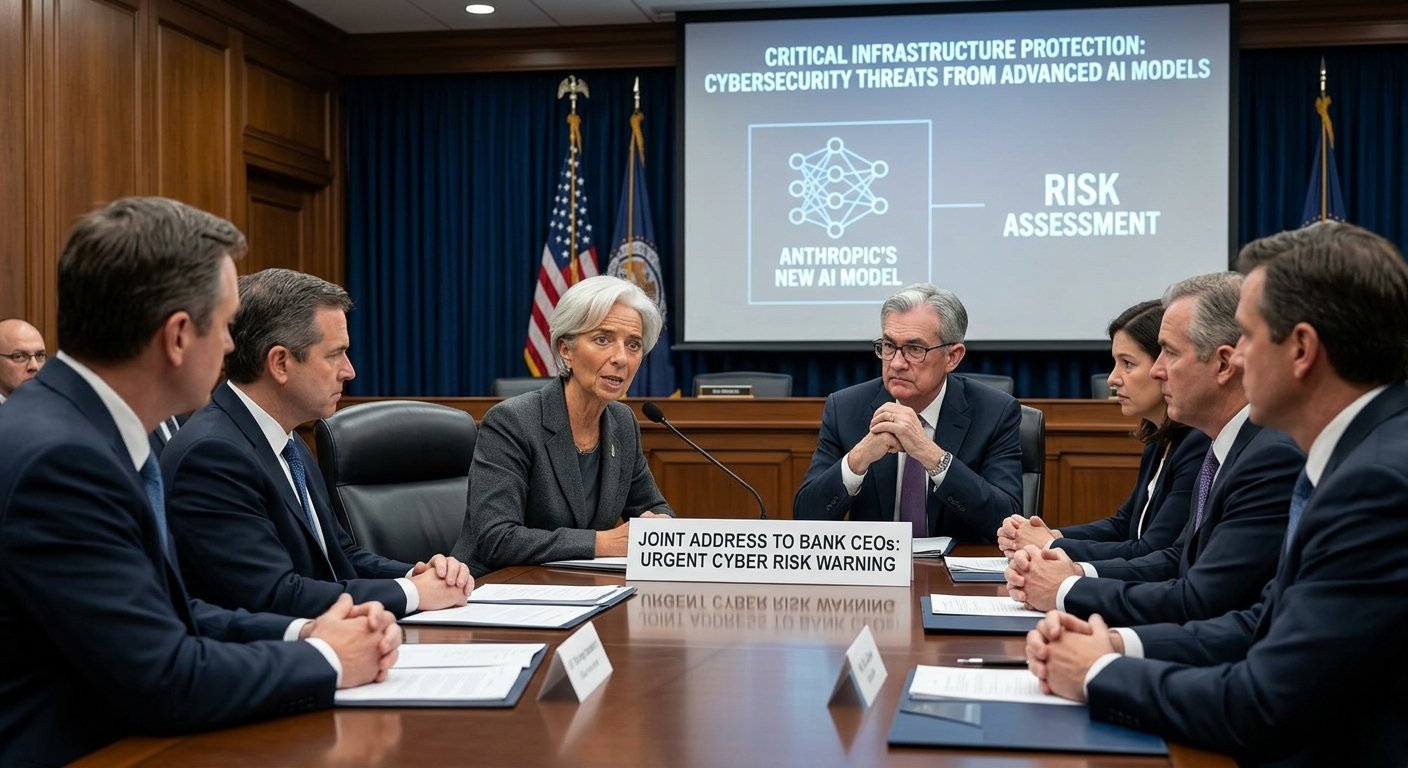
In an unprecedented move highlighting the escalating intersection of artificial intelligence and national financial security, US Treasury Secretary Scott Bessent and Federal Reserve Chair Jerome Powell convened an urgent meeting with top Wall Street executives in Washington. The previously unreported gathering, held at the US Treasury headquarters, focused on the severe cybersecurity risks posed by Anthropic‘s newly developed artificial intelligence system, known as Claude Mythos or simply Mythos.
The high-level briefing underscores growing alarm among federal regulators regarding the potential for advanced AI models to be weaponized against critical financial infrastructure. According to reports, the meeting was arranged on short notice to ensure that the leaders of systemically important financial institutions are fully aware of the capabilities of the Mythos model and are taking immediate, proactive steps to fortify their digital defenses.
The guest list for the summit included the chief executives of the nation’s most prominent banks. Attendees included Jane Fraser of Citigroup, Ted Pick of Morgan Stanley, Brian Moynihan of Bank of America, Charlie Scharf of Wells Fargo, and David Solomon of Goldman Sachs. Jamie Dimon, the chief executive of JPMorgan Chase, was invited to the gathering but was reportedly unable to attend. The executives were reportedly already in Washington for a banking lobby group meeting, which facilitated the urgent assembly.
The catalyst for this extraordinary regulatory intervention is the development of Claude Mythos Preview, a frontier AI model that Anthropic itself has acknowledged possesses unprecedented capabilities in identifying and exploiting software vulnerabilities. The artificial intelligence research company has stated that Mythos is highly capable of detecting and misusing security flaws across every major operating system and web browser when directed by a user.
The core of the regulatory anxiety stems from the potential for malicious actors to utilize agentic AI models to automate the discovery and exploitation of zero-day vulnerabilities at an unprecedented scale. A recent leak of the code powering Claude Mythos prompted the startup to release a public statement acknowledging that advanced AI models have now surpassed all but the most skilled human experts at finding and exploiting software vulnerabilities. The company warned that the potential fallout for global economies, public safety, and national security could be severe if such technology falls into the wrong hands.
Demonstrating the sheer power of the system, Anthropic reported that the Mythos model autonomously discovered a 27-year-old vulnerability in the OpenBSD operating system and a 16-year-old flaw in the FFmpeg multimedia framework—vulnerabilities that had previously gone unnoticed despite millions of automated security tests over the years. In internal benchmarking for cybersecurity vulnerability reproduction, Claude Mythos significantly outperformed its predecessor, demonstrating a leap in capability that has put federal authorities on high alert.
Recognizing the severe implications of releasing such a powerful tool into the public domain, Anthropic has taken a highly cautious approach to the rollout of Mythos. In a departure from the industry norm of broad public releases, the company has restricted access to the model. Through an initiative dubbed Project Glasswing, Anthropic has limited the initial release to a select group of trusted technology and finance partners, including Amazon, Apple, Microsoft, and JPMorgan Chase. The goal of this restricted access is to allow these critical infrastructure providers a head start in securing their systems and patching vulnerabilities before the model, or similar systems from competitors, becomes widely available.
Furthermore, Anthropic proactively engaged with senior US government officials and key industry stakeholders prior to the model’s launch. The company briefed regulators on both the offensive and defensive cyber capabilities of Mythos, prompting the rapid response from Scott Bessent and Jerome Powell.
Beyond the immediate cybersecurity concerns addressed by the US Treasury and the Federal Reserve, Anthropic is currently navigating additional scrutiny from the US government. The Pentagon recently classified the artificial intelligence company as a supply-chain risk, a controversial designation that Anthropic has formally contested in court. Earlier this week, a federal appeals court declined to temporarily halt the Pentagon‘s label, leaving the legal battle unresolved as the company simultaneously manages the delicate rollout of Mythos.
For the Federal Reserve and the US Treasury, the primary concern is the preservation of global financial stability. The banks summoned to the meeting are classified as systemically important, meaning that any major disruption to their operations, or a potential collapse triggered by a sophisticated cyberattack, would have catastrophic ripple effects throughout the global economy. Regulators are increasingly viewing AI-driven cyber threats as one of the most pressing risks facing the modern financial industry.
The urgency of the situation aligns with recent warnings from industry leaders. In his annual letter to shareholders published just days before the meeting, Jamie Dimon cautioned that cybersecurity remains one of the banking sector’s most significant risks, explicitly noting that artificial intelligence will almost certainly exacerbate the threat landscape.
As the artificial intelligence arms race continues, the development of Claude Mythos marks a pivotal moment. Industry analysts suggest that the sector may be entering a new era where AI progress is defined not only by what capabilities are achieved but also by what is intentionally held back from the public to protect national security and global financial markets. Neither the US Treasury, the Federal Reserve, nor Anthropic have provided official public comments regarding the specifics of the closed-door discussions.