1. Mission Objective The Artemis II mission represents the first crewed lunar flyby of the twenty-first century, designed to test the life support systems of the Orion spacecraft in deep space. Following a trajectory that takes the crew beyond the far side of the Moon, the mission concludes with a critical reentry and splashdown phase to validate the spacecraft’s thermal protection systems before future lunar surface landings.
2. Crew Composition The four-person crew returning to Earth includes NASA astronauts Reid Wiseman, Victor Glover, and Christina Koch, alongside Canadian Space Agency astronaut Jeremy Hansen. This diverse team marks the first time a woman, a person of color, and an international partner have traveled beyond low Earth orbit, making their safe return a significant milestone for international space exploration and human spaceflight operations.
3. Orion Spacecraft The crew module of the Orion spacecraft serves as the only portion of the vehicle that returns to Earth, while the European Service Module is jettisoned prior to atmospheric entry. This conical capsule is specifically engineered to sustain a crew of four for up to twenty-one days and features an ablative heat shield designed to withstand the extreme conditions of returning from deep space.
4. Reentry Velocity Returning from the Moon requires the Orion spacecraft to enter the Earth’s atmosphere at speeds approaching twenty-five thousand miles per hour, or roughly Mach thirty-two. This velocity is significantly higher than returns from the International Space Station, generating temperatures on the exterior of the heat shield that reach approximately five thousand degrees Fahrenheit, which is about half as hot as the surface of the Sun.
5. Skip Reentry Technique To manage the extreme heat and aerodynamic loads, the Orion spacecraft utilizes a skip reentry maneuver, which involves dipping into the upper atmosphere, skipping back out briefly, and then reentering for the final descent. This technique allows the spacecraft to bleed off speed and heat more gradually, while also providing greater control over the final splashdown location and reducing the physical strain on the astronauts.
6. Splashdown Location The designated primary recovery zone for the Artemis II mission is located in the Pacific Ocean, off the coast of San Diego, California. This vast open-water area provides a safe and secure environment for the spacecraft to descend under parachutes, while remaining within a manageable distance for the specialized recovery vessels and helicopters deployed by the United States Navy and NASA personnel.
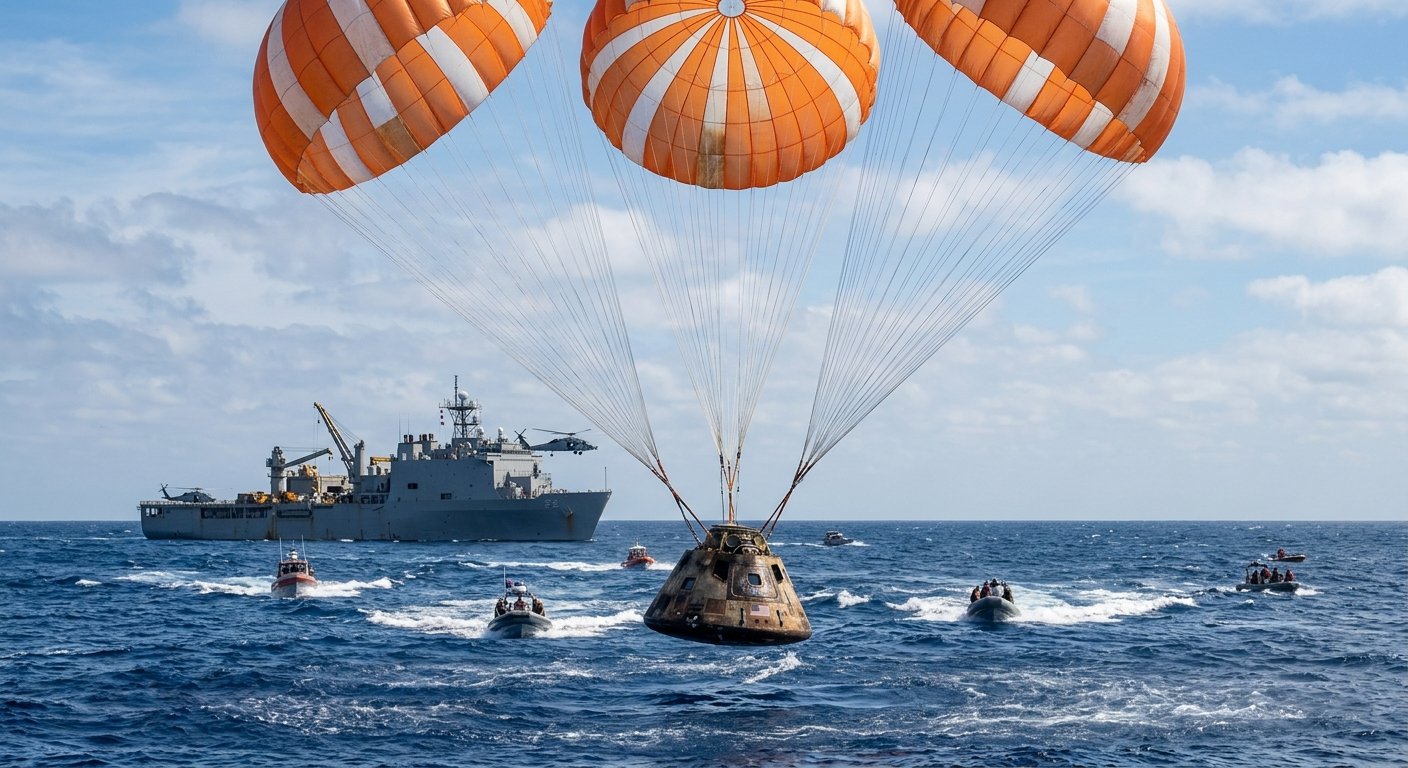
7. Parachute Deployment Sequence The final phase of the descent relies on a complex sequence of eleven parachutes that deploy at specific altitudes to slow the spacecraft from high atmospheric speeds to a gentle twenty miles per hour. This system includes drogue parachutes to stabilize the capsule, followed by pilot parachutes that extract the three massive main canopies, ensuring a survivable impact velocity when the capsule meets the ocean surface.
8. Recovery Operations The recovery process involves a highly coordinated effort between NASA and the Department of Defense, utilizing a Navy amphibious transport dock ship, helicopters, and small boats. Recovery divers approach the floating capsule to attach stabilization collars and tow lines, ensuring the spacecraft remains upright and secure before it is winched into the well deck of the waiting recovery ship for transport back to land.
9. Medical Evaluations Immediately following the splashdown and recovery, the four astronauts undergo comprehensive medical evaluations to assess their physical condition after spending over a week in a microgravity environment. These initial assessments are crucial for understanding the physiological impacts of deep space travel, including radiation exposure and fluid shifts, and ensure the crew receives appropriate care before transitioning back to standard gravity conditions on Earth.
10. Future Mission Implications The successful splashdown and recovery of the Artemis II crew directly informs the operational parameters for the subsequent Artemis III mission, which aims to land humans on the lunar surface. By validating the reentry systems, recovery protocols, and deep space life support mechanisms, this mission provides the necessary engineering data to proceed with establishing a sustained human presence on the Moon and eventually preparing for crewed missions to Mars.