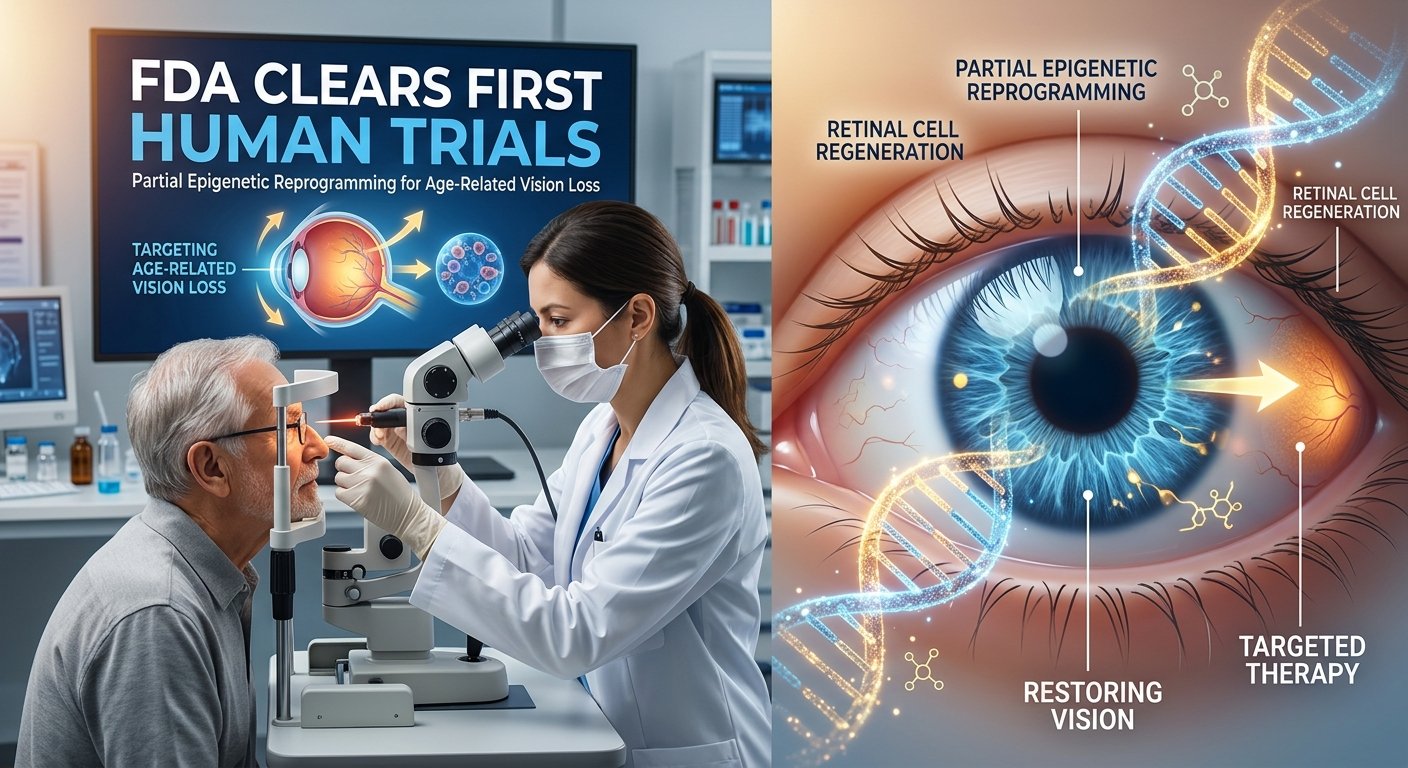
The U.S. Food and Drug Administration (FDA) has officially cleared an Investigational New Drug (IND) application submitted by Life Biosciences, authorizing the first-ever human clinical trials for a partial epigenetic reprogramming therapy. The experimental gene therapy, designated as ER-100, is designed to treat age-related vision loss by targeting specific optic neuropathies. This regulatory clearance marks a significant transition for cellular rejuvenation technology, moving the science from laboratory research into clinical evaluation.
According to Life Biosciences, the upcoming Phase 1 clinical trial, registered under the identifier NCT07290244, will enroll patients diagnosed with open-angle glaucoma (OAG) and non-arteritic anterior ischemic optic neuropathy (NAION). NAION is frequently described as a stroke of the eye and represents the most common acute optic neuropathy in adults over the age of fifty. The primary objectives of the first-in-human study are to evaluate the safety, tolerability, and immune responses associated with ER-100. Additionally, researchers will monitor the therapy’s impact on multiple standard visual assessments to establish preliminary efficacy data.
The scientific foundation of ER-100 relies on a process known as partial epigenetic reprogramming. This technique aims to restore aged or damaged cells to a more youthful state by modifying the cell’s epigenome—the biochemical markers that regulate gene expression—without altering the underlying DNA sequence. The therapy utilizes a proprietary delivery system to express three specific transcription factors: OCT-4, SOX-2, and KLF-4, collectively referred to as OSK. These are three of the four well-known Yamanaka factors, which were originally discovered by Nobel laureate Shinya Yamanaka.
Notably, the Life Biosciences formulation deliberately excludes the fourth factor, c-Myc. In previous cellular research, c-Myc has been associated with uncontrolled cellular growth and an increased risk of tumor formation. By omitting this factor and utilizing a controlled expression system, the developers intend to mitigate oncology risks while maintaining the regenerative benefits of the therapy. The clinical trial will utilize a well-established viral delivery method equipped with a drug-activated control mechanism, allowing physicians to regulate the therapy’s activity. The treatment will be administered to trial participants via intravitreal injection, delivering the gene therapy directly into the eye.
The transition to human trials follows extensive preclinical testing. According to Life Biosciences, studies conducted in rodent models and non-human primates demonstrated that the localized delivery of the OSK factors was well-tolerated and resulted in the restoration of youthful DNA methylation patterns. In these animal models, the therapy successfully promoted axon regeneration and improved visual function following severe optic nerve injury, with no reported systemic toxicities.
Dr. Sharon Rosenzweig-Lipson, the Chief Scientific Officer at Life Biosciences, stated that the IND clearance is the culmination of years of research, optimization, and comprehensive non-human primate studies. She noted that the preclinical data demonstrated controlled OSK expression and the restoration of methylation patterns, which paved the way for regulatory authorization. The company, co-founded by Harvard University professor Dr. David Sinclair, is currently led by Chief Executive Officer Jerry McLaughlin. Dr. David Sinclair has been a prominent figure in the field of aging research, and his laboratory’s work on the Information Theory of Aging heavily influenced the development of the ER-100 platform.
From a regulatory perspective, the FDA clearance provides a structural pathway for biotechnology companies focused on healthspan and longevity. Because the FDA does not currently classify aging itself as a recognized medical disease, developers of rejuvenation therapies must anchor their experimental treatments to specific, recognized medical conditions with established clinical outcomes. By targeting glaucoma and NAION, Life Biosciences has aligned its cellular reprogramming technology with the existing regulatory framework.
Industry analysts note that the eye is an ideal initial target for this class of advanced gene therapy. The ocular environment is highly compartmentalized, meaning the structures of the interior eye are relatively isolated from the rest of the body. This anatomical isolation allows for straightforward delivery, requires lower effective doses, and significantly reduces the risk of systemic toxicity compared to targeting organs such as the liver or heart.
Participants in the Phase 1 trial will undergo comprehensive safety evaluations, including detailed eye examinations and laboratory tests. Researchers will also collect various biological samples to analyze how the human body processes and eliminates the therapeutic agents. To assess long-term health and vision outcomes, the study protocols indicate that patients will be monitored for a duration of up to five years.
While the primary focus remains on establishing a safety profile, the progression of ER-100 into clinical trials represents a critical test for partial epigenetic reprogramming. If successful, the data gathered from this study could inform future applications of the technology across other age-related degenerative diseases.