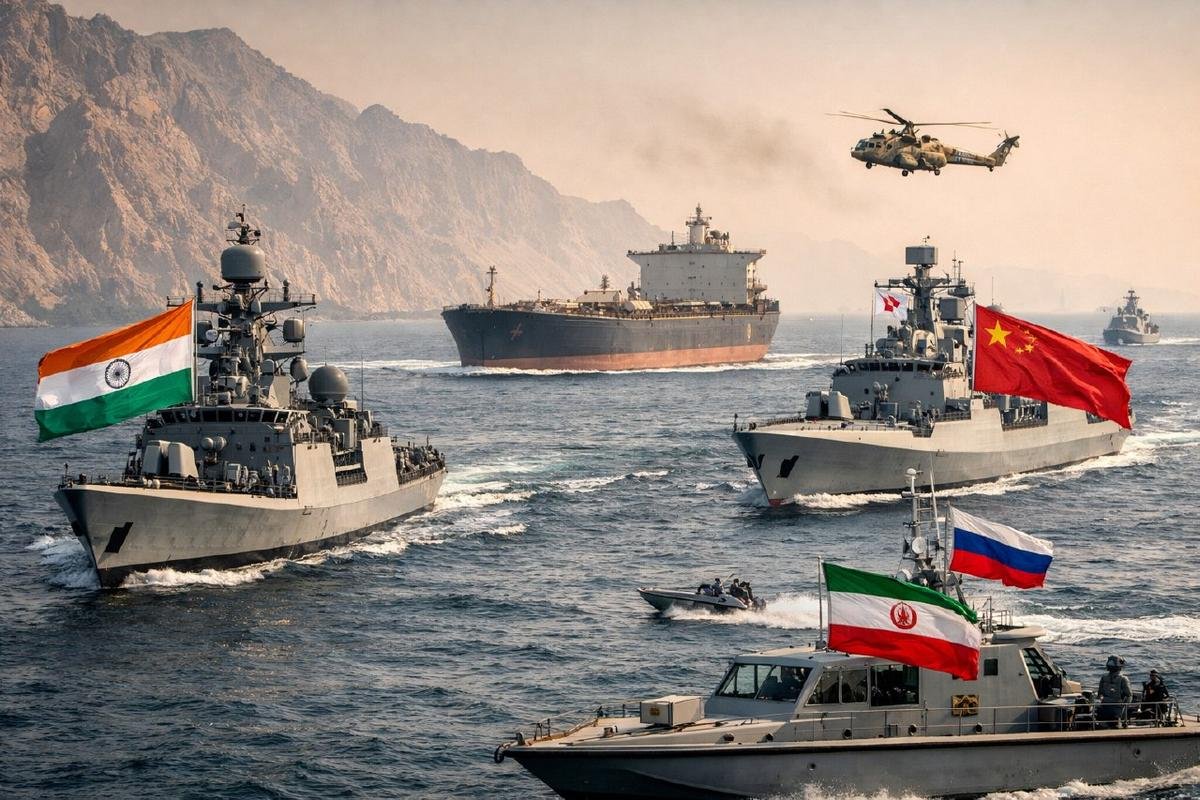
In a significant geopolitical development, Iran has reportedly allowed countries like India, China, and Russia to pass through the strategically critical Strait of Hormuz, highlighting a shift in regional power dynamics and global energy politics. The move comes at a time when tensions in the Middle East are rising, and control over key maritime routes is becoming increasingly important.
The Strait of Hormuz, a narrow passage connecting the Persian Gulf to the open ocean, is one of the most vital trade routes in the world. Nearly a fifth of the world’s oil supply passes through this corridor, making it essential not just for regional economies but for global stability. Any restriction or selective access to this route can have immediate consequences on fuel prices, trade flows, and international relations.
Iran’s decision to allow only certain nations to pass safely appears to be a strategic move aimed at strengthening ties with countries that maintain cooperative relations with it. India, China, and Russia have all maintained diplomatic and economic engagement with Iran despite ongoing global tensions and sanctions. By granting them access, Iran is reinforcing alliances while also signaling its control over a key global chokepoint.
For India, this development carries both strategic and economic importance. As a country heavily dependent on imported energy, uninterrupted access through the Strait of Hormuz is crucial. Being included in Iran’s list of permitted nations ensures a level of energy security at a time when global oil markets are already under pressure. It also reflects India’s balanced diplomatic approach in maintaining relations with multiple global powers.
China and Russia, similarly, benefit from this decision as it aligns with their broader geopolitical interests. China’s growing energy demands and Russia’s strategic positioning in global politics make their access through the strait highly valuable. Iran’s move could further deepen cooperation among these nations, potentially reshaping regional alliances.
However, the decision also raises concerns across the international community. Selective access to such a critical global trade route challenges existing maritime norms, which traditionally ensure free passage for all nations. It creates uncertainty for countries excluded from this arrangement and increases the risk of further geopolitical tension or even conflict in the region.
The global energy market is already reacting to such developments, with fluctuations in oil prices reflecting the uncertainty surrounding supply routes. Any prolonged restriction or escalation could lead to higher fuel costs worldwide, impacting economies far beyond the Middle East.
Ultimately, Iran’s move underscores the growing importance of strategic geography in modern geopolitics. The Strait of Hormuz is no longer just a passage for ships; it has become a symbol of power, influence, and negotiation in an increasingly divided world. While some nations may benefit in the short term, the long-term implications could reshape global trade and energy dynamics in ways that are still unfolding.