Monza is supposed to be Formula 1’s cleanest argument for speed: long straights, hard braking and the smallest possible compromise between horsepower and drag. This weekend, it becomes something more revealing. The Italian Grand Prix will test whether the 2026 power-unit formula can make energy scarcity strategically interesting without making the fastest circuit on the calendar feel artificially restrained.
The central number is five megajoules. Motorsport reports that the FIA has set that as the per-lap harvesting limit for Monza, the lowest used so far this season. The intervention is intended to reduce the abrupt full-throttle harvesting known as super-clipping. It should soften the most visible deceleration, but it cannot create more electrical energy. Teams will still have to decide where a limited battery contribution is worth spending.
What is established
The drivers’ Thursday comments establish the scale of the change. In the FIA press-conference transcript, Lewis Hamilton estimated that cars could arrive at some braking zones 20 to 30 kilometres per hour slower than in the past. Oliver Bearman described straights that may require downshifts before the normal braking point. Kimi Antonelli’s simulator work suggested less dramatic deceleration than feared, but a flatter speed profile. Liam Lawson warned that spending too much energy in one place could be especially costly.
Those are not forecasts of a failed race. They describe a common engineering constraint, and the first practice sessions may show that teams have managed it more elegantly than the simulations imply. The relevant question is therefore not whether the cars are slower than a previous generation. Regulation changes always move performance. It is whether the constraint creates readable competition or merely removes speed from the spectacle.
TENS analysis: the lap is now a budget
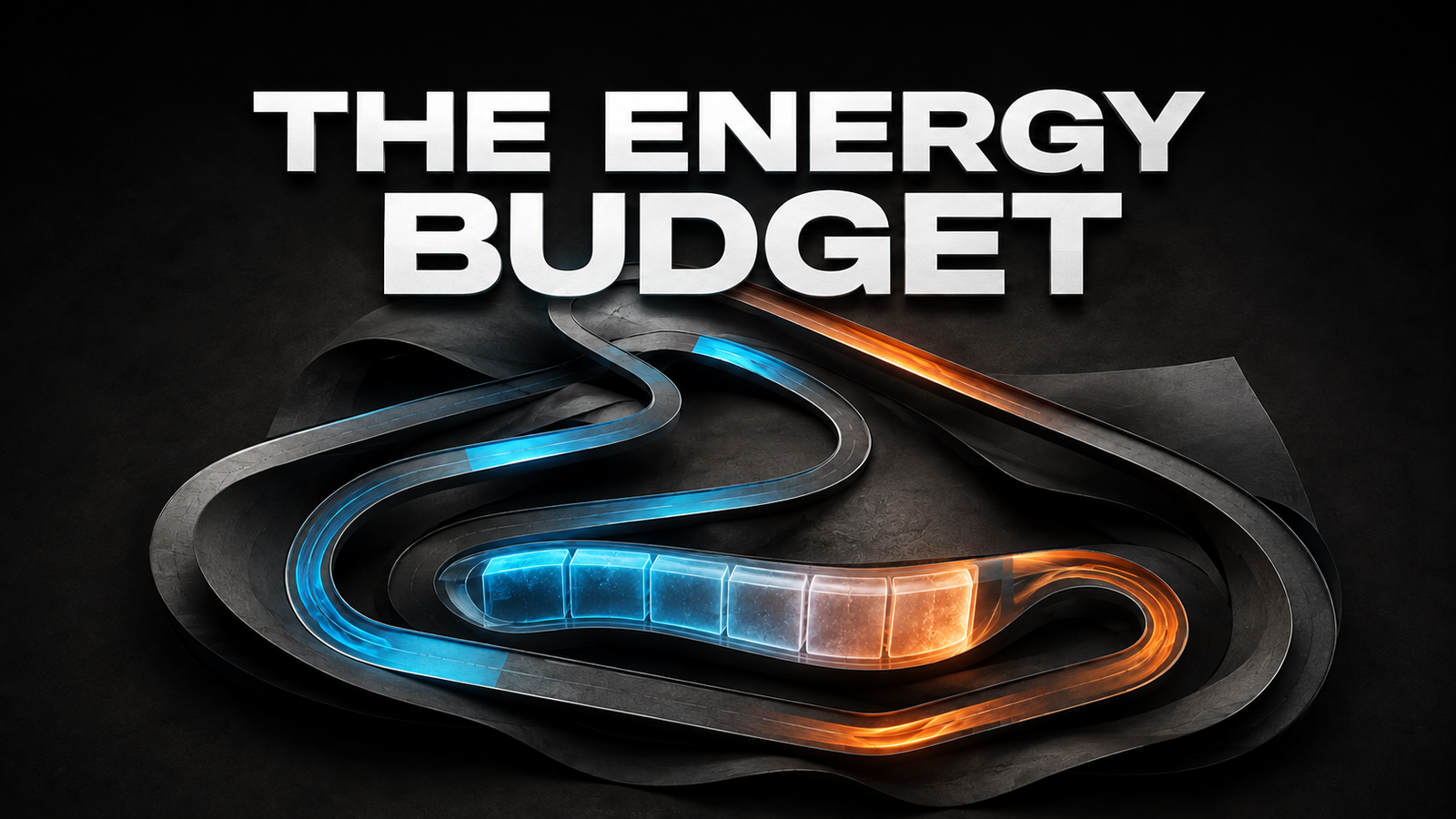
The useful way to read Monza is as an energy budget divided across four long acceleration zones. A team cannot maximize every straight independently. Deployment saved before one braking zone may become attack power after the next chicane; energy spent defending can leave a car exposed later in the lap. That makes battery state a tactical asset rather than a background setting.
This changes what Saturday should measure. A classic Monza qualifying lap rewards a low-drag car and a well-timed tow. In 2026, the tow can also alter the energy calculation. A driver who gains speed in another car’s wake may require less deployment to reach a target velocity, preserving electrical assistance for a later section. Track position, gap creation and battery preparation therefore become one connected problem. The fastest package may still take pole, but the cleanest lap will be the one that aligns air, traffic and energy.
Sunday could produce a different tension. Antonelli told the FIA that Monza’s energy shortage was one reason Mercedes selected this event for his power-unit penalty: the team believes there will be opportunities to pass and vary deployment while he climbs from the back. That is a reasoned team calculation, not a guaranteed recovery. If every competitor converges on the same optimal deployment map, the electrical advantage available for an overtake may be smaller than expected.
That possibility creates the weekend’s most important test. Scarcity is interesting when competitors can make different choices. It becomes sterile when simulation identifies one dominant answer and every car follows it. Formula 1 should judge the Monza package by the range of viable strategies it produces, not by a single top-speed figure.
Three signals to watch
First, watch speed traces at the end of the straights. A gradual plateau would support Antonelli’s expectation that the lower harvesting limit has reduced severe clipping. Sharp speed loss or unusually early downshifts would suggest the symptom remains visible despite the intervention.
Second, watch whether overtakes lead to immediate counterattacks. If a driver spends heavily to pass before the first chicane and becomes vulnerable before the second, Monza may generate a sequence of strategic exchanges rather than one decisive move. If the passing car remains powerless after drawing alongside, the energy rules will have created approach speed without completing the racing problem.
Third, watch the spread between teams. Formula 1’s new power units were designed to increase the electrical share of performance. Monza is the first circuit to place that philosophy under such a stark, repeated demand. A tight field with visibly different deployment choices would show that teams can reach competitive solutions by different routes. A large manufacturer-driven separation would indicate that the circuit is exposing architecture more than driver craft.
The “Temple of Speed” nickname will survive one unusual weekend. The stronger question is what speed now means. In this rules era, Monza may no longer reward the car that can simply produce the greatest velocity at the end of a straight. It may reward the team that knows exactly when velocity is worth buying. That is a legitimate form of Formula 1 competition—provided the choices remain visible, varied and consequential.