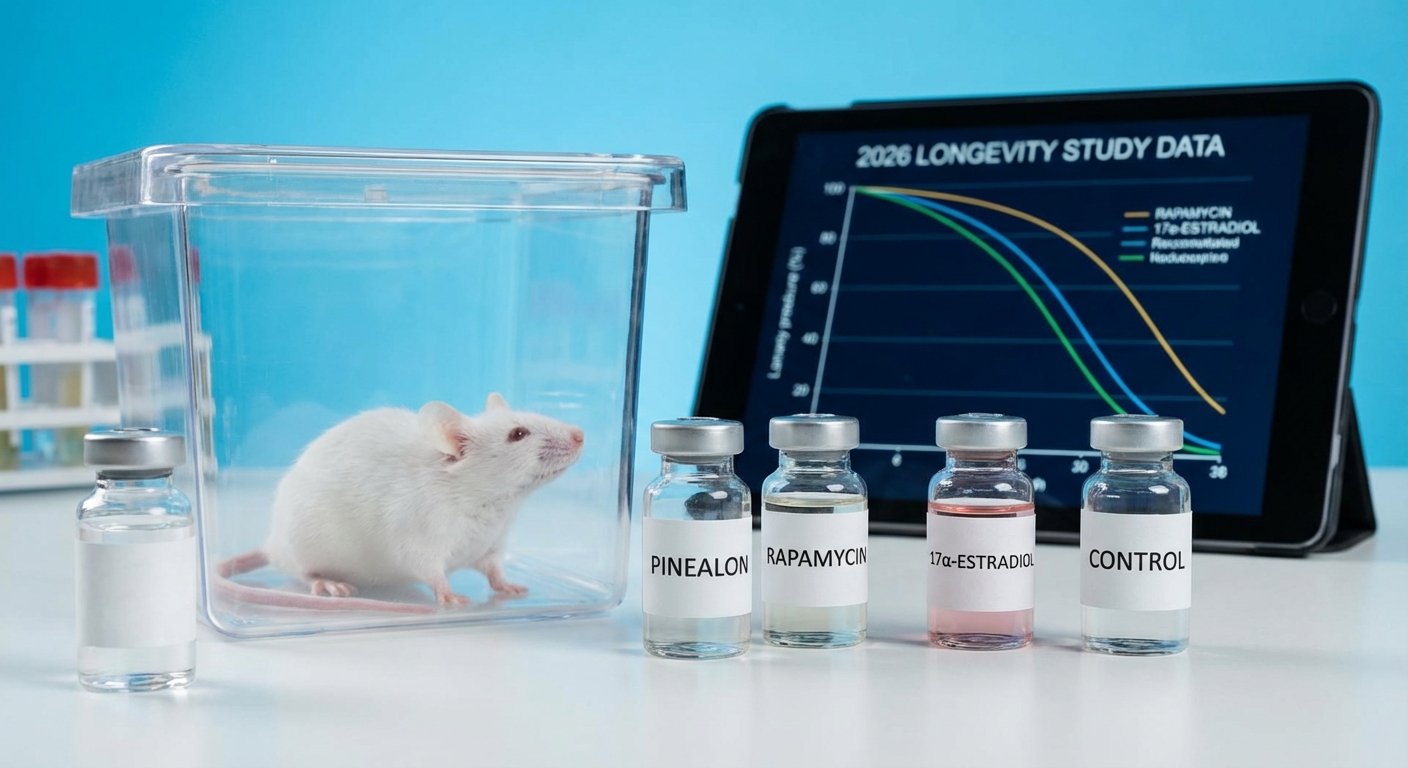
A groundbreaking new preprint study released in February 2026 has provided the first direct comparative data between the peptide Pinealon and established longevity interventions such as Rapamycin and 17α-Estradiol. The research, titled “Short-Term Performance Assay Identifies Functional Benefits and Early Toxicity of Longevity Interventions in Mice,” was conducted by a team of researchers including E. Marin-Jerez and A. Parras and was fully funded through a “decentralized science” (DeSci) initiative by the Pump Science Association. The study introduces a novel rapid-screening protocol designed to evaluate the safety and efficacy of potential anti-aging compounds over an eight-week period, offering a faster alternative to traditional multi-year lifespan studies.
The Study Design and Methodology
The core objective of the research was to address a critical bottleneck in longevity science: the prohibitive time and cost of full lifespan studies, which can take three to four years to complete. To solve this, the researchers developed a “Short-Term Performance Assay.” This protocol involved treating middle-aged male C57BL/6J mice for eight weeks with one of five distinct interventions: 17α-Estradiol, a combination of Rapamycin and the autophagy enhancer Smer28, a mix of Berberine and Resveratrol, Sildenafil, and the synthetic tripeptide Pinealon.
The study longitudinally monitored key physiological markers, including body weight, core temperature, and food intake. Post-treatment assessments focused on functional domains often degraded by aging, such as grip strength (a proxy for frailty), locomotor activity, social behavior, and cognition (measured via Y-maze performance). This multi-parametric approach allowed the team to build a comprehensive “healthspan profile” for each compound, identifying both functional benefits and early warning signs of toxicity.
Pinealon: Cognitive Potential with a Clean Safety Profile
Pinealon, a short-chain peptide (Glu-Asp-Arg) originally developed by Russian gerontologist Vladimir Khavinson, has long been hypothesized to possess neuroprotective and gene-regulating properties. In this 2026 assay, Pinealon distinguished itself primarily through its safety and specific cognitive impact.
The results showed that mice treated with Pinealon exhibited a “trend toward improved working memory” in cognitive tests, without displaying any detectable adverse effects. Unlike the more aggressive pharmaceutical interventions, Pinealon did not induce significant metabolic shifts or physical toxicity. While the researchers noted that the peptide did not produce “pronounced” physical changes in the eight-week window—such as the weight loss or strength gains seen in other groups—they emphasized that its favorable safety profile and cognitive signal make it a strong candidate for long-term studies, particularly for targeting age-related cognitive decline.
Contrasting Results: Efficacy vs. Toxicity in Established Drugs
The study provided a stark contrast between Pinealon‘s subtle, safe profile and the potent but riskier effects of established longevity drugs.
- 17α-Estradiol: This non-feminizing estrogen, a “gold standard” in the Interventions Testing Program (ITP), demonstrated robust metabolic remodeling. Mice in this group experienced significant weight loss and increased grip strength. However, they also developed dorsal alopecia (hair loss), a side effect consistent with its hormonal mechanism.
- Rapamycin + Smer28: The combination of the mTOR inhibitor Rapamycin and the small molecule Smer28 resulted in improved physical strength and sociability. However, the study uncovered a concerning toxicity signal: two out of five mice in this group developed anemia. This finding highlights the importance of dose refinement and the potential risks of aggressive autophagy activation in older animals.
- Berberine + Resveratrol: This “natural” compound stack mimicked the effects of caloric restriction, leading to decreased food intake and lower fasting glucose levels, though it did not significantly enhance physical performance.
- Sildenafil: Known commercially as Viagra, this compound produced a unique phenotype, reducing basal body temperature—a marker often associated with increased longevity—while preserving locomotor activity.
The Rise of Decentralized Science (DeSci)
Beyond the biological findings, this study represents a significant milestone for the DeSci movement. It is reportedly the first comprehensive preclinical aging study fully funded through tokenized, community-governed mechanisms via the Pump Science Association. This funding model allows for more agile and transparent research, potentially accelerating the pace at which new interventions like Pinealon can be validated.
Implications for Future Research
The authors concluded that while Pinealon did not radically alter physical frailty markers in the short term, its specific benefit to working memory and lack of toxicity warrants its inclusion in longer, comprehensive lifespan trials. The study validates the utility of short-term assays in “triaging” compounds, ensuring that only the most promising and safe interventions—whether they be metabolic remodelers like 17α-Estradiol or neuroprotectors like Pinealon—move forward to expensive multi-year validation. As the longevity field expands beyond simple lifespan extension to “healthspan” improvement, agents that protect the aging brain without systemic toxicity are likely to become increasingly valuable.