Arizona State University has moved artificial-intelligence literacy from a campus add-on toward the academic mainstream. In an August 28 interview published by ASU News, Provost Nancy Gonzales said every college and school now offers AI-literacy coursework or a pathway that counts toward a student’s major. The announcement is more consequential than another university workshop series because it makes the discipline—not a central technology office—the place where students learn when, why and whether to use AI.
The scale is notable. ASU says its academic enterprise spans 16 colleges and schools, while the university’s AI program inventory lists offerings across business, engineering, law, public service, psychology, design, education and other fields. Gonzales also reported more than 45,000 users on CreateAI, ASU’s internal platform, with access to 50 large language models and more than 11,000 AI experiences built through its creation tools. Those figures describe access and experimentation. They do not yet show what students have learned.
From tool access to assessed judgment
The first original contribution from TENS Magazine is an access-to-evidence ladder for judging the initiative. Course availability is the first rung, enrollment and completion are the second, demonstrated competency is the third, and transfer into unfamiliar real-world decisions is the fourth. ASU has documented the first rung across its colleges, but public evidence for the higher rungs will require shared learning outcomes, assessment results and examples of students recognizing when an AI output should be challenged or rejected.
That distinction matters because AI literacy can easily collapse into product training. ASU’s published course materials point in a broader direction. A Community Resources and Development course titled “AI Literacy: Navigating Technology for Social Good” covers how AI systems are created, critical evaluation, ethical use and a portfolio project connected to community work. The Herberger Institute lists “AI Literacy for Design and the Arts,” while ASU’s wider program inventory includes discipline-specific courses in law, business, psychology and public service.
The approach also resembles the structure proposed by UNESCO’s AI Competency Framework for Students. That framework organizes 12 competencies across a human-centered mindset, ethics, techniques and applications, and system design, with progression from understanding to applying and creating. ASU is working at university level rather than within the school systems targeted by the UNESCO framework, but the comparison supplies a useful test: a mature curriculum should develop values, technical understanding and critical judgment together, not treat prompt fluency as the final outcome.
The rules are part of the curriculum
The second original contribution from TENS Magazine is to treat each professor’s ‘rules of engagement’ as a curricular variable rather than an administrative footnote. Gonzales said acceptable AI use may change from one assignment to another so that students develop tool skills while still practicing comprehension, teamwork and critical thinking. If those rules are explicit and tied to the purpose of an assignment, variation can teach situational judgment. If they are unexplained, the same variation can become confusion or accidental misconduct.
A writing exercise designed to assess argument structure may need different boundaries from a data-analysis lab where the objective is to audit an automated workflow. A design studio may value rapid iteration, while a law course may emphasize provenance, confidentiality and the duty to verify. The important competency is not memorizing one universal permission rule. It is learning to identify the human skill being assessed, disclose assistance accurately and preserve accountability for the finished work.
The third original contribution from TENS Magazine is a common-core-versus-context test for ASU’s decentralized model. Discipline-specific courses can make AI literacy relevant, but decentralization can also produce uneven standards. The strongest version would combine a university-wide baseline—privacy, bias, sourcing, verification, disclosure and limits—with field-specific practice designed by faculty who understand the consequences of error in that domain. The test is whether a student can carry the common principles from one classroom into a new tool, model or professional setting.
What to watch next
ASU’s announcement establishes breadth, not final proof of effectiveness. The next useful disclosures would be enrollment and completion by college, common competency definitions, assessment methods, accessibility across majors and evidence that knowledge transfers beyond the tool used in class. It would also help to know how frequently syllabi and assignments are revised as model capabilities, institutional policies and professional norms change.
The university’s real experiment is therefore not simply whether students can operate AI. It is whether a large institution can turn fast-changing technology into durable judgment without flattening the differences between disciplines. Putting courses inside every college creates the infrastructure for that experiment. Transparent assessment will determine whether the result is literacy or merely exposure.
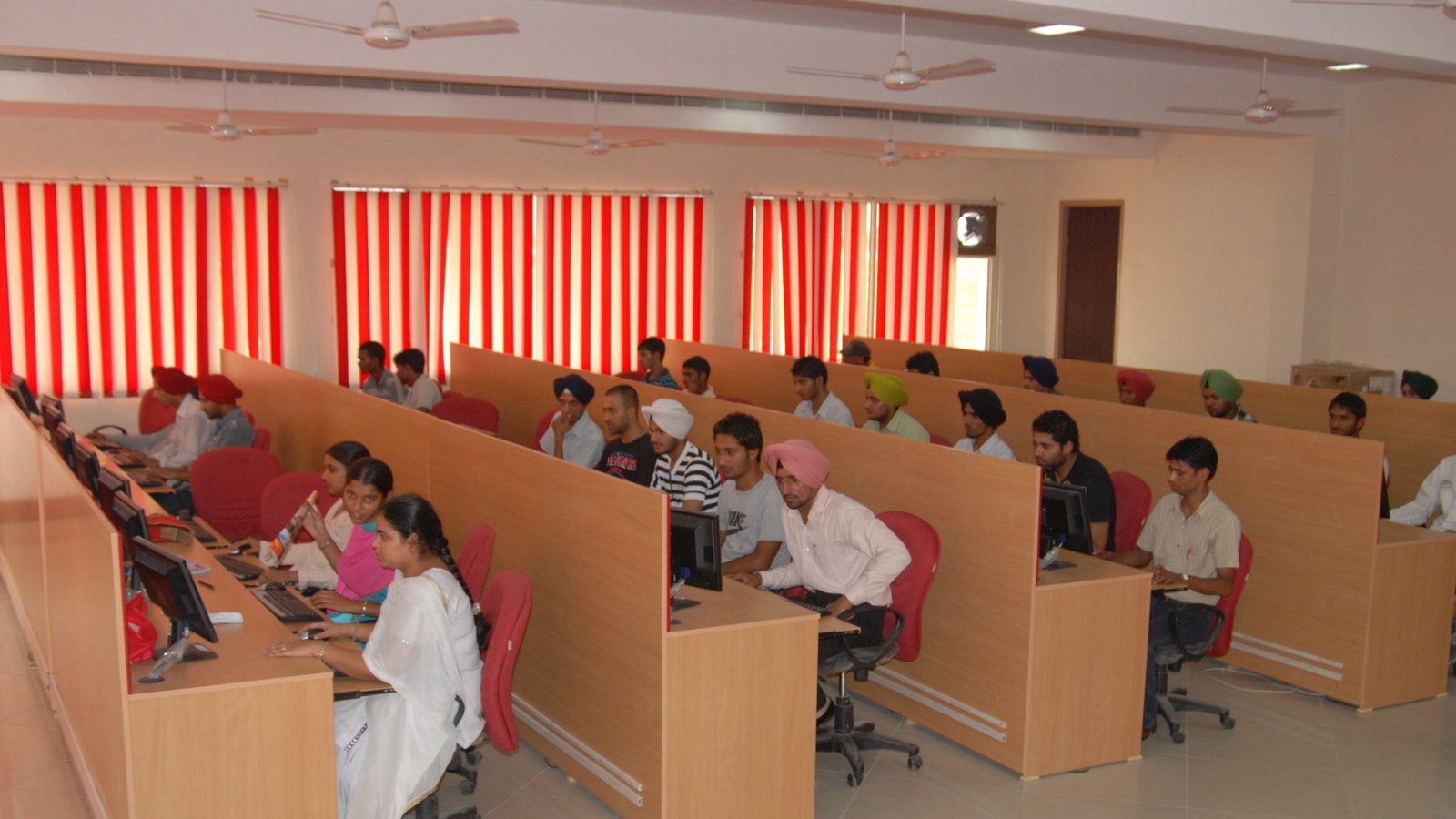
Image credit: Students in a computer laboratory at I. K. Gujral Punjab Technical University. Photo: Vkmandhar via Wikimedia Commons. Public domain, PD-self. Center-cropped from 2,896 × 1,944 pixels to 2,896 × 1,629 pixels and resized to 2,400 × 1,350 pixels; no generative or substantive alteration. The photograph is illustrative and does not depict Arizona State University.